Introduction
[Last updated April 10 2025]
The forty-foot, 70-ton, Hi-Cube boxcars were built in the mid-1960s specifically for high volume, low weight cargo and were most often used in captive service between appliance manufacturers and distributors. They occasionally branched out into furniture and paper loads. Manufactured by Pacific Car and Foundry and Pullman-Standard, ultimately, their small size and the load limitations this imposed saw them leave the rails in a relatively short time. Other larger boxcars from around the same era continued to ride the rails when this article was written (Editor’s note: August 10, 2010).
The forty-footers were a stop-gap car, never meant to have a long life. They provided shippers and receivers with a means to utilise their existing dock and door spacing for 40-foot cars while allowing double-layer (vertical) loading of refrigerators and freezers. From an economic perspective, this was a win-win. With less money spent on new boxcars and upgrades of current boxcars than would have been required on new facilities, doubling the number of refrigerator and freezer units shipped per car made economic sense.
US appliance companies such as Amana, Maytag, Whirlpool and others would, within a decade, begin upgrading their manufacturing facilities and receiving warehouses as older ones were closed or rebuilt. As a result of these upgrades, 60ft High-Cubes, which could haul a vastly larger load, became the norm. However, there is photographic evidence of the cars riding the rails until at least the beginning of August 1984. I have seen photos showing one of the cars in revenue use in the early 2000s. Some served in paper service and maintenance-of-way (MoW) before retirement and eventual scrapping. Sadly, none to my knowledge exist in railroad museum collections.
Southern Pacific and Cotton Belt B-70-36 Box Cars
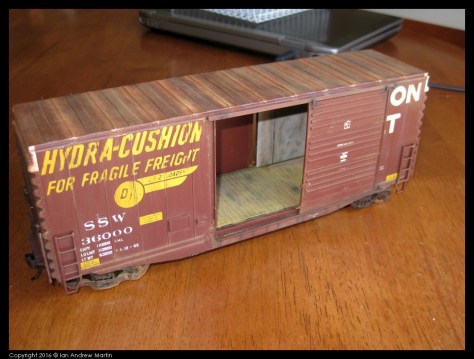
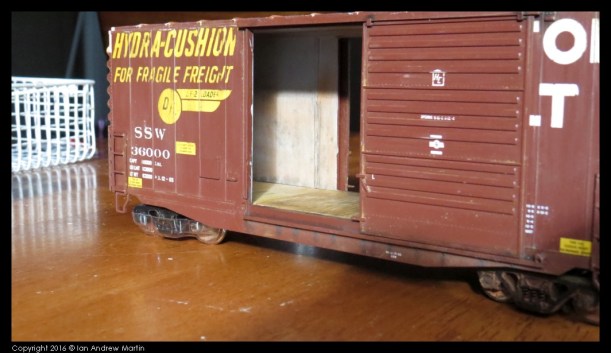
My primary interest is in Southern Pacific (SP) and Cotton Belt (SSW) hi-cube box cars, which were all built to the same design by Pacific Car & Foundry in 1966 and 1967, featuring a 5001 cubic foot capacity, Hydra-Cushion underframes and 10′-6″ Youngstown sliding doors. These cars came to be nicknamed the “Ugly Ducklings” due to their awkward appearance.
Intended for captive appliance service, their internal dimensions were 40′-6″ long, 9’ 6” wide and 13’ high. This allowed double stacking of freezers, allowing greater loads than regular boxcars. Until their introduction, the second layer of freezers was laid on their sides. This led to problems with damage to the second layer from train handling.
Externally, the cars had an overall coupled length of 45’ 5”, a maximum width of 10’ 8” and stood at their highest 16’ 10” above the rail height. It should be noted that the 1969 ORER shows the 11 SP cars one inch higher at 16’ 11”. A roster of the class B-70-36 Hi-Cube box cars for the Southern Pacific (SP) and the St Louis Southwestern (SSW) or Cotton Belt is provided in Table 1 below:
Road Number Range Number Load Specific Data [1]
——————————————————————-
SP 659100-659111 12 DF-B loaders
SSW 36014–36026 13 DF, DF-B, Car Pac loaders
SSW 36027–36081 54 As Above
SSW 36082–36120 39 As Above
SSW 36121-36126 6 As Above
Total Cars: 124
Table 1: Southern Pacific Railway System 40’ High-Cube data
NOTE: The Cotton Belt had another set of Hi-Cube cars (SSW 36000-36013) not covered by this article. These were rebuilt from cars in the SSW 33850-33949 series built by Pullman-Standard in 1951. Their roofs were raised and they were given new 10′-6″ wide by 11′-9″ tall doors. These cars were converted at Pine Bluff between December 1965 and January 1966 [2].
Operationally, the Cotton Belt (SSW) had the lion’s share of these 40-foot cars. It would appear that they were delivered in four different lots during 1966 and into 1967 that, while consecutively numbered, were given different listings in the ORERs of the time.
Modelling the 40-foot Hi-Cube
NOTE: It should be noted that these cars were few in number and in captive service between the major white-goods manufacturers and the regional distribution locations.
Built from the mid to late 1960’s they appear to have all been off the roster, or in MOW service (thus out of white-goods revenue service) by the late-1980s. recent research has shown that some went into furnitures and paper service.
Having said all of that, if you love these cars as much as I do, for a small layout or just want to have a few on your layout, the details below will be of assistance to you.
Athearn
- The cars manufactured by Pacific Car and Foundry for Southern Pacific (SP) and the Cotton Belt (SSW) match the Athearn exterior-post model. (#1950 40′ Ob Hi-Cube Box Car – PC&F for SP 659100-659111; SSW series 36014-36126, both class B-70-36) fairly closely
- The UP’s home-built car, which was not covered in this article, closely matches the Athearn plug-door model; these also match the rebuilt cars of the SP. (#1960 40′ Plug Door Hi-Cube Box Car – UP class B-50-4 appliance car)
Bibliography
- This data was sourced from the January 1969 Official Railway Equipment Register.
- Source: for more information please visit:
- For SP and SSW cars, see: http://www.railgoat.railfan.net/spcars/byclass/box/b070-36.htm
- See https://tycotrain.tripod.com/id28.html (updated link to the same information, just on a different site)



 Andrew's Trains