It has been a while, I know. I promise you, it’s me, and not you. However, there are some really neat free (as in beer) e-zines that I’ve found over the last couple of days that I just had to share with you. Let’s get into them.
Free E-Zines
Free, yes, you guessed it, free as in air, electrons and radicals.
Produced by the “Toowoomba Model Railway Club Inc.” in Queensland, Australia (that’s the pointy bit of our country on the right-hand side), Train Talk is a monthly publication. Certainly club-based, but plenty of modelling information inside too. You can read online or download it here: Train Talk
Railway Modeller Australia, another E-zine in Australia, is a reincarnation of Rail Modeller Australia magazine, which was started in June 2020 by Robyn Taylor. I could not find any mention of the original in my searching, though. Lots of modelling content and well worth the read. You can read online or download it here: Railway Modeller Australia
This last one you may already know about, but super worth mentioning. Ian Holmes has been producing the Micro Model Railway Dispatch for nearly 5 years now. For those of you looking into small layouts (and I know you are), this is a great read. Produced quarterly, get on Ian’s mailing list to get a reminder when the newest E-zine is available for download. Head over to the website here: The Micro Model Railway Dispatch
Finally, Ian Holmes has a new E-book available for download. A Journey into Micro Layouts. I’ve just bought the book, and as soon as this is published, I’m off to read it. Available from Ian’s Buy me a Coffee page. Not free, but more than well worth the low cost (I only paid A$15.53 in Australian Pesos for what I think is a US$10.00 book).
And that is all for this Site-Seeing adventure.
.
Staying in Contact
Interested in keeping in touch or discussing posts, pages and ideas? You can do that in several ways by:
Commenting on this post (I read and answer each one)
First channel video (talking about the channel and what I intend to make of it) releases to YouTube on Sunday, August 3rd.
It has been a journey
This common saying originated from a Chinese proverb. The quote originates from Chapter 64 of the Tao Te Ching, attributed to Laozi. This saying teaches that even the longest and most difficult ventures have a starting point; something which begins literally where one stands.
I have had to relearn almost everything I knew since my last time working in this arena. My family has been wired, mic’d and are listening through good basic pro gear. Everyone has come on board to help out and get this done. Talk about standing on the shoulders of giants.
Thanks also have to go out to the following YouTube creators:
Wayne Fick (Created by Wayne) for his outstanding Canva video learning videos
Kevin Kolbe for his, unknown to him, continuing support and encouragement over the last several months
I aim to have a second video out by mid-August to kick off the topic of small layout operations. Then, one video will be released each month, on the first Sunday of every month, until the end of the year.
And yes, I know I said I’d do that last year, too. What I’ve learned since then is that I was overestimating my knowledge. My skills weren’t up to the level I needed them to reach a standard I believed the subject and those of you who’ve been reading this blog deserved.
I am at the bottom of the ladder now, but I’m pleased with what I’ve created, and I aim to better my skills as I go forward. I look forward to your feedback on the next post that will be out on Sunday morning, my time here in the freezingly cold South-Western corner of Australia.
Staying in Contact
Interested in keeping in touch or discussing posts, pages and ideas? You can do that in several ways by:
Leaving a comment on YouTube starting Sunday, August 3rd 2025
Commenting on this post (I read and answer each one)
We’ve had to move twice in 12 months. This gets old fast when it’s not by choice. However, we’re now in a new house and we’ve a level of certainty that we have not had recently.
But, there’s a problem with that.
It’s like 1985 in here…
There is no internet, and our mobile phone reception is marginal on a good day due to our distance from the nearest cell tower.
We’re waiting on an electrician to come in to trench out and replace the current conduit, which ends 25 metres short of the pit in the street, so that the broadband company can connect us up.
The result is that hopefully sometime in February we’ll have the internet connected and I’ll be able to upload January’s video.
1985 is better than I remember it in someways, but worse in others. For now I’ll keep working on thing’s here in the Turdis, and keep carrying on.
I just wish you could see me typing this on my phone. It would be nice if I could make my sausage fingers work on it, like they do on the keyboard.
I’ll be in touch in a week or two. Assuming we’ve arrived in 1997 by then. I wonder if my CompuServe account still works?
Resources
Wish we had some
Staying in Contact
Interested in keeping in touch or discussing posts, pages and ideas? You can do that in several ways by:
Commenting on this post (I read and answer each one)
In a post dated November 2023, I mentioned that I had plans for more content during 2024. Unfortunately, health complications came along.
An ongoing battle with Colon cancer (since 2015) came to a head along with a more recent workplace injury to add injury to insult.
I found it difficult to focus on tasks outside of maintaining my health. Together, the two challenges overwhelmed me. Leaving me exhausted at the end of each day.
My thanks go out to you for your support and for remaining a subscriber, especially over the last two years.
But, it would appear that things are looking up. My doctors have told me that my cancer is finally under control. My workplace injury is getting better which has also been a long painfilled road.
Looking forward
Therefore, here’s my focus for 2025.
I’ll be producing new content just for you. If you are someone into small layouts who is interested in getting into or improving their current understanding of operations, then I’m here to support you.
Whether you are at the start of your journey or further down the track, I’ll help cut the effort it can take to learn about and understand rail operations.
I’ve been reviewing my current operations content to make it better and to support the upcoming video content.
The topics I’m going to tackle first are:
what is the meaning of operations in a modelling sense
what that means for you the small layout owner/builder
why operations are important for your small layout, and
how you can make it work for the layout you already have
My challenge is to post the first video before the end of January 2025. I’m challenging myself to complete one operations video each month throughout the year.
I’d love to hear your thoughts on what you would like to see covered in these and other videos. Please get in touch (more details in the “Resources” section below).
Happy New Year!
Finally, I want to wish you a safe, and prosperous new year. (I missed wishing you a Merry Christmas – my apologies.)
I hope that the end of 2024 sees you and your family in good spirits and health and I want to wish you and yours the very best for the new year.
Resources
Staying in Contact
I hope you’ll keep in touch and discuss posts, pages and ideas! You can do that in several ways:
Commenting on this post (I read and answer each one)
A short overview of the goings-on at the Sebastopol Works this month…
What’s new
Car Ordering & Switchlist spreadsheet – DRAFT
I finally have a fully working spreadsheet for Car Ordering operations, in a DRAFT state now. I have been working on this for ages.
It came from an original idea of Mike Rosenberg. I’ve spent quite some time now refining and making the spreadsheet work for the small operating layouts I love. [If anyone knows of Mike and has his contact details I’d appreciate an email or contact so I can share with him what I’ve done with his spreadsheet idea.]
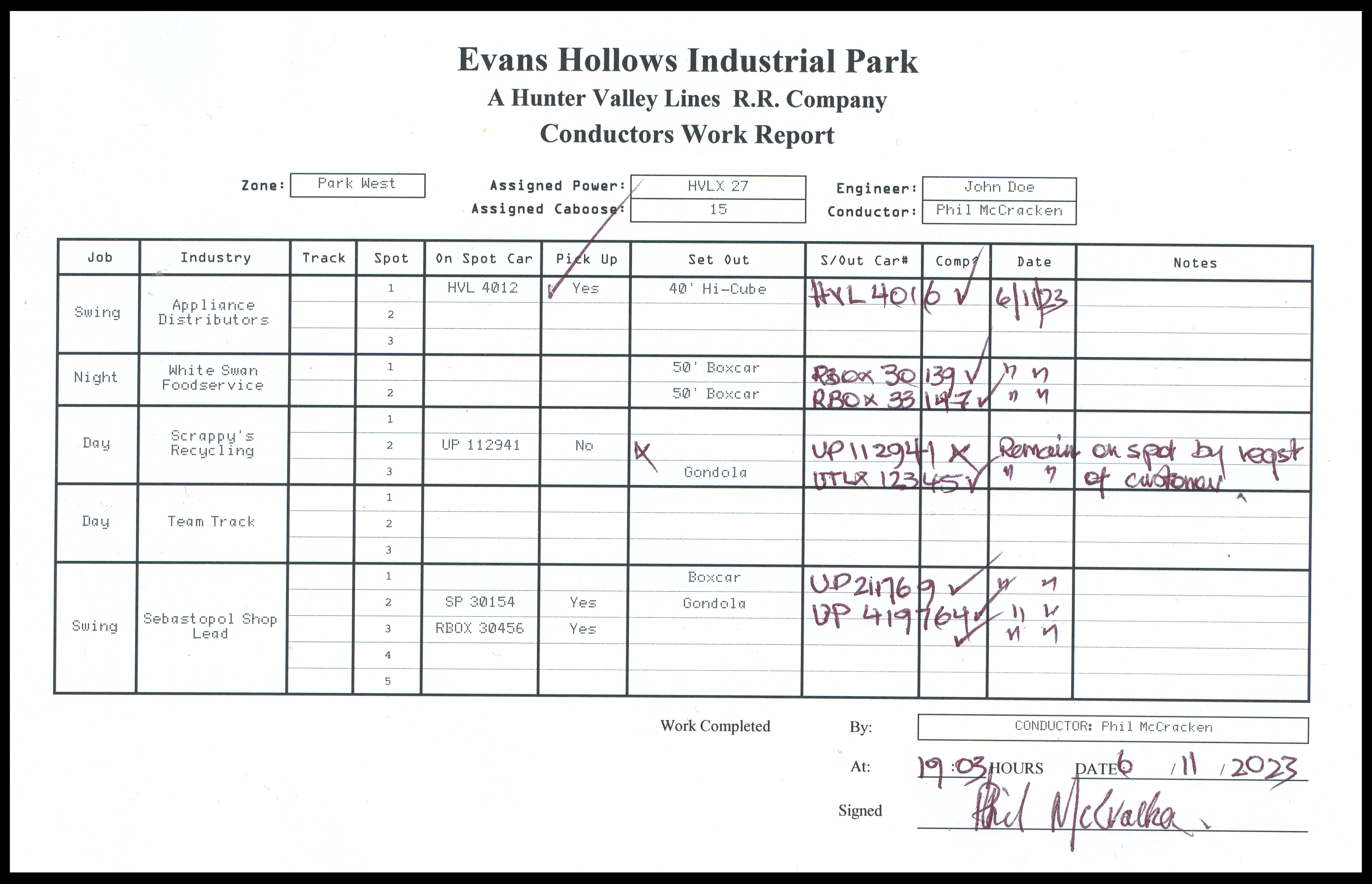
I wanted to share some of the images for the spreadsheet. I’ve done a lot of tidying up over October, and am pretty pleased with it. I’ve been running ‘mock’ operating sessions based on my stalled Evans Hollows layout (still sitting in the garage due to a lack of funding). So far all of the automation (and there is only one piece of code in the spreadsheet) is working well. Doing only what it should and not causing any major issues or dramas with the data.
Switchlist Version 6
The Switchlist is printed out and then filled in by the Conductor, in this case Mr Phil McCracken, as the work is completed. Brief notes can be added, as in the case of the UP gondola left on-spot at Scrappy’s recycling, to assist in the movement of cars onto the modelled portion of your layout, and then back into staging (in my case fiddle sticks).
If you are unaware of Car Ordering, full documentation is being completed at the moment to help anyone interested try this out. I am hopeful that I’ll have this completed before the end of November. However, I’ll be spending some time on the operating table then, so it may be finished sometime in December.
The draft version of the spreadsheet is available right now for you to play around with. I am aiming to do some testing later this month on both Google Docs and Open Office/Libre Office to see if it works there too. There is nothing major that should stop the migration outside of the Microsoft space as most of the work is done by formulas with a single macro to move data around with a button press. More of that once I get the documentation finished.
YouTube Video Series for 2024
Small Layouts Designed for Operations has been my passion since 2003. I’ve been working away at this, solo, for 20 years now. My son, a talented musician and writer/composer has been egging me on to make this a passion project on YouTube. He’s very persuasive, and I’ve updated my channel, rebranded and am in the early stages of script writing and filming a new series for debut in January 2024. I aim to pump out 1 video each month that will be a series in 12 parts throughout 2024.
I may make more than this, once I get my workflow figured out, but there’ll be a minimum of 12 videos in that series. The focus initially will be on designing for operations, and then how to get operating using the spreadsheet above. I don’t like the complexity of car cards, and train orders, and blah, blah, blah. The focus is on car ordering by online customers, fulfilling that need, delivering the car, and then picking it up again. I’m going to be using the Evan’s Hollow layout design as an example.
If you are interested in that sort of information, please visit the page on Facebook, the YouTube channel and of course right here. See the staying in contact section below for more details.
I’ve been watching the Boomer Dioramas’ channel for over a year now. I never cease to be amazed by his skill, dedication and most of all, his artistry. This two-part series is a standout.
I hope that you’ll enjoy learning the skills, tips and tricks that Boomer uses to build this mixed media kit. Apart from being a beautiful little kit, there is a lot of scratch building that elevates the kit from good to brilliant.
Building Showcase Miniatures Wrecker
This two-part series is an absolute must-watch. I’ve learned so much about building mixed media kits just watching. And I’ll be referring back to them regularly to increase my skills as I have several kit builds that have stalled because of my limitations.
This all started when I saw a Facebook post by Aaron Riley showcasing his Metra Service Centre layout, adapted from a Robert Chant design, in HO scale. I reached out to him and asked if he’d be willing to share more about his layout with us all. Aaron was gracious and extended many images and much information about his layout that allowed me to create that initial post. What most struck me from the outset was that the layout in the photos does not look like what it is, a small footprint layout. It appears larger while providing a great deal of operating potential that would provide many years of interesting operations for anyone interested in building from Rob’s original design.
Inspired by the layout I pulled information from my day job working in a similar location and wrote the Operations for Maintenance Centre Layout Series (see the links for all 7 parts in the resources section below). While you don’t need to read all of the posts before taking on this post, there is a lot of contextual information there that will help in understanding the redesign that I’m proposing.
I want to take Rob Chant’s original layout design, which is more suited to an earlier time of operation (say through the early to mid-1990s) and bring it into the 21st century. Those not in the rail industry often think that maintenance centres change little over time. Nothing is further from the truth. As operational needs and operators change, major often drastic changes to facilities occur that allow operators to streamline and manage throughput (lowering costs in the process). My depot has changed twice in the last 20 years. Each time with major additions to its layout.
Enough preamble, let’s get into the meat of the article and look at how to bring Rob’s design into the modern-day.
Rob’s Original Design
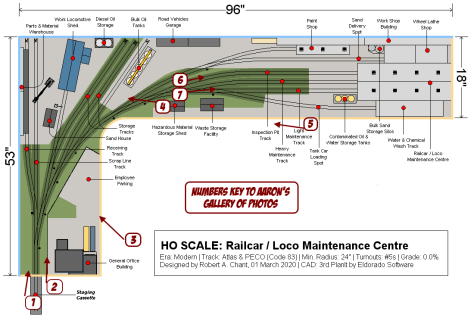
For reference here is Rob Chant’s design, as used by Aaron Riley to build his layout. I’m going to be referring back to this image quite a lot. It may be worthwhile to either open a new window, or another tab with this image to make referring to it easier.
Rob Chant’s original Track Plan with numbers keying to Aaron’s gallery of photos
Bringing the layout into the 21st Century
The design below mirrors, to some degree, what I see at work every day.
A running depot for passenger operation of diesel hauled push-pull train sets
Comparing the two designs you’ll notice right away the differences. The second design is streamlined and devoted to one function: getting train sets out of the gate and onto the mainline and the reverse as needed. To cover all of the changes I’ll start on the left and move to the right.
Parts Warehouse – GONE
Starting on the left top of the layout you’ll notice that the parts warehouse is gone, along with the scrapping line, sand house and locomotive shed. In modern facilities such as this, all parts have been moved into the main maintenance sheds and are now delivered by road. Except for rolling stock being returned from upstream maintenance centres, nothing arrives by rail.
Scrap Line – GONE
Scrapping too has moved off-site. As I mentioned in the article series major maintenance is carried out off-site at what I term upstream maintenance centres. Determination of end-of-life status for railcars and locomotives happens at this higher level and not at the running depot level.
To help you understand why running depots no longer have the means or the authority to scrap rolling stock onsite let’s go down the rabbit warren to understand the three major reasons for removing rolling stock from the asset register (or roster if you prefer):
Condemnation occurs when rolling stock is:
life expired because of age, mileage covered, or material stress such as fractures in frames, failures of major high-cost components
determined to be uneconomic to continue to maintain or repair, often because of the rising cost of replacement parts or sub-assemblies driving ongoing maintenance costs above those of outright replacement
Withdrawal occurs when rolling stock is:
considered to be excess to current need due to adverse economic circumstances such as a downturn (COVID caused a lot of this), which usually means the asset will be stored out of service until needed later on by the operator,
determined to be no longer required by the operator, yet is still in a saleable and serviceable condition in which case it will be put out for tender by interested parties and often sold into service with another operator, and finally
determined to be no longer required for operation by the operator, but usable as a source of spare parts to keep other similar units running by the operator
Accident damage occurs when rolling stock is:
involved in an accident and has suffered damage sufficient to make the cost of refurbishment equal to or more than the value of the asset, its insurance value, for example, it will be stripped of usable parts by the maintenance teams, and then sold by tender to interested scrappers
Locomotive Shed – GONE
Locomotives are generally left out in the open on an available track spot, so shedding is no longer required. All light maintenance that can be carried out at the running depot would be carried out in the regular maintenance sheds. These items would include checking and topping up fluid levels, replacing minor components such as oil filters, light globes, brake blocks, windscreen wipers, cleaning the crew compartment, emptying waste tanks, etc. All other maintenance items would be carried out at the upstream facilities.
Bulk Oil & Diesel Tanks – MOVED
The bulk oil tanks for locomotive fuel have been moved to the area near the admin offices. This allows for trucks to deliver directly to the tank area. No supplies are received at the running facility by rail. The tanks can be serviced by trucks 24 hours a day, and most likely receive a top-up on Monday, Wednesday and Friday.
Road Vehicle Garage – MOVED
With the focus changed to getting train sets serviced and onto the mainline, road vehicles have been moved off the layout. Any of the greyed areas can act as parking spaces (so long as there is clearance between trains and vehicles).
Crew Amenities Building – ADDED
The crew amenities building and the cleaners annexe have been added to provide better facilities for change rooms, meal (mess) areas, toilets and training rooms in line with modern practice.
Hazardous & Waste Storage – MOVED
These two sheds have been moved to the maintenance shed (off layout) in line with modern practice.
Paint Shop – GONE
All paint-work has been moved to the upstream maintenance centres.
Contaminated Storage Tanks – MOVED
As with the other storage buildings mentioned above, all of this storage is now contained within the maintenance building footprint.
Bulk Sand Storage Silos – MOVED
Sanding facilities have been moved to the roof of the maintenance facility to save space and simplify sand delivery to sandboxes wherever it is needed. Sand delivery comes in by road at the rear of 4 road on the paved area there. There is an air feed sand line that runs across the top of the maintenance sheds to the loco sanding facility between 9 and 10 roads.
As an additional point of interest, passenger cars can be filled by a sand buggy (not a dune buggy, unfortunately) that allows sand service to passenger cars when and where needed in the facility. The sand buggy has its own air supply to blow sand into the sandboxes.
Road Numbering – ADDED
Each road has been numbered and is used as follows:
1-3 are for ‘ready; train set storage, that is these sets are ready to run out onto the mainline.
4 through 8 are maintenance roads where:
4 road is the washing road.
5 road is the wheel lathe road.
6, 7 and 8 roads are all pit roads for general service and maintenance of train sets.
9 and 10 roads are for locomotive storage and supplemental sanding
11 road is the locomotive fueling road
Modellers should note that fueling and sanding may occur without interfering with maintenance activity on 8 road. 9 road may be designated the locomotive arrival road. And when time allows sanding can happen here, before the locomotive goes to 11 road to be fueled. After fueling the locomotive can be stored on 10 road until needed.
Wrap-Up
This is the last post in the current series based around Aaron Riley’s excellent Metra Layout. I’ve tried to share my knowledge of the operation of these facilities and I hope that you have gotten something from the series. If you have a comment on what you’ve enjoyed and would like more of would be appreciated.
I’ll be moving on to looking at how I would operate the Australian RIP track layout I posted about some time ago. I have another very small layout design that I am working on at the moment in that vein, and I wanted to see what sort of operations you can have on a 4 foot long RIP track layout to keep it interesting. More on that in the next post.
Welcome to the final instalment of the Operations on a Maintenance Centre Layout series. In this post, we’ll run through the game using the layout as the game board, the train sets as the pieces and using the cards offered in the last post as the modifiers and randomisers for the game. Let’s begin.
Setting Up
If you have not already read through the series, I suggest that you do so, You really need to have the background and knowledge of the previous posts to make the most sense of this. Still, it’s your electrons, so let’s get started on operating the layout as Rob Chant has envisioned for Aaron.
Please keep in mind that the following four steps (which are all paperwork related) can be done well before your next operating session once you have your train sets built, and the paperwork bundled together (as I posted in part 4). Now you see why I say you need to read all the previous parts to simplify this final post.
Step 1 – Set up your train sets
As we’ve already discussed a train set consists of a locomotive, a cab car and one or more trailer cars. This is the smallest (whole piece) in the game. Each train set needs to be stabled on the layout. Where it is doesn’t matter, it must be on the modelled section of the layout to matter at the start of the operating session.
Step 2 – Set up your train set paperwork
Using a train set holder (see part 4 for more information), that contains the basic set data, match your locomotive cards, cab car cards and trailer car cards to the locomotive and cars in each train set. Once this is completed you can now determine the state of the train set before the start of the running day in step 3 below.
Step 3 – Using dice for randomness
Each train set has to be cleared before leaving the yard for the mainline. This requires a dice roll (I’ve referenced this in Part 4) which I’ve decided can be a 6-sided dice. Keep in mind that if you’ve skipped the previous parts, what we’re doing is looking for switching opportunities (that is operations) within and without the yard. The dice assists in allowing chance to determine what train set is fit to run out of the yard, and what needs servicing or maintenance.
Step 4 – Consulting the card packs
With the die cast for each train set you now work through the results of the die roll to see whether the train set runs out as expected (which should be the bulk of outcomes), or maintenance on a loco, car or set is required.
Where a loco, car or set requires servicing, you consult the specified card set and follow the advice thereon. (Part 5 contains the downloads that allow you to print the cards in PDF format)
Minor delay cards mean just that. A set may not be clean and ready to run out. Or lights might not be functioning on a car in the train set. Sometimes no fault is found by our maintenance and train staff (represented by the die roll). I’ve skewed almost 43% of the cards toward this outcome because it is quite common that while a fault is reported by the train crew during use, maintenance staff either clear it on first touch or the fault has cleared by the time they get to it.
Medium delay cards work in the same manner, as do the major delay cards. The difference with these two card packs is that they provide for switching operations of “spare” cars and locos between sets, and require in some cases that cars and locos be moved to a higher level maintenance centre (for resolution of the problems) and thus you now have switching moves to complete.
Step 5 – Generating a switchlist
I suggest using a switch list as it allows me to enjoy the switching without the headache of remembering what goes where (click this link for an example I built using Excel in a new tab). You can keep it super simple and write everything you need to do using a pad of paper and a pen or pencil. Whatever floats your boat.
Once you understand what you need to do from the switchlist, it is time to get playing (or switching if you prefer). Among the things that you may need to do to train sets on the layout could include:
Moving train sets to service tracks,
Cutting locomotives off train sets and replacing them with another loco, or
Cutting a car, or cars out of a train set and moving them to maintenance tracks, before cutting a replacement car or cars into the train set, and clearing it for service (to staging),
Moving trains sets from service tracks to storage tracks when ready for service,
Building trains to be moved to upstream maintenance centres, and finally
Moving trains (of cars, of locos, or mixed consists) off the layout to those service centres.
After your first operating session, you will also be receiving cars and locos back after they’ve been fixed by the upstream maintenance centres (staging). These will require switching to either storage roads or into train set consists. And so the operations will go from there onward.
Final Thoughts
For small layouts built around maintenance centres, the hope of long term use and enjoyment at home or for exhibition use requires an easy means to make the layout work for you. Through the use of switching activities, randomness and an adversary (as mentioned in a previous post) you may find that you have more than enough to keep your interest using my method here.
I hope that you’ve found this series of benefit to you and your layout. Perhaps you can adapt what I’ve described to your own use and situation. Perhaps you can use it as is. If it gets you thinking about how you can use a system like this to improve your small layout operation then I’m a happy man. Let me know in the comments or on Facebook (link at the bottom of the page) how you have put it to use.
I wrote back in December 2021 that I caught “the virus” and was hoping to be over it in short order. Yeah, well that didn’t happen. Read on…
Recovery and Delayed Posts
“What doesn’t kill you gives you a set of unhealthy coping mechanisms and a dark sense of humour” – Unknown
So, what started out as an optimistic case of COVID-19, turned into a 7-week absence from work, including 5 weeks (solid) of 24 hour-a-day coughing fits, being as weak as a kitten, and 2 plus months of continual work to get back to my fitness level. I get that everyone’s story with COVID is different. I was lucky not to have ended up at the hospital, but it was a close-run thing. Thankfully, Australia’s public health system held up and is outstanding; I had a fantastic team on my side made up of my GP, The Royal Melbourne Hospital‘s COVID triage team, Nurse-On-Call, family and friends to help out. Seems that raising a child is not the only thing that requires a village.
I’m still finding that overwhelming tiredness at the end of the day remains. Each day that goes by, thank the fates, I am still here and getting back toward normal. While my wife caught COVID, it was less aggressive with her than with me. It would have been better not to have caught it at all. I’ve now had my 3rd vaccination and hope not to catch it again. Let’s just hope that it turns more benign as time goes on and as we become used to having it in the world at large.
If you’ve been through it I hope that you are O.K. and that your family and friends likewise are on the mend.
Needless to say, posting has been delayed as life, in general, has taken priority. I hope that you will stick with me as I get back on track to work on finishing the last post in the “Operations on a Maintenance Centre Layout (Part 7 – Op till you Drop)” series. In this post, which I’ve begun working on again will take us through an op session on the layout. I aim to finish that soon.
Chain-Link Fence Tutorial
Boomer-Diaries on YouTube has been a must-watch, that I found during my time watching ‘everything’ on YouTube during my convalescence. He recently posted what I feel is the best Chain Link fence tutorial I’ve ever seen or read. I’ve linked it below. Watch and enjoy as you get a masterclass in how-to modelling, painting and dressing a great scenic item.
Once you go down this rabbit-hole though, you may be some time, to misquote Capt Robert Oates (of Scott’s doomed Antartcic expedition) as Boomer diaries has a big collection of outstnading videos on the current layout build.





 Andrew's Trains