Tag Archives: operations

Operations on a Maintenance Centre Layout (Part 3 – Game Theory)

This is the third post of the continuing series on Operations for Maintenance Centre Layouts. In part 1, we looked at the types of passenger facilities I’m familiar with. In part 2, we looked at how we can use the prototype’s methods to develop an operations plan that suits a small layout.

In this post I wanted to address two questions about small layout operations: firstly is model railroad operations a game, and if so, how can we keep the game interesting for the longer term?


Railroad operations is a game?

From my first introduction to model railroad/railway operations (railops), I noticed a lot in common between it and the Role-Playing Games (RPGs) and board games with which I was familiar. Bear in mind that I’m addressing railops in a general sense (both freight and passenger operation), not just as it applies to Aaron’s excellent layout and Rob Chant’s design, as there is much in common to apply to both styles of operation.

I want to give a quick side by side comparison (they’re really one below the other) of the parts of your ‘average’ board game and a small layout.

The board game has A small layout has
counters or player pieces Cars and Locos
a board on which the counters move The layout board
rules that describe how the counters can move Rules
a means to add some randomness (usually dice, or a spinner) a means to add some randomness (car cards/waybills, the timetable, the ops plan, the list goes on)
a starting point and an end goal to close out the game a starting point and an end goal (switching cars into spots according to the ops plan), which when complete, ends the game

Once you see the commonalities, I’ve found there’s no going back.

Countering boredom with randomness

On Facebook, back in November of 2020 a post from Paul Boehlert got my attention. I didn’t want to reproduce the post in its entirety, so I’ve cut it down to the following.

A couple of days ago, a member asked the group how we keep interest high on a small switching layout. The following is a short description of a scheme my son and I worked out. It makes each session a bit unpredictable and adds variety, which helps maintain interest.

My adult son is a skilled and talented games designer and has been around model railroading all his life. When I asked him what he would do to make operation more interesting and varied on a small layout, his reply was immediate: I needed to generate some randomness, and I needed an adversary.

Paul went on to describe how he used one of his son’s 12 sided gaming dice to assist with introducing random events into the operations gameplay. His initial focus was on the weather, due to the setting (location) of his layout. Multiple roles of the dice allow him to determine the time of year, and the level of ferocity of the weather.

As he points out, the weather is not the only adversary. The interactive nature of the railroad right of way with cars, trucks, other railroads, shippers and receivers, trees, power lines and the poles they use (just to name a few) means that lots of events can and do on occasion happen that interfere with the railroad doing its stated job of moving stuff. Technology can be a problem, no matter the time period you model. Steam engines sometimes wouldn’t fire correctly lowering their tractive effort and slowing them down. Diesel locomotives have mechanical, electrical and electronics issues that need to be rectified either on the road or in the shed before being able to complete their shift. Cars become bad-ordered due to mechanical faults, accident or loading/unloading damage, or vandalism which all have effects on the operation out on the line.

Paul’s solution was to make “a list of random events, and roll the 12-sided die one more time when things get a bit too predictable. If you want lots of random possibilities, gaming dice come with up to 100 sides.

No two days are the same in the railroad industry. Each day presents different challenges, and there is always something that is not working the way it should. It affects what you can achieve and how you can achieve it.

At work often nature is our adversary. For example every time it rains we have problems with random detector loops. These pick up transponder signals. They are sealed, but they misbehave whenever there’s a lot of rain. But never the same one each time. Or high winds bring down trees along the rail corridor, blocking lines until maintenance crews can get out and cut the trees and clear the line.

There are general technical issues that occur, point/turnout motor failures for example are unfortunately common at the moment. Each of these requires spare parts and in the COVID world of 2021, those parts are not always available. So it’s back to the 19th century we have to go, manually throwing over the switch blades (points) until the spare parts arrive. Electronics are slow for the same reason at the moment with computer chips being in short supply due to COVID-19s effect on the supply chain in China. From design to fabrication, land and sea transport, we have slowdowns that are affecting rail suppliers worldwide.


Takeaway

Treating railops as a game, and using randomness and an adversary can make for better gameplay and longer-term interest.

Final thoughts

On small layouts, especially those with a small visible footprint, even with all the permutations mentioned above, can it, like Monopoly, Cluedo, or Trouble get too predictable?

Can boredom set in too early in the life of the layout? Is that why so many small layouts are sold on, torn down, rebuilt and replaced with yet another?

I’m interested in your thoughts on this.


Resources

The series so far:

Staying in Contact

Interested in keeping in touch or discussing posts, pages and ideas?  You can do that in several ways by:

  • Commenting on this post (I read and answer each one)
  • Sending me a note using our About page (email)
  • Connecting with us on Facebook at the Andrew’s Trains page
More first Mile/Last Mile? We can do that…

I posted a while ago about a flour mill, here in Melbourne, that showcases a loads-in, empties out flour milling operation. Today we’ll look at another operation, this time in Montpelier Ohio which is an empties-in/loads-out facility for grain. This is truly first/last-mile railroading at its best.

Switching the Montpelier Ohio Elevator

We’ll talk about modelling a facility using the track layout and operations featured in this post next time. For now, I’d suggest that you watch this outstanding video from YouTuber Scott Taipale. With WAER 223 an SW 1200 switcher (ex IHRC 223, ex TRRA 1223) working a unit grain train at the elevator in Montpelier Ohio.

This SW 1200 switcher was built for the Terminal RR of St Louis in 1955. Later owned by the Indiana Hi-Rail and successor Wabash Erie, it is now used exclusively by the Edon Farmers Co-Op to handle the bulk car movements you’ll note in the video.

A couple of notes on the video from Scott:

  • The line furthest right (North) used to be Wabash’s 1st district which ran from Toledo to Montpelier (now truncated, it ends 4800 feet behind/east of the camera)
  • The branch line connects to the former Wabash yard in Montpelier (now Norfolk Southern)

In my next post, we’ll look at how you can model a layout based on the track diagram and how you can fit this facility into your space and time limitations. Thanks for reading along.  and if you get the chance please like and subscribe to this blog, and to the Facebook page. Your support is greatly appreciated.

Resources

My switching first/last-mile playlist on YouTube

Previous Kensington Posts:

Scott Taipale

Staying in Contact

Interested in keeping in touch or discussing posts, pages and ideas?  You can do that in several ways:

Site Seeing – The Operations Gold Mine Edition

Seeing how others conduct their operations, and their session is a valuable learning tool. Visit the Burnt Hills and Big Flats railroad for some great ideas and examples.


The Burnt Hills and Big Flats Ops Site

Steve Prevette’s layout is a great layout in its own right. Beyond that he’s made it a great example of how to operate also. Of more importance, I think, is his willingness to share his operating information online.

His site (listed in the Resources section below) shows thoughtfulness and planning. There’s overviews, details and instructions and in all it is an excellent site to see how things “should, and “can” be done for a layout large or small.

I hope that you enjoy reading the information presented by Steve as much as I have.


Resources

Interested in keeping in touch or discussing posts, pages and ideas? Connect with us on the Andrew’s Trains page on Facebook

Site Seeing – Books on Operations (Real and Model)

I talk a lot about operations for model railroads. There are many reasons for this. Primarily I urge railway and railroad modellers to consider this aspect of the hobby because it allows greater play value – no matter the size of your layout space.

Today while packing for our upcoming move I got to my operations section. Two books on my shelf stood out and I wanted to share them with you. One focuses on the prototype, the other on the model. Both enlighten on their own the mysterious world of operation. Together they provide a great insight (at least to me when I was learning) and compliment each other in helping you understand how operations works.

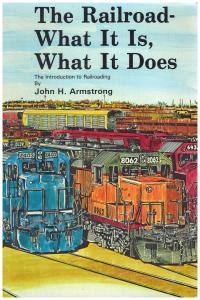
The Railroad – What it is, and What it does (The introduction to railroading)

By John H Armstrong

Everything you ever wanted to know about railroads (*or railways for that matter) is in this book. Ans as a railroader primer, it gets you inside the industry quickly and explains the why and what in clear easy to read language.

Starting from the absolute basics of how trains evolved to using the flange, through train speeds and the reason for trains, and not individual cars, you’ll soon find that you are on the inside, rather than struggling to understand.

Keep in mind that this is only the beginning of the rabbit hole, that is the railroading industry, but what a great way to start your journey. My version covers me though to my operating period.

The newest version (which I have yet to buy – waiting on some of those books to sell!) covers equipment to procedures and marketing to maintenance.  Amazon’s blurb says: “This book is ideal for novices and experts alike. The easy-to-read narrative presents a brief history of railroading from the coal-fed ‘iron horses’ that helped build a nation to the latest generation of EPA-compliant locomotives. You’ll also find current information on new technologies such as ECP brakes and computer-assisted transportation systems. The fifth edition is a resource for anyone wanting to learn about modern day railroads. The book delves into many facets of the railroad industry including such topics as freight cars, locomotives, track, signal and communication technology, intermodal traffic, operations, labor relations, and design engineering.”

If you don’t have a copy – go get one. Simple as that. It will make your understanding of the railroad and your ability to see beyond the layout so much better.

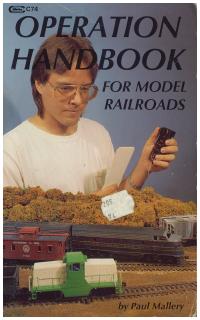
Operation Handbook – For Model Railroads

By Paul Mallery

This book is (in my opinion) the best of the readily available model railroad operation books. Are there others out there? Sure there are. Tony Koester has one, but I feel it is merely a glossary for the better works of Paul Mallery and Bruce Chubb.

Paul Mallery’s books provides a complete handbook for running a realistic model railroad. It covers every aspect of operations, including timetables, orders, signals, waybills, communication, passengers, freight, locomotives, and MOW.

At 200 pages with a full index I highly recommend it to you if you want to put the learning from the first book, onto the layout.

Resources

The other book to which I’ve referred above for the modeller is:

  • How to Operate Your Model Railroad by Bruce A. Chubb.

I believe that this is the best of the model railroad operations books available. Getting a good used copy is difficult, very worthwhile though.


Site seeing – Op till you drop ‘Blue Flag’ edition – August 18

In this post we’ll be looking at blue flags; what they are, what they do and how to model them.


What blue flags are, and what they do

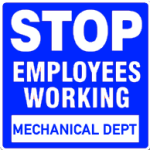
Blue Flags are used in the North American  railroading industry to show that railroad or other personnel are working, on, about, under or between railroad equipment and that the railroad equipment may not be connected to. These signs may be posted at the entry to the track upon which the vehicle sits or may be at, or close to, the railroad equipment itself.

Whoever places the flag is generally the only person that may remove said flag. However anyone from that same ‘craft’ may remove the flag. While this generally applies to railroad mechanical departments many customers have also begun to use the blue flag to ensure that cars loading or unloading have the same level of protection. Railroad crews are so used to dealing with these safety items that ‘everyone’ in the industry understands what their placement on a siding or spur means.

Canadian Pacific’s safety regulations state the following:

12.3.7 Blue flag protection is used to indicate that CP or Contractor Personnel are working on, under or between Railway Equipment and movement of trains or other Railway Equipment is prohibited. Blue flags must not be tampered with or obstructed. Blue flags can only be removed by the person or group of persons who originally applied it. Application, use, and removal of blue flags, when appropriate, may only be done under the authorization and guidance of the Manager in Charge.


Modelling blue flags

Have you considered adding ‘blue flag’ operations on your layout? Adding prototype processes to an operating session provides two important benefits:

  1. It makes the time you spend on the layout more meaningful through the application of, and adherence to the rules, and
  2. It slows down the session and forces you to work in real-time.

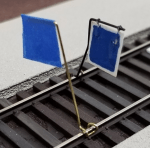
Over on the Model Railroad Hobbyist blog of Craig Thomasson he recently described how he builds HO scale blue flags for operations and how they are used on his layout. I found his blog post interesting and think that you might find as interesting and useful as I did.

Resources

If you’ve not met Blue Flags in the operations sense before here are some resources that you might find useful:

Site seeing – Saturday morning video watching edition

It’s been a while since I’ve had the time to post. A range of reasons you’re all familiar with – work, tiredness, time pressure and the needs for others among them. And then that this is at the moment a hobby and not my primary income source (sigh).

While taking a little time out for myself in the early morning (before the sun came up on a very chilly day in Ballarat) I rediscovered the video produced by the folks over at Model Railroader on model railroad operations. Hosted by the late (and greatly lamented Andy Sperandeo) this video is a great introduction to operations, without all the paperwork, and other stuff that can hamper your entry into the realm.

I hope you enjoy, and it is great to share with you Andy’s wit and personality. I miss being able to chat with him as I did every now and then online about operations and the finer points he knew from a lifetime of modelling. Have a great weekend.

Site Seeing – the Model RR to Go edition

Good day readers wherever you may be, and whatever you may be doing. It has been a while since my last post. That’s mainly down to my work schedule being all-consuming, and the days being long and the start times being all over the clock face. Nine months into my new role as a tram driver I’ve just managed a couple of weeks off and needed every moment to recover.

While recovering and looking around for some layout baseboard design ideas today I stumbled across Rick De Candido’s Fillmore Avenue Roundhouse blog.

His section of layout concepts (click this link to open a new window) has several great ideas. He really thinks outside the box on many of his designs. There is such creativity from this space starved modeller.


POST UPDATE – August 8, 2019
It appears that Rick’s WP site has been removed. I’m trying to contact him through multiple sites to see if there is a new site for this layout. I’ll do my best to keep this post updated.

His terminal layout is something to see too, and can utilise up to 6 operators on the layout during each 2.5 hour operating session. Well worth the time to visit the site and take a long read through the many useful posts there. Thanks to Rick for sharing his passion.

Rick’s Fillmore Avenue Roundhouse layout

Unfortunately I have no contact details for Rick, and there is nothing on the site where I can post a comment to let him know that I’ve profiled his site. If any of you can help with getting me in touch with Rick would you please reply to this post?

Site update – Operations pages updated

I’ve completed a complete rewrite of the introduction page to the operations section. In addition I’ve added another page to the ops section to improve the information flow. I wrote the original in September 2014 stating that it would be a living document, and so it has proved.

You can read the updated intro page here. That page then refers you to the new 101 – Ops Intro page which has more information on the subject moved on from the first page. I’ve updated several of the other pages also. There is still more work to do to make a better complete article. I’ll continue working on this section during January and February 2018. More information once I complete the new sections.

I don’t expect that you will agree with me on every point in this article series on Operations. For me it is about creating the conversation, and getting people to talk and think about the subject. I hope that you will use it as a jumping off point from which to refine your own vision of what model railroad operations means for you.

Make sure to comment and share your ideas with me. I love hearing what you have to say.

Site Seeing – August 7 – Master class: Operating Session

A recent post on the Model Railroad Hobbyist site by Tim Garland and the associated video (see below) shows the realism and enjoyment that can be achieved by operators with little cost beyond the time to set up and the time to operate.

What I enjoyed most out of this operating session video was the way that both Tim (who works as an Engineer for NS) and Tom Klimoski (the layout owner) work together as a team to get the ‘work’ done in a professional way, without hassle, in a small layout space, all the time working the layout to get the switching work done. Better was the way that you cannot see the engineer (Tom in this case) only the conductor on the ground working the cars into place.

Watch the video below and share your thoughts here or on Facebook.

At the Recent Ballarat Model Railway show (June 2017) I managed to catch up with a long time railway mate and his layout. When I saw this video I forwarded it onto Neil as a teaching tool to help him get operations going on his own layout. I think that what Tom Klimoski has recorded is the gold standard for small layout operations. It shows how (and I’m guessing on time) over a shorter operating session two people can work and have a lot of fun switching. Maximising the usefulness of a small layout by following the rules as set out, and by opening and closing gates, calling out the moves, and so on makes such a difference. I hope that you enjoy the video as much as I did.

Additionally there is a great post by Tim going on over at the MRH site about this video. Click the link at the top of the post for more. Lots of really good stuff in that post for the operator as well.

Ops, TT&TO, invective, and blah-blah-blah

It’s been a while since my last post. Life has become hectic with lots of work (as the opposite to none at all for quite some time) so to keep the blog moving I thought I’d cross post my response to Joe Fugate’s recent editorial: Secret to needing less layout on page 11 of the June 2017 edition of the e-zine ‘Model Railroad Hobbyist’. I found that as I read through the responses there was a lot of heat being generated by those for and against the smaller layout ethos. A recent kind email from a new model railroading friend Charles Malinowski got me to thinking about the original post on Joe’s editorial and the thought that perhaps it might be time to draw that line in the sand on this blog too.

If you can, take a moment, to read of some of the initial responses to Joe’s posting. Then either read my post on the MRH  site or as reproduced below. Don’t be shy. Got something to say, then comment and start the conversation here. It’s the only way we all learn.

Am I missing something? Did the hobby just become a pain in the butt during this discussion (and I’m not through reading all the responses yet)? Timetable and train orders, and… all to much work for me. While I understand that model railroading is all things to all people I don’t need all of that other stuff to make a me a happy modeller or operator.

I like small layouts. I live in rented accommodation, and will likely for the remainder of my life due to circumstances beyond my control. My wife loves the idea of me ‘not’ cluttering the place up with ugly wooden stuff that takes over the space, so I have to consider the aesthetic of any layout design as well as the piece of furniture it must also purport to be.

I’m limited in space, money and the time I have available to actually build the thing. So a long time ago I took the first mile, last mile approach to railway modelling. I model industries and locations where there is a lot of work to go on (switching) at an industry or location (such as a team track facility) getting the loads in and out in an efficient and useful way.

Do I care about Timetable and Train Order operation? Nope. Does it affect me as either the modelled customer or as an operator? Nope. And lastly, does it affect my enjoyment of the hobby? Nope. Would I love to model TT&TO operations? I’d love to but I cannot afford it.

I use paperwork, operations plans and rule books to model, and there’s a reason for this. I like my crew (usually my son and I) to feel the need to get the work done efficiently and with haste. There’s a train to catch out there somewhere and our cars need to be on it. I love operating by real railroad rules and with prototypical operations paperwork.

I focus on the things that matter to me, and that is the first mile and the last mile. What happens in between where the rail line curves away from my business – is none of my business. I put a lot of thought into what makes operations work for me. And I’ve shared that online as well. And it is not all that hard to achieve, especially in a small space. You can read more about that on my blog.

Joe’s TOMA approach I like. It means that it is achievable, in space, time and money. It gets you working quickly and allows for interests to develop as your skills and knowledge develop. Big TOMA, small TOMA, even in between TOMA… who cares? The idea is to get something going that allows you to play, find out what you enjoy the most and do that with the effort you have available.

Thanks Joe for sharing that article. I’ve been following along with the TOMA approach because it mirrors what I’m already doing and because it makes sense from my son’s perspective (Dad can we get something running now, I want to play with the trains again).

I appreciate that others do things differently. It’s a good thing. Let’s not get so focused on the forest that we forget about the trees. Happy modelling from Ballarat in Victoria.