Tag Archives: model

Site seeing – July 30

It’s tool time.

Over on the model railroad hobbyist forum, at the outer end of the western spiral arm, is a discussion going on about the ”Challenges of working in a small space’. Sprinkled in and among that discussion are some of the best ideas I’ve seen for organisation yet.

I won’t say that the solutions are available in your country however, they do give great food for thought and we can all work to come up with something similar. Some of the best ones I’ve seen are so simple I wish I’d thought of them.

Site 1: Model Railroad Hobbyist Forum

In this thread I’ve seen some great tool sets and here are a couple from this thread:

If you get the chance head over to the link and take a read through. I’m looking at building that second stand. Without an inside modelling location at the moment (I normally model in the garage during late spring, summer and early autumn) I have to be mobile in my modelling approach.

20150730_201931[1]

Image 1: Andrew’s yellow carry bucket of tools

Site seeing – July 7

A local site seeing tour today of the newest pages uploaded to the blog.

Site 1: Small Layouts [Follow the link —>]

This is the small layouts section of the old HunterValleyLines.com/gallery website that is now offline as mentioned in my post yesterday. There are over 30 layout designs in this section.

Site 2: Medium Layouts [Follow the link –>]

This is the medium layouts section of the old HunterValleyLines.com/gallery website. There are 13 layout designs in this section.

Site 3: Large Layouts [Follow the link –>]

This is the large layouts section of the old HunterValleyLines.com/gallery website. There are 3 layout designs in this section.

Site 4: Ideas and Scribbles [Follow the link –>]

This is the most interesting and fastest growing section of the website. The Ideas and scribbles section is the storehouse of all of the doodling and noodling that I’ve done over the years. There are narrow gauge loco designs, industry designs, layout ideas and designs but all are drawings only.

  1. Layout Bits
  2. Layout Ideas
  3. Other Stuff
  4. Track Diagrams


Broken down into four major sections follow the links and find some hopefully useful ideas to kickstart your own modelling process.

Site seeing – June 18

Cutting Costs and Styrene

The costs of buying sheet styrene has gone up a lot recently. Let me say that I love my Evergreen styrene; I could not model what I model without them. I recently updated and added to my modelling stash of shapes for upcoming projects. Luckily I found a local supplier who is among the cheapest in Victoria for Evergreen.

However, when you need a lot of sheet styrene buying multiple packs of 40 thou (1.0 mm) and 20 thou (0.5 mm) styrene gets expensive very quickly. A business friend bought the local plastic company here in town a couple of years ago and he has these thicknesses of styrene I use most often (called HIPS in the trade in Australia) available in 8′ x 4′ (1200 x 2400 mm) sheets. At around $A22.00 for that size of 20 thou sheet and double that for 40 thou sheet you can see that there is some serious savings to be had buying that way.

Site 1: General Plastics Ballarat [+ Link]

Dale, the owner of General Plastic in Ballarat, is always helpful to modellers and a lot of modellers use his services to get what they need in the Western Victorian region. Dale has a full set of products and can get whatever you need. More importantly Dale has added a Laser Cutter and can cut whatever you need directly from your CAD file. If you live close by drop in and say hello.

Site 2: Harper’s Hobbies and Collectibles  [+ Link]

Harper’s’ Hobbies in Wendouree is becoming a really great place to visit. Ballarat is not short of good model sellers. What makes the difference is that Harper’s has the basics you need to scratchbuild, along with a really good tool choice. That makes a difference. Also they have begun to stock the Warhammer 40K range of kits that my son is right into.

While the sites are really Western Victorian focused today, perhaps you’d like to share your favourite modelling suppliers. Leave a comment and share.

Takeaway

If you buy larger sheets of styrene, one big problem is storage. Here’s what I do:

  • Cut the sheet into 4 pieces across the sheet with shears of large scissors
  • Using plastic clamps, join all four sheets to keep them under control.
  • That way when you need it you simply cut off what you need, and then rehang the remaining pieces.

Talk to you later.

Why I chose not to design my layout – Part 5

Somewhere back in a previous post I am certain that I published a basic op session. Today I wanted to update that in light of the new layout design, as there is a pretty big change to both the ops plan and the layout since I first set track on plywood.

A Modified Op Session

An op session will start where ever the previous session stopped. You should keep in mind that I am aiming to have roughly one 30 minute operating session per night, at least 3 nights per week. I’d like more but the realities of work and family mean that aiming for 3 nights is achievable.

Assuming that a full day’s work (around 90 minutes odd) is planned for say a Saturday op session here’s how the work would be done.

The yardmaster will go through the electronic system (more about that later on) and determine what cars are due to be picked up and what inbound cars are due to be setout for the day. The YM then hands the paperwork off to the switch crew and goes about his business.

We pick up with the switch crew after they’ve already travelled out to the interchange, connected on, pumped up the air and begun their return back to the Industrial park.

  1. Train arrives from interchange
  2. Loco runs around the train on the arrival track and moves the train over to the classification 1 track
  3. Cars are classified according to the switch list using the main, loop and the Class 2 track
  4. The crew checks the pickups and setouts for industries and then sets about doing the individual jobs for each customer. In cases where there are multiple customers on a spur, the job is handled as a single job
  5. Industries are pulled and setout as required by the switching documentation
  6. The crew then returns outbound cars to the yard, for storage while other switching goes on for other customers (if any that day)
  7. Once all of the industries for that day are switched all outbound cars are made up into a train (blocking is not required)
  8. The final work for the day is to pull the outbounds to the interchange
  9. The cars are set out, handbrakes applied as needed and the air bled off
  10. The loco crew return empty handed to the yard, carry out any further trimming of the class tracks as needed, and
  11. Run the loco back into the maintenance facility.

Here endeth the operating session.

As I said above this full operating session ought to take up about 90 minutes. Allowing the session to be broken down into shorter, easier to achieve 30 minute mini-sessions means I’ll be more likelt to play with my layout, and get more enjoyment from it.

Between sessions the paper work will be hung on clip boards off the front of the layout ready for me the next night.

Should I want to run a longer session I can do that and simply complete the previous sessions work as a part of that.

Why I chose not to design my layout – Part 4

I did some measuring on the new track plan (version 3) today and the result is pleasing (at least to me). On the HVRR we use a XAF10 Railbox car as our standard measure for cars; These car’s measure 190 mm over coupler faces – that’s right on the 54′ and some change that a real car has for door spacing if it is recorded as a 50′ car. With the numbers in hand I tried a few calculations to see how everything fit.

Yard Tracks

With measurements now completed on all of the storage and “yard” tracks our holding ability on all tracks suggests that the:

  • Main (at 1400 mm) can clear 7 standard cars,
  • Loop (at 1500 mm) can clear 8 standard cars.
  • Classification track 1(at 1800 mm) can clear 9 cars ,
  • Classification track 2 (at 1300 mm) can clear 6 cars, and
  • The total on-track yard capacity is 30 cars (not including the interchange as I consider the interchange loadings to be a part of this number).

Yard Occupancy

I don’t want to flood the yard on any one day so I expect that the total yard occupancy at maximum will be 50% of the total – leaving me with 15 cars maximum. So that even with a full train of 9 cars coming in from the interchange I can use Class 1 & 2 to store all of the cars and leave the main and the loop free to work. More on this though below.

Industry tracks

On the main board there are two industries:

  • Industry 1 is 800 mm long and can manage 4 cars
  • Industry 2 is 1600 mm long and can manage 8 cars
  • Interchange track (at 2400 mm) can clear 9 cars plus the loco. The interchange track is considered an industry also.

The trackage on the base of the L are to be built based on an article in Model Trains International #58, page 106 by Bruce Petty. While this was essentially an article on scratchbuilding the Strongheart Packing Co. there was also a track diagram included. While I cannot post the magazine article here for you, I can point you to Bruce’s website which has the same information and track diagram (link here)

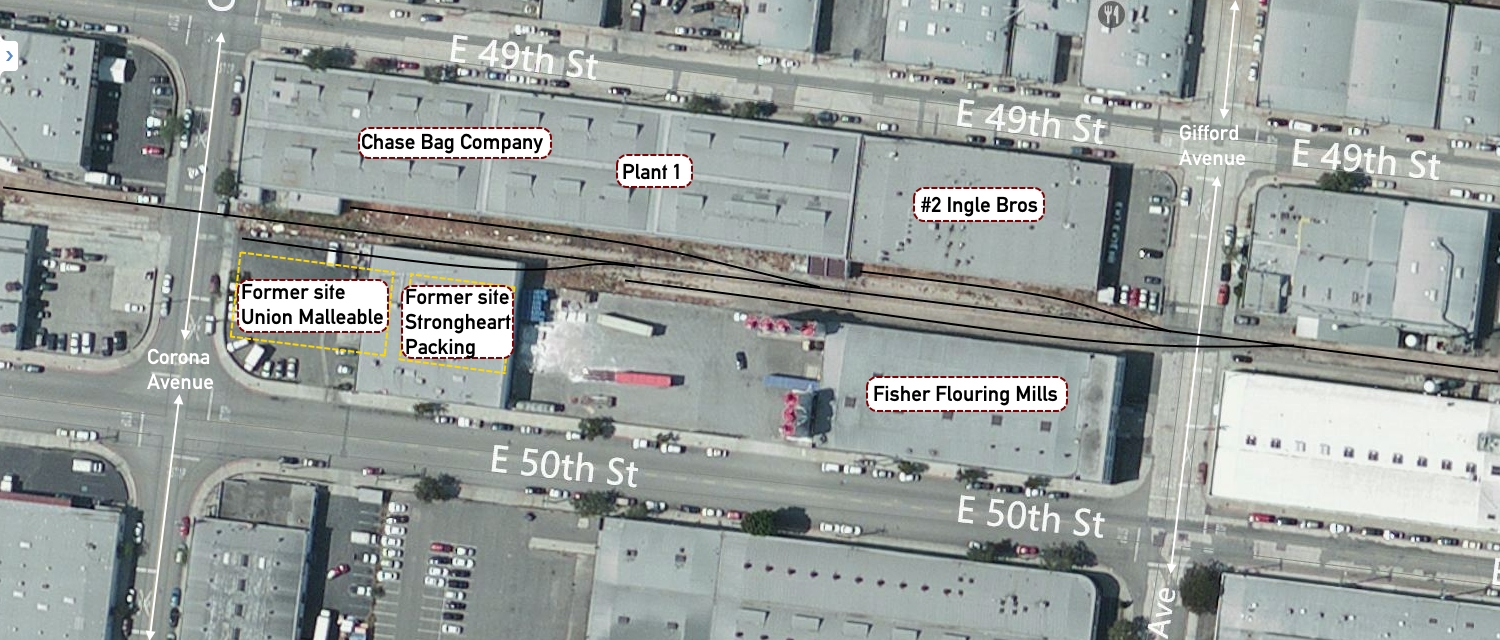
The current track layout in this area bounded by East 49th and E 50th Street is somewhat different from that of 25 – 35 years ago, this is reflected in the two images here:
Strongheart Packing Co - Vernon CA

Image 1: Block bounded by 49th & 50th Street, and Gifford To Corona Ave

This is an overhead view of the same block as in the article, but several of the buildings have been removed; specifically Union Malleable and Strongheart Packing. Otherwise the track for the most psrt seems to be intact.

Vernon CA - 49-50th Street - Gifford to Corona Ave - Track Layout

Another overhead view showing a slightly different angle that puts the article map in perspective.

I’ll be leaving building’s in place at Ingle Bros. It is a nice, generic building, plain brick that will be easy to model. It will have the two car spots as on the plan. The Chase Bag Co will go. In it’s place I’m going to put a team track. This will ensure that I can have a range of cars in that spot, and in addition give a great view of the remainder of this section of the layout.

The other buildings will be changed slightly to give that 1970’s renewal look of tilt-up concrete construction so prevalent in Texas.

Industry occupancy

Just as for the yard, I do not want to flood the industry tracks with cars. There are two reasons for this:

  1. I like that industries are not always blocked with cars – this is also very prototypical, and
  2. I am aiming at maximum to have industries be 50-60 percent occupied

Thus the total car numbers of the main board will be:

  • Industry 1 holds on average 2 cars with a maximum of 3 cars
  • Industry 2 holds on average 4 cars with a maximum of 5 cars
  • Interchange holds on average 5 cars (rounded up from 4.5) to 7 cars.

As noted earlier it can clear up to 9 cars at any one time if needed; this ensures that the interchange and the yard tracks should never be flooded with cars to stop the operations of the railroad.

The industrial park (bottom of the L) boards will hold on average 7 cars using the same occupancy rate. In total then the maximum cars in and out of the layout (should all of the occupied spots be switched on one day) would be 17 cars. Luckily that is not going to happen because these car movements would be spread over 6 days.

I am hoping the average will be in the range of 4-5 cars per session. This meets my goal of a short switching session, but with plenty of interest for me as the crew. More on this later.

Why I chose not to design my layout – Part 3

I wanted to show my working (as my Math teacher always encouraged me to do) on the layout design as it evolves to meet my needs. I was not happy with the way the original design performed when I looked at the yard throat design. There was an ‘irksome’ separation between the mainline and the branchline running into the future Industrial park extension. Image 1 below, shows my attempt to fix that issue; a simplified version of the first track layout.

New Layout Design - Take 2
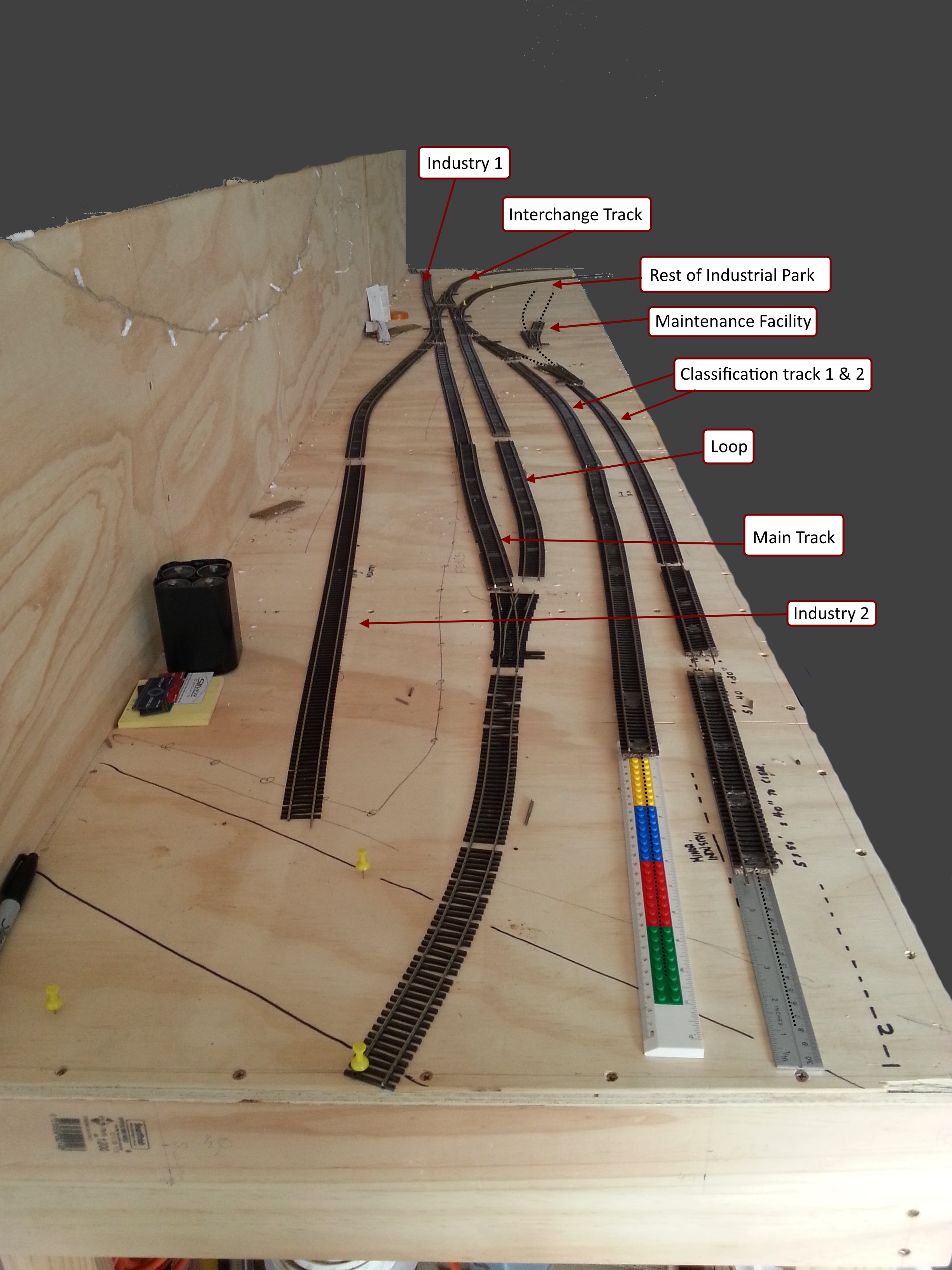
Image 1: Take 2 on the layout design

The throat area is the set of switches around the Interchange track and the branch out to the rest of the industrial park. In mock operating sessions the biggest issue I had on the fist design was the lead out to the rest of the industrial park had crept down quite a way onto the upright of the L shaped boards. Keep in mind here that the other boards are not yet attached to the three boards in the image.

Additionally, I wanted to have a better yard throat, that was easier to switch through and took up less space.  After due reflection, the layout just didn’t look right for a small, smart industrial line with the smarts to build their own industrial park out of a couple of abandoned branch lines. Thus we arrive at version 3.

New Layout Design - Take 3
Image 2: Take 3 of the layout design

First there’s a better use of space,and visual appeal (to me anyway) with the long classification track #1, and the maintenance lead / class track # 2 being at the front end of the board.

All of it coming direct off the old main (now the interchange track). It simply feels better, and right in a way that the previous versions did not. I’ve run a quick thought exercise ops session on the new layout, and it also makes it easier to do business on the new layout. I’ll post the results of that a few days in the future once I have some other modelling work that I have to complete done.

On reflection I will be moving the switch (currently a Wye that will be replaced with a left #5) further back toward the camera to extend the run-around on both the main and the loop. This will stop just short of the road overpass and ensure that a loco can pull clear of the switch to allow the run-around move to take place. Additionally it will allow the

That’s it for me at the moment. Talk to you all later. If you have any questions let me know.

Exhibition Report – Labour Day Weekend March 7-9

In Victoria there are two exhibitions (that I am aware of) on the Labour Day Long Weekend (March 7-9). First is the very large exhibition at Sandown Racecourse; the second is the great little exhibition at Kyneton.

On Saturday March 7 the kids and I decided to head off to Kyneton only, as there was also a trade fair on showcasing all of the Ye Olde trades that my son loves.

Having finally gotten the video uploaded today on youtube, I hope you enjoy the overview of the show.

This is one of the best little shows around in regional Victoria. It is easily doable by public transport, with a nice walk into town from the railway station.  The food in town is really good, with a lot of great eateries.

If you are driving it is easy to get to, taking us only about an hour from Ballarat; roughly the same time from Melbourne. Quicker from Bendigo.

Why I chose not to design my layout – part 2

Introduction

In my last post (Why I chose not to design my layout – part 1) I discussed some of the reasons for ‘eyeballing’ my new layout and not ‘designing’ my new layout. This time around I wanted to clarify any uncertainties around the design process, and continue on with some meta-data about the design to help me clear my vision of the layout and the eventual role I’d like it to take in the future.

The Mod. 1, Mark 1 Eyeball

There is nothing better than eyeballing a space, and understanding how all the elements fit together. Obviously it makes the process easier if you understand what you aim to make, and have a sense of perspective on the amount of track you can reasonably have within the bounds of the layout space.

The layout’s story

My layout’s story revolves around switching within an industrial park. Service delivery is the primary focus of the layout and thus switching is the primary activity of the layout. With the design I wanted to be able to have a train:

  • arrive from the class 1 partner (interchange track),
  • be brought into the industrial park (switching yard),
  • switched into job lots for delivery within the park (customers), or to off-spot storage (storage yard),
  • run out to the customers needing switching that day, switch the site and then return to the yard,
  • have outbound cars switched and readied for delivery to the class 1 partner, and finally
  • have the outbound cars switched to the interchange track

Because I expect to have multiple small operating sessions each week, independent jobs that allow me to complete a little part of the operating session (between 30 – 50 minutes) each day I need a layout that supports that kind of operation.  Should I manage to get a couple of people over who want to operate a full session, we can simply pick up the next job sheet and continue on from where we started.

Why the design I’ve come up with?

A multiple industry layout was always my goal since I decided to build another layout in 2003. You can see some of these layouts in the Layout Design Gallery (Offsite Link), or directly from the ‘Resources’ section below.

I read about the Modesto & Empire Traction in Model Railroader many years ago, and have a lot of research on them. But as we don’t own our own home I am loath to build something bigger than my current proposed layout even semi-permanently at the moment. So I’ve gone down the path with my own module design, that can be added to over time. Another influence was the Progressive Rail layout that MR did several years ago. Again too big for me, but there is a core of the operation that I can mimic in the space I have.

In the next post ‘Why I chose not to “design” my new layout – part 3’ I’ll review my ideas on the operational aspect of the layout; the proposed paperwork that I want to use. It’s getting late and Sons of Liberty is on the Tele tonight. From Ballarat, on a cool and clear evening – good night.

Resources:

Multi Industry Switching Layouts


Site seeing – March 5

It’s O scale day! And today there are resources everywhere.

One of the best modellers out there today, in O scale, is Mike Cougill. Mike’s been a railroad modeller for over 40 years and been actively involved in the hobby press for a long time. Mike’s written magazine articles, a regular column and been the editor of O Scale Trains Magazine before starting a new company, OST Publications. Mike’s partner in the new business  passed away in 2013 and he’s run the company since.

Site 1: OST Publications

The aspect of OST Publications (link here) approach that I like most is a focus on doing great work, and thinking things through to yourself as a modeller. I have no interest in any of the sites that I bring up while ‘Site seeing’ except as a participant, or satisfied customer.

Among the best areas of the site are the free downloads. I’ve since bought a couple of his ‘Missing conversation’ series e-books and I just saw another one on scratchbuilding that I’m going to buy tonight once I’ve finished writing this post.

Site 2: Proto48 Modeller

More of a resource centre for those modelling in Proto48 (finescale 1/48th O Scale) I like the site’s approach to sharing information on manufacturers and, suppliers and publishers that are specific to Proto48. I am simply too lazy to model to this level, however, I do like to see the skills of others and to gain ideas from them about how to make my modelling more acceptable to me.

There are a lot of resources here, along with articles and lots of links. Enjoy

Resources:

OST Publications

  • Detailing Track – Techniques For Modeling Prototypical Looking Track (Link)
  • The free guides – special editions of ‘The Missing Conversation’ eBooks (Link)

Proto48 Modeler

  • Articles and Tips (Link)
  • A condensed eBook by Mike Cougill (PDF for download) (link)

Site seeing – March 3

I’ve said it before that I love the Internet – when I need information on a specific locomotive or car I can find it at a moments notice.

Site 1: The Diesel Detailer

One of the best US focused locomotive sites on the web. This site is especially useful for modellers (link here). There are boards for all levels of diesel modellers and those interested in improving their modelling.

There are boards for specific diesel manufacturers, Alco, EMD, etc. with more boards by generation also. So if you need a second generation (Dash-2) model there’s a board for that too.

When you get a chance take a look and let me know what you think.