Tag Archives: Industrial Switching Layout

Evans Hollow Industrial: Build Update

Wanted to share some photos of the new layout build. I’ve been preparing, and where I needed to, buying wiring materials to complete the major wiring. More…


The layout – as built

Here are some more images of the layout build as it stands at the moment. You’ll note that the layout is freestanding, resting on trestles (hand built with simple woodworking tools in my garage – more on that later in another post).

I’ve included the final trackplan; it’s important for me to point out that you can plan forever on screen, but while ever you don’t take the plan to the baseboard I really cannot see what I have and what I need to do to make the layout visually appealing (well at least that’s how it is for me).


Track laying

When I begin to lay out the track I print out the track plan, and using a grid marked out on the plan and layout board, begin to match up the plan to the layout.

Then I mark up the top of the layout surface (in this case 2″ blue foam) using a pencil to mark the outside of the ties. This enables me to positively place the cork where I need it to be once the track is removed, drill holes for feeds and frogs, and although not shown in these photos mark out the sub-terrain ‘rod in tube’ locations from the tie bar to the front fascia of the layout.

These markings allow me to dig out the foam before installing the cork, drill the holes in the fascia and install the tubes in place using hot glue. There’ll be a post on that too in the not too distant future for those that may not know about this switch operating method.


Wrap up

That’s it for this post.

I’m finding that time to write posts is really short at the moment – work is an all consuming animal as we live 120 Km from where I work – so I’m adding 4 travel hours a day to what is an already 9-10 hour day. Looking forward to moving back into Melbourne later in the year which will give me a lot of time back in my life.

I have three weeks of holiday coming up in 1 week batches over the next 6 weeks – looking forward to that and to getting more photos and posts out to you all.

Next week I’ll be working broken shifts and will be working on posts covering these topics:

  1. Layout Build Part 3 post on building Trestles,
  2. Track laying,
  3. Switching infrastructure (rod in tube), and
  4. Wiring.

I hope that you’ll ask any questions that you have either here through the comments, or on the facebook page.


Resources

Interested in keeping in touch or discussing posts, pages and ideas? Connect with us on the

Andrew’s Trains page on Facebook

Evans Hollow Industrial: Build Update (A name finally)

It’s nice to have the time to allow ideas to form in their own way, and in their own time. Deciding on a name with the new layout has been one of those journeys…


Finding a name

Tonight after dinner the family and I caught the end of my favourite movie ‘Field of Dreams’. I believe this movie is the ultimate Dad and son movie. The constant refrain in the movie is: ‘If you build it, he will come’. I’m under no illusion that my Dad will walk out of the corn field any time soon to spend time to operate with me. (I don’t have a cornfield, and I’m avert to cornfield meets in any case.) On the odd chance that he does walk out of the corn he’ll have a great time working the layout. So you know – there’ll be a complete post covering everything you’ll want to know about operating the layout in a future post – never fear.

I doubt that I would have my love of trains and transportation if it were not for my Dad. We were not a well to do family but my father made sure that I had a train set or two, including a Triang 00 scale Dock shunter set. We had our issues he and I, but then which father and son do not? Without his early influence I doubt I’d have had my life long passion of railway modelling and transportation.

My Dad (Evan Louis Martin) was a World War 2 veteran, suffering silently all of his life after service with PTSD. Passing through the veil in 1993 I will be celebrating him in October 2021 on his 100th birthday.

It’s fitting then that the man who started it all for me should have this layout named after him. After my ‘Field of Dreams’ moment last night I’ve decided instead on celebrating the man who bought me to my passion. So I’d like to welcome you to the Evans Hollow Industrial.

There’ll be another post on the layout soon, Part 3 covering the building of the trestles. All the best until then.

Evans Hollow Industrial: Build Update

Just a quick update on the new layout build. The woodwork was completed before I went back to work on Sunday this week. And the layout was set up in its temporary location until we move back to the big smoke later in the year. Where it will again live on the trestles I’ve built for it.

Between now and then my goal is to get the layout up to operating standards (track laid, wired, tested, trains running etc.). Once we move back to Melbourne I’ll complete the basic scenery such as ballasting and landforms. Then there’ll be the large industrial buildings to build, the junk yard fence and the junk to complete. From there I’ll be detailing the layout.

Today however I want to look at the track plan, and setting that up on the layout board. I’ve been a big fan of working things out on the board now for several years. And today’s exercise has reinforced that.

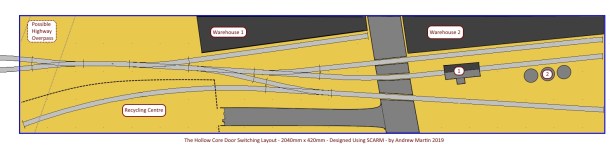
Here’s a reminder of the version I was working to when I began setting down track today:

Image 1: The original track plan (version 4)

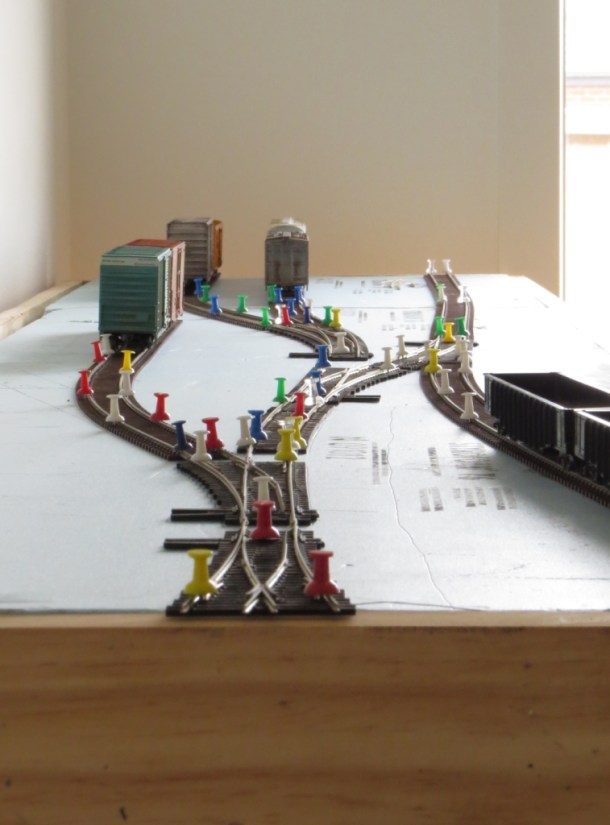
The basic layout design and the track layout are very close. I was happy with the original design on paper (and screen). In the flesh however, it was ‘off’, just not quite right (NQR). So out came some cars, and a couple of extra switches and away we went. I like the more organic look of the track formation now. It is pleasing to the eye, and the camera (see Image 2 below).

Image 2: An overview of the layout design modifications

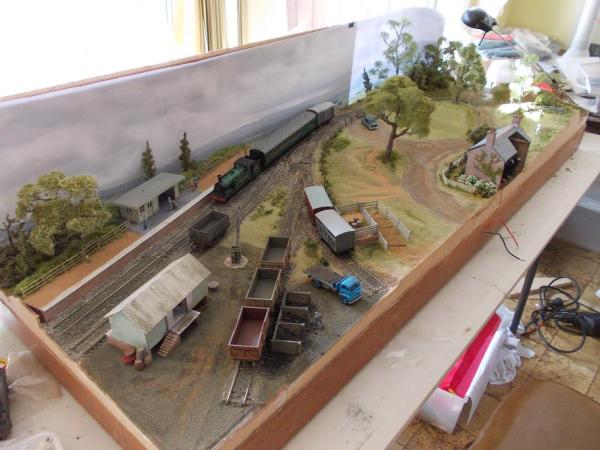
There’s enough straight lines about this layout (baseboard and the two warehouses – the two spurs at back left). To ensure that the viewer would not be overwhelmed by that I decided to change the 4th turnout from the straight in the plan to a curved turnout. That change to the geometry has created what is now a serpentine look to the layout. By ensuring that the trackwork is ‘going in all directions’ provides a ‘real’ feel to it all. And that pleases me very much.

Image 3: A lower shot showing the organic flow of the track arrangement

So much for a short update! I’ll be posting over the weekend in regard to the layout board and legs; as both are a new way to work for me. All the best. You thoughts and comments are most welcome here and on Facebook. Please share and let me know your thoughts.

Site Seeing – The Little Critter that could edition

It’s not often that you get to see internal (in-plant) company railway operations today. Thankfully “Saginaw Terminal Docks” (Facebook and YouTube) posted a video from Reid Machinery in Lansing, Mi showing how they use old freight cars to store valuable machinery on their site prior to sale.


Reid Machinery’s internal railroad

Reid Machinery Inc of Lansing Michigan have specialised in moving machinery, primarily in the forging industry, throughout North America since 1992. And while that may not seem like the most worthy thing to write about on the third Tuesday in July – I urge you to hang around a moment longer. You see they also hold their large (as in big – not lots of) inventory on and in their own railroad assets.

Yes – they have their own switching layout.

Thanks to Saginaw Terminal Docks we have a front row seat, and a cab ride on one of these switching moves. I asked him about connections to the rest of the world. He tells me that the in-plant line connects to the JAIL/Adrian & Blissfield on over a mile of old track through Lansing’s south side.

And this is so modellable…


YouTube video

Some of the things to watch out for in the video are:

  • The three person crew (Engineer, conductor, and digger – and yes it’s a guy with  a shovel)
  • Slow switching speeds
  • At around the 18 minute mark – opening the boxcar door with the forklift forks (we often model the result but the actual operation is rarely filmed)

So sit back, turn up the volume and enjoy the show.


Resources

Site Seeing – the “I love the Yard” edition

Imagine an industrial 7mm narrow and standard gauge model railway with radio controlled crane and lorries. Then look at a great video and see it in action.


The Yard

Built by a group of four during a three-month period for a club exhibition. This layout is in 7mm scale and uses both 16.5mm (3.5mm HO standard gauge) and 32mm (7mm O scale gauge) track. Scenic area is only 2’2” x 6’, with an overall size of 2’2” x 9’ including fiddle yard.

Of particular note are the working features of the layout including:

  • standard and narrow gauge trains
  • working gantry crane, and
  • radio controlled lorries

The gantry crane had apparently been on another layout and manually controlled. When moved to the yard it was converted to radio control. The lorries, which I believe are the work of Mr Giles Favell, (see the resources section below for more) were in use on other layouts. The rolling stock came from other layouts also.

Control of trains is by DCC, while point control uses MERG canbus.


Resources

See more about the wonders of Giles Favell’s radio control 7mm scale lorries and his layouts at:

Site seeing – the Second Hand Inglenook edition – September 20, 2018

I admire modellers who can get to the meat of a project, quickly and with vigour. Gazmanjack (Gary) on RMWeb used second-hand track, wood and other parts from his modelling left-overs to create a stunningly good small layout for operations. Read on for more.


Linden Ford – the second-hand layout

Gazmanjack (his handle on RMWeb) back in 2014 built an outstanding layout from left over bits and pieces, as an adjunct to his current layout, to give himself something to operate on during the other layout’s longer build. I’ve only just found it and wanted to share the forum post with you.

And what a cracker this layout is. I won’t go into too much detail here, as I think the adage of a picture telling a thousand words is true on this occasion. There is plenty of information in the post too on the build including scenery, tree armatures, and so on.

Image 1: Linden Ford – an outstanding small Inglenook layout

I hope that you find inspiration in the post. So much with so little that turned out so well. Well done Gary!


Resources

Site Seeing – August 7 – Master class: Operating Session

A recent post on the Model Railroad Hobbyist site by Tim Garland and the associated video (see below) shows the realism and enjoyment that can be achieved by operators with little cost beyond the time to set up and the time to operate.

What I enjoyed most out of this operating session video was the way that both Tim (who works as an Engineer for NS) and Tom Klimoski (the layout owner) work together as a team to get the ‘work’ done in a professional way, without hassle, in a small layout space, all the time working the layout to get the switching work done. Better was the way that you cannot see the engineer (Tom in this case) only the conductor on the ground working the cars into place.

Watch the video below and share your thoughts here or on Facebook.

At the Recent Ballarat Model Railway show (June 2017) I managed to catch up with a long time railway mate and his layout. When I saw this video I forwarded it onto Neil as a teaching tool to help him get operations going on his own layout. I think that what Tom Klimoski has recorded is the gold standard for small layout operations. It shows how (and I’m guessing on time) over a shorter operating session two people can work and have a lot of fun switching. Maximising the usefulness of a small layout by following the rules as set out, and by opening and closing gates, calling out the moves, and so on makes such a difference. I hope that you enjoy the video as much as I did.

Additionally there is a great post by Tim going on over at the MRH site about this video. Click the link at the top of the post for more. Lots of really good stuff in that post for the operator as well.

Site update – 20 March – Updated 12 foot home layout design page

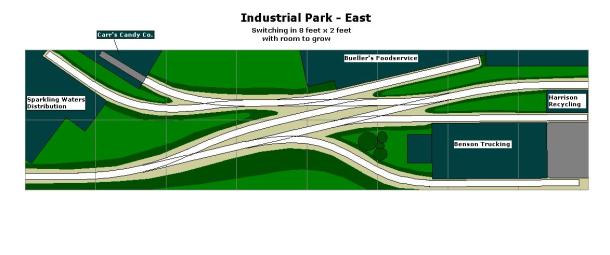
There has been a lot of thoughtful experimentation going on at Andrew’s Trains of late. While I was ‘reasonably happy’ with my Mk 72 layout design I wasn’t joyous about it. Recently while rediscovering some of my older layout designs I came across the design for ‘Industrial Park East’, as shown below, from somewhere about 2006-7.‘. Something in this design called out to me and so I set off on a slight redesign from the Mk 72 to Mk73 version. The changes I made have allowed me to get the ‘flow’, and the look that I wanted. I know this all sounds like something ‘the Dude’ would say from the Big Lebowski at this point but if it doesn’t work for you while you’re designing it, then it sure won’t work for you once you’ve committed track to plywood.

There’s a lot more information on the what, the why and the wherefore on the additional layout design page (yes I added another one to keep it all straight in my head). If your interest is peaked and you’d like to see more click the link in the line above and head on over to read on.

Thanks for reading – now it’s back to your regularly scheduled programming.

Site Seeing – March 18 – The ‘other’ Glendale freight layout edition

It’s been a while since my last post and that is thankfully due to being fully employed for the first time in two and a half years. A full-time job is a very satisfying thing. But I digress.

As I wrote in my March 6th post I’ve worked up another idea for the Glendale Freight layout. Let me say from the outset, that this is not one of my better ideas; especially after seeing Bruce Petty’s original layout. There’s merit in the ideas expressed in the design certainly – it just doesn’t have that vibe going on as Bruce’s layout does in spades. Before I go on to tear my work apart let’s take a look at a 1/12th scale model and why I find them so useful for designing a layout.

So what’s wrong with this layout idea?

  • Firstly the central theme of the design is not the freight station, it is the entrance from staging onto the layout.
  • I wanted to have the train enter through a portal of buildings, cross the street and then go about its business. It’s a pretty skimpy idea right? There’s no meat on the bones though.
  • Why this means to enter onto the layout instead of some other way? Is there some missing story about this means of entrance; did the city grow up around the freight station for example? But isn’t this supposed to be Glendale CA, right? Well, is it?

The layout is overall 8 feet long (2400mm) and each square is 12 x 12 inches (300 x 300 mm). It is 2 feet (600mm) wide. And it’s very linear.

So what would I do different now that I’ve built this mini layout?

  1. Angle the entrance onto the layout,
  2. Angle the buildings and the street to the long axis of the layout,
  3. Cluster the switches near the end of the run around, and finally
  4. I’d make a transition between the industrial area on ‘main street’ at the entrance end and the other end of the layout – making it more suburban

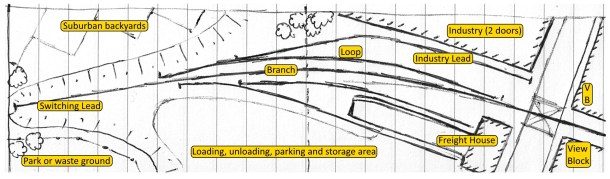
And having had a while to think on how I’d make those changes here’s a rough drawing of the layout that ‘could’ spring from this thought experiment.

This design has gravitas. It is the last bastion of railroading in the inner city, and the edge of the suburbs. Sure there are some strange curves, and I’d rework the industry lead and the industry back wall too. But it is much more interesting and tells much more of a story than the first layout.

This layout could be setup as is with the industries, it could be modified for a single industry layout (say an industrial workplace such as a foundry), or it could be something that I’ve not considered and that you already have swimming around in that pool of ideas in your head. As an aside, I videoed the first layout build process. If interested in seeing that video let me know in the comments and I’ll post it here over the next week or so.

Site seeing – March 06 – Bruce Petty’s Glendale Freight house Module Redux edition

In a post on January 18, 2017 I made mention of Bruce Petty’s excellent module of the end of the Union Pacific’s Glendale Branch and the freight station located there. Bruce’s Module is 5 feet (1500mm) x 18 inches (450mm) but to my eye looks much bigger because of the great use of the space he has made. There is no crowding, no feeling of busyness, only the feeling of a warm summers afternoon in Los Angeles sometime during the 1960s or 1970s. This small scene is evocative and places you immediately in the place and time, even if that is coloured by your chosen time period.

The majority of my layout designs fit into an 8 foot space Bruce’s layout module with the addition of a 3 foot fiddle yard fits right in the space available and would make an excellent display or exhibition layout. More importantly it would fit with any time period from the late 1940s – early 1950s (when I believe that the freight house was built) through to the mid to late 1980s when I believe the freight house fell out of use.

As I said in the previous post I’ve pondered over how to use Bruce’s track plan in other ways. I’ve even worked the design up into a 1/12th scale model to see how it might work. I’ll come back to the alternative in my next post; for now let’s revisit Bruce’s excellent module.

A closer look at Bruce’s module

While this module is a part of Bruce’s larger railroad forming the end of the UP’s Glendale branch it can also stand alone as a layout in its own right. At its heart it is an Inglenook layout. Each of the freight house roads can take two 40 foot boxcars against the dock. For those of you interested in modelling this layout at a later stage it is highly likely that the Freight station never hosted more than 2 x 50 foot boxcars at any one time. If it did so then they would be placed on the right most track with the second car either unloaded directly into trucks as shown in Photo 1 above or set off spot on the left most track and switched out once a suitable space was available at the dock. Lots of switching possibilities here.

Of particular note in the photo above is the connecting piece to the rest of the layout. I like this little yet important touch. The wooden insert which allows the module to join the layout has been disguised as a typical UP/SP bridge. Very smart and ensures that the layout and the module appear to be a single whole and not something that Bruce built later on.

Operation

Operations on this layout would be pretty good too. As we’ve discussed before on the blog Inglenooks are completely prototypical and often used by railroads in tight places. Operating with a locomotive pushing in – pulling out switching focuses on the industry or industries served. The longest track on Bruce’s layout I would use as my switching storage and sorting track. The incoming train pulling outbound cars before spotting them on the long track. Cars would then be switched according to requirement on the remaining two car tracks at the docks. Any cars from those pulled needing to be spotted back at the dock could then be spotted before the locomotive crew pick up the remaining outbound cars and head back across the bridge and back to the yard. And here endeth the session.

Short, clear, easy to achieve, enjoyable and within the 30 minutes to 1 hour per day play time that a small layout should give you. Whether you use a single person (driver/engineer only) or two person (driver/engineer and conductor) crew to do the work the time taken will remain roughly the same. I prefer a two person crew simply because it makes the play time more fun when family or friends get involved.

Hope that this revisit has been of some use. If you like the blog don’t forget to Like and Subscribe. PLease comment if you are looking for more information on layout designs or on the designs I’ve previously posted. And of course take the time to visit the “further reading and resources” links below.

Further Reading and Resources