Back in August I showcased the work of Martin Wellberg, from Borne in the Netherlands. He’s back after working on another set of large models. On to the visual feast.
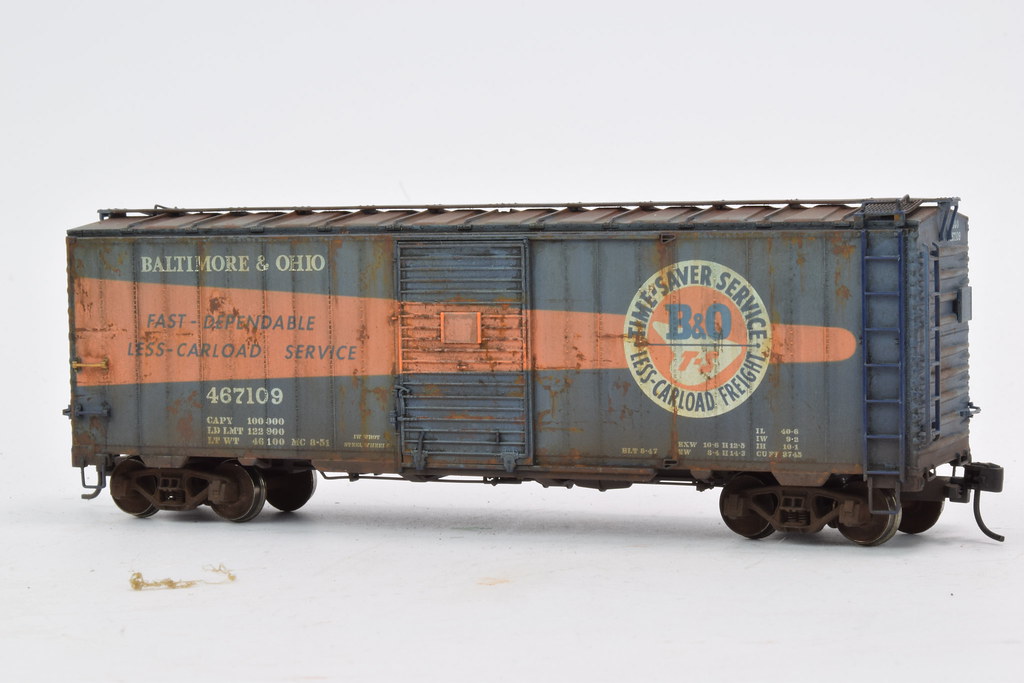
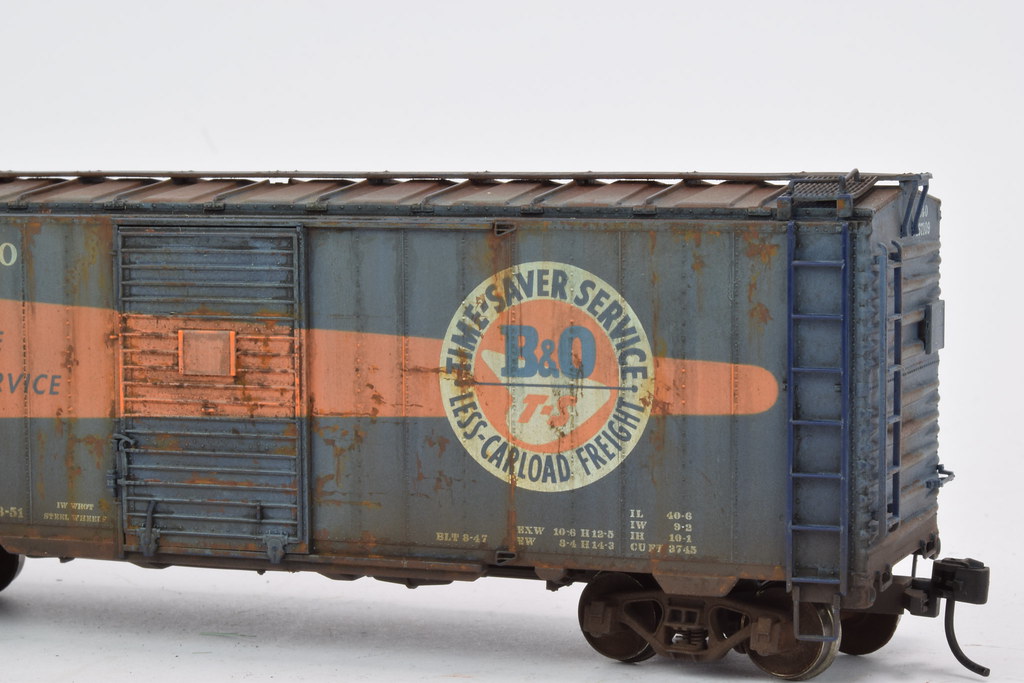
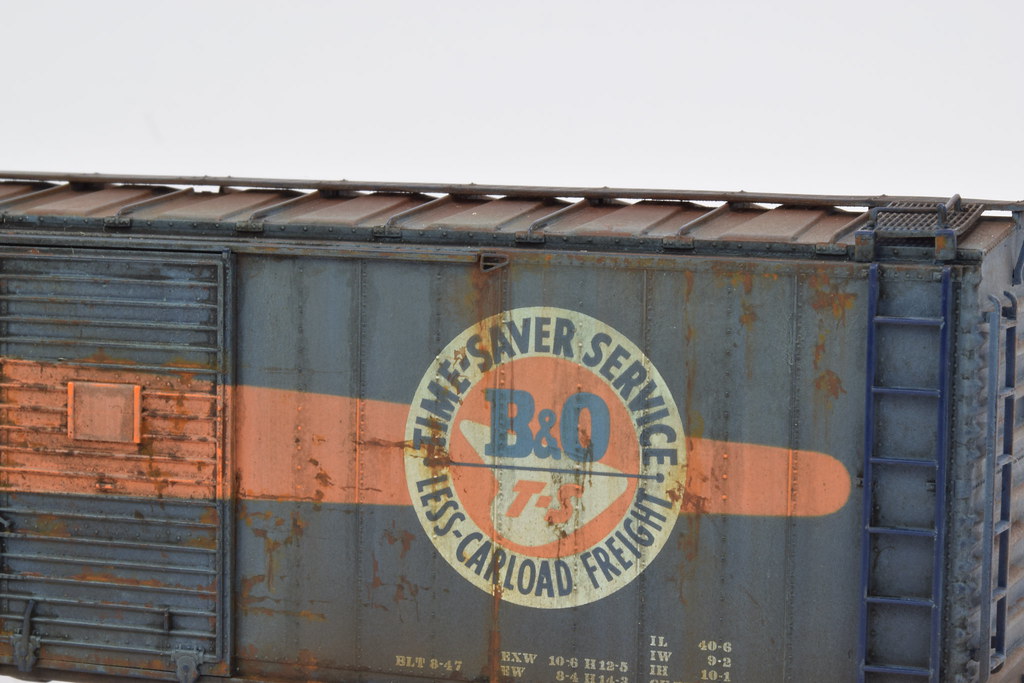
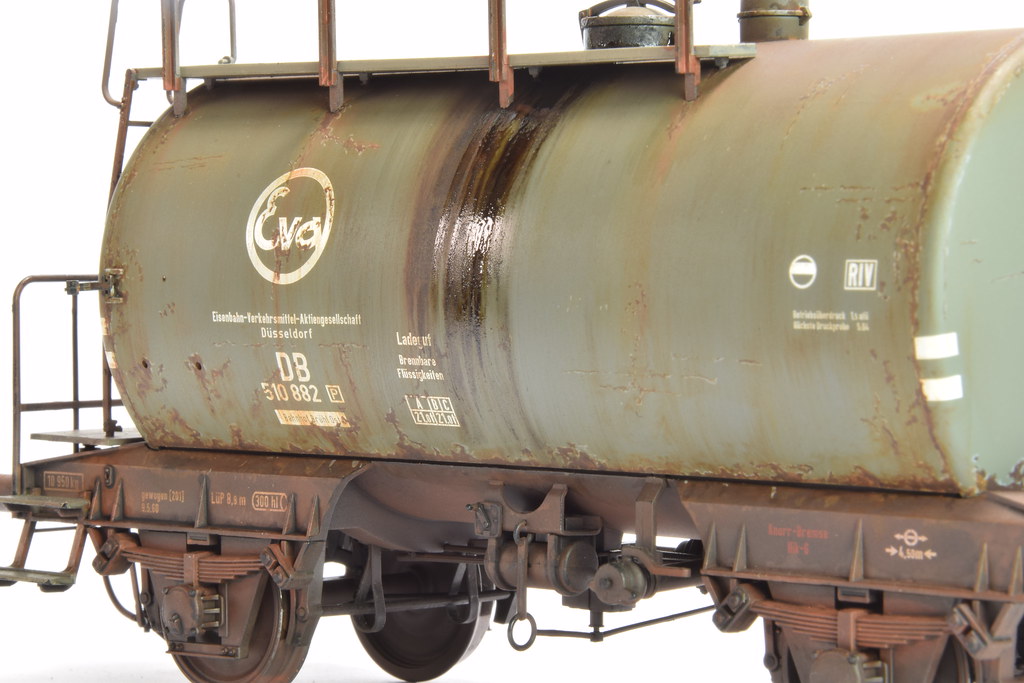
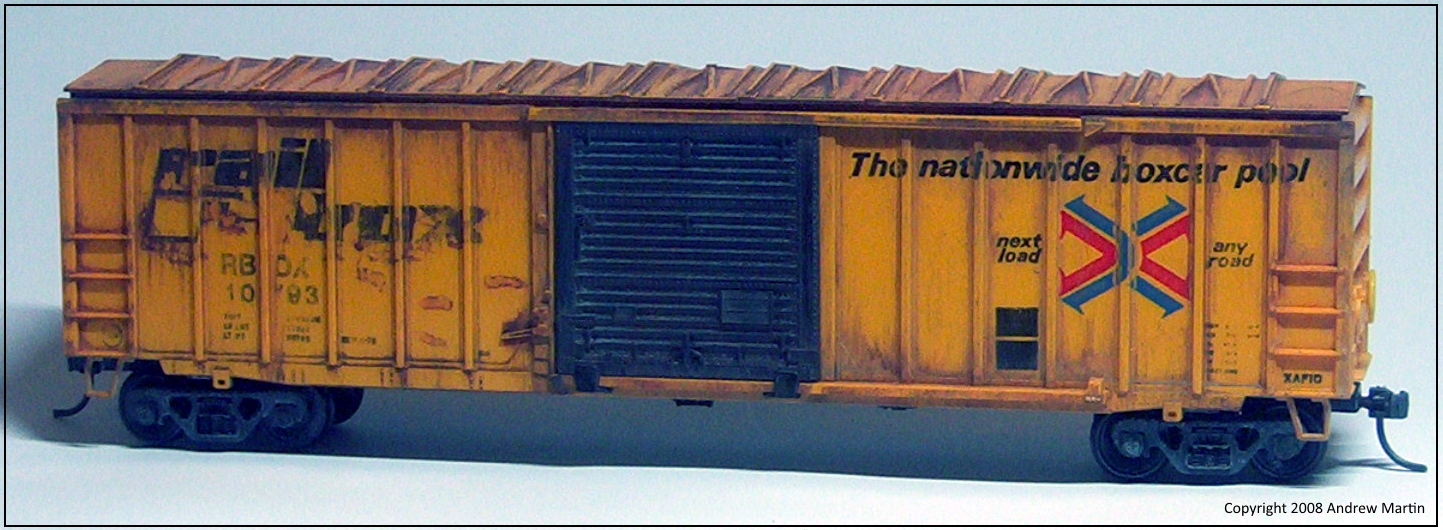
I’m not going to write too much about this, this is entirely weathered train porn, it’s that simple. First let’s look over Martin’s HO Scale B&O Boxcar:
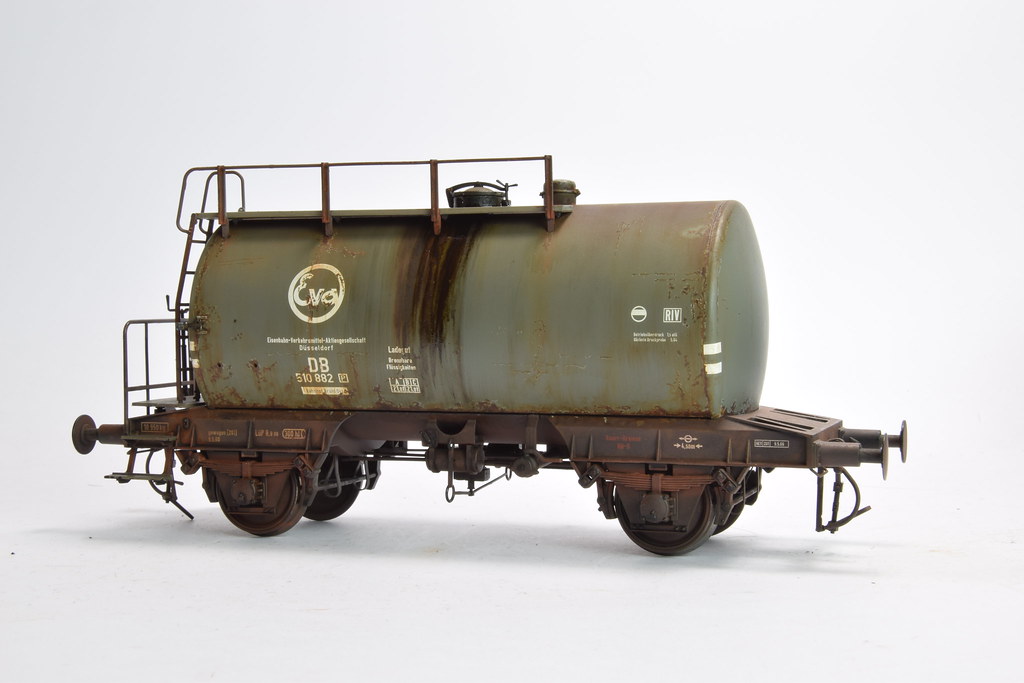
Second let’s take a look at what I consider to be the best weathered freight car I’ve seen:
Hope that you enjoyed these images. Thanks go out to Martin for being so willing to share his work.
Site 1: Loading a boxcar with broken down loading bins
If you’ve ever wondered what a load should look like inside a boxcar (I know that this is specific to this particular load – but I am certain that I can make up some realistic looking loads using these principles) then watch the video below; it is fascinating.
No longer should you boxcar doors open with nothing inside of them. I’ve gotten some ideas out of this one for a small project.
I love the size, and the presence that O scale models have. While cruising around on the MRH forum the other day I came across the blog of Jack from France (SVJRR) whose modelling is just outstanding. And so onto today’s site.
Image 1: Jack’s completed rebuild and respray of the Atlas/Roco 1970s Boxcar
Jack, whose English is very good for those who might be worried, steps you through a tutorial on how he updated some of the 1970’s Atlas O Scale cars (actually made by Roco in Europe) into modern-day equivalents.
As I have around 10 of these cars sitting quietly in my stash his tutorial came about at exactly the right time. The work is simple (and not surprisingly mirrors the work I am doing on the Gondola build at the moment.
I know that the cars are not exact matches for specific prototypes, although they are very close, but they allow you to get up and running quickly with little effort beyond grabs, steps and a repaint.
Part 1 – No plan survives first contact with the enemy
It has been some time since I’ve had the funds or the time really to do much of anything in the modelling realm.
I’ve simply not had the funds to bring a lot of the work I’ve had underway forward to completion. Thanks to the Taxman and a payout due to being laid off, I’ve been able to order some extra parts to complete most of my Railbox cars.
The most important of all the parts has been a set of Microscale decals.
I ordered these from Microscale in the US and very quickly in the post I received 3 packets of Microscale (87-1291) HO scale RBOX & ABOX decals. Microscale’s service was fast and excellent after ordering directly from their website. They decal two cars of each type and come with all the car data you need for the cars.
I have a lot of these cars to re-work; at last count I believe about there were 10 in total. I have enough to cover 6 cars for now. With my layout that I’m building (currently set in 1978) there’s latitude for the Hunter Valley to have bought some similar per diem boxcars. These cars I’ll complete last as I have to produce or manufacture my own decals for them.
Updating the Athearn Blue Box model
The Athearn model is, except for the roof pattern used, correct for the XAF10 series cars. The kit does not have the detail that modern-day kits come with as standard, but they were only $7.50 when I bought them and even after the upgrade process will top out in real dollar terms at less than I can buy the newer models for now. To keep the costs down I’m making most of the add-on parts. To be fair I love scratch building. It has always been my favourite part of the hobby.
Let me say this before the rivet counters jump in: I know that the roof panels on these cars are wrong, I can live with that. At the height above the floor the new layout will be, they really won’t be all that obvious,even if they may be easy to see.
When money is tight these simple upgrades make all the difference. What other issues remain I can live with. There are some issues though that I just cannot live with. In order of descending importance they are:
Trucks – I replace these on all of my Blue-Box cars. In this case they’ll be the 70 ton roller bearing trucks (fully equalised) by Kadee. I love these trucks, and with proper weighting they run like a dream floating along and bending to the poor track of the HVL (we are a ribbon in the weeds kind of Shortline you know). At around A$15.00 per pair they are not cheap, but they work so well I’ll eventually fit them on my entire fleet as I can afford to.
The body side the grab irons just irk the hell out of me; moulded onto the body side and just begging to be milled and replaced with brass wire – the image below shows the experimental car with these.modifications. While the grab-irons on this model look over sized I am certain that once they’re painted they’ll stand out a lot less. If they don’t then I’ve since sourced some really fine brass, and if they aren’t fine enough I can always get some fine copper wire, tin it and then fit them for prototypical accuracy
The stirrups on the car ends are OK, but I can do better using brass wire, brass strip or as shown in the image above good old-fashioned staples (which have proven to look great but will need to be drilled, glued and then have NBW castings glued through them and into the body to stay on – every one of them has been knocked off – even with careful handling and using the best super glue)
Updated Kadee knuckle couplers (I prefer the #58 which have a much finer head casting). From these I’ll be removing the magnetic glad hand as I do all of my uncoupling with a skewer, and because I’ll be adding air hoses and glad hands (these magnetic units which look really great as you can see in the YouTube video below. They are now available from P.W.R.S. at: http://www.pacific-western-rail.com)
Remember how I said no plan survives first contact?
If I were a purist, or a glutton for punishment, I could rework the car ends. There is much that could be done by milling the ends and cleaning everything up and starting again. I just can’t be bothered. The ends are good enough, and because they’ll be in between other cars, and generally not focused on I’m not going to worry.
The coupler box used on the model is wider that the real one used on the real car, but again, this is between the cars during normal operation and really, I just don’t think it matters. I’ll live with it.
In part 2 I’ll provide a historical context to the build, and then in part 3 I’ll move on to reworking the basic car into something better for your railroad, and mine.
The forty-foot, 70-ton, Hi-Cube boxcars were built in the mid-1960s specifically for high volume, low weight cargo and were most often used in captive service between appliance manufacturers and distributors. They occasionally branched out into furniture and paper loads. Manufactured by Pacific Car and Foundry and Pullman-Standard, ultimately, their small size and the load limitations this imposed saw them leave the rails in a relatively short time. Other larger boxcars from around the same era continued to ride the rails when this article was written (Editor’s note: August 10, 2010).
The forty-footers were a stop-gap car, never meant to have a long life. They provided shippers and receivers with a means to utilise their existing dock and door spacing for 40-foot cars while allowing double-layer (vertical) loading of refrigerators and freezers. From an economic perspective, this was a win-win. With less money spent on new boxcars and upgrades of current boxcars than would have been required on new facilities, doubling the number of refrigerator and freezer units shipped per car made economic sense.
US appliance companies such as Amana, Maytag, Whirlpool and others would, within a decade, begin upgrading their manufacturing facilities and receiving warehouses as older ones were closed or rebuilt. As a result of these upgrades, 60ft High-Cubes, which could haul a vastly larger load, became the norm. However, there is photographic evidence of the cars riding the rails until at least the beginning of August 1984. I have seen photos showing one of the cars in revenue use in the early 2000s. Some served in paper service and maintenance-of-way (MoW) before retirement and eventual scrapping. Sadly, none to my knowledge exist in railroad museum collections.
Southern Pacific and Cotton Belt B-70-36 Box Cars
My primary interest is in Southern Pacific (SP) and Cotton Belt (SSW) hi-cube box cars, which were all built to the same design by Pacific Car & Foundry in 1966 and 1967, featuring a 5001 cubic foot capacity, Hydra-Cushion underframes and 10′-6″ Youngstown sliding doors. These cars came to be nicknamed the “Ugly Ducklings” due to their awkward appearance.
Intended for captive appliance service, their internal dimensions were 40′-6″ long, 9’ 6” wide and 13’ high. This allowed double stacking of freezers, allowing greater loads than regular boxcars. Until their introduction, the second layer of freezers was laid on their sides. This led to problems with damage to the second layer from train handling.
Externally, the cars had an overall coupled length of 45’ 5”, a maximum width of 10’ 8” and stood at their highest 16’ 10” above the rail height. It should be noted that the 1969 ORER shows the 11 SP cars one inch higher at 16’ 11”. A roster of the class B-70-36 Hi-Cube box cars for the Southern Pacific (SP) and the St Louis Southwestern (SSW) or Cotton Belt is provided in Table 1 below:
Road Number Range Number Load Specific Data [1]
——————————————————————-
SP 659100-659111 12 DF-B loaders
SSW 36014–36026 13 DF, DF-B, Car Pac loaders
SSW 36027–36081 54 As Above
SSW 36082–36120 39 As Above
SSW 36121-36126 6 As Above
Total Cars: 124
Table 1: Southern Pacific Railway System 40’ High-Cube data
NOTE: The Cotton Belt had another set of Hi-Cube cars (SSW 36000-36013) not covered by this article. These were rebuilt from cars in the SSW 33850-33949 series built by Pullman-Standard in 1951. Their roofs were raised and they were given new 10′-6″ wide by 11′-9″ tall doors. These cars were converted at Pine Bluff between December 1965 and January 1966 [2].
Operationally, the Cotton Belt (SSW) had the lion’s share of these 40-foot cars. It would appear that they were delivered in four different lots during 1966 and into 1967 that, while consecutively numbered, were given different listings in the ORERs of the time.
Modelling the 40-foot Hi-Cube
NOTE: It should be noted that these cars were few in number and in captive service between the major white-goods manufacturers and the regional distribution locations.
Built from the mid to late 1960’s they appear to have all been off the roster, or in MOW service (thus out of white-goods revenue service) by the late-1980s. recent research has shown that some went into furnitures and paper service.
Having said all of that, if you love these cars as much as I do, for a small layout or just want to have a few on your layout, the details below will be of assistance to you.
Athearn
The cars manufactured by Pacific Car and Foundry for Southern Pacific (SP) and the Cotton Belt (SSW) match the Athearn exterior-post model. (#1950 40′ Ob Hi-Cube Box Car – PC&F for SP 659100-659111; SSW series 36014-36126, both class B-70-36) fairly closely
The UP’s home-built car, which was not covered in this article, closely matches the Athearn plug-door model; these also match the rebuilt cars of the SP. (#1960 40′ Plug Door Hi-Cube Box Car – UP class B-50-4 appliance car)
Bibliography
This data was sourced from the January 1969 Official Railway Equipment Register.




 Andrew's Trains