Site seeing – January 30 – The PowerPoint and PDF edition

Edward Traxler is someone I’ve read about for a while. Only recently did I visit his website. Where I found today’s interesting set of resources.

Site 1: Edward Traxler’s The Deep River Railroad – PDFs and PPTs page

It’s just what the name says folks. A few really good clinic presentations and PDF files for building all sorts of interesting things. Plans for loading ramps, piers, and links to other resources for the interested.

Site 2 – as for site 1 – Building cardstock models the modern way

Also on Edwards site is a great tutorial on building using cardstock (thicker grades of paper). Both a PDF and PPT file are available for download and there is an overview on the page in the link above also.

Site seeing – January 27 – The ‘times they are a changing’ edition

I received an email from Shawn Branstetter earlier this week announcing that his site http://shortlinemodelers.com/ would be closing down very shortly. I was, to say the least devastated. Shawn’s site is a treasure trove of useful articles and ideas.

I contacted Shawn for comment and post it here in its entirety: “Unfortunately it is true Andrew. I’m not exactly sure what I’m going to do with the content however, the Facebook page will remain active. Whiteriver Productions has expressed interest in hosting the content and I don’t want the name to go away I just don’t have time to be a developer, writer, very poor editor and illustrator by myself and find time to build. It’s just too much. Somehow I will make sure all content is available to everyone. As soon as I figure that out, I’ll let you know.”

Site 1: Get it before it is gone – Shortline Modelers

Go see it and grab anything you can now. Not sure how long this will remain available or where it may move to. Check out his cement modelling articles – they are outstanding.

Site 2: Shortline Modelers on Facebook

Head on over to the Facebook page and follow him there if you have a Facebook account. This will keep you in touch with Shawn for the future.

Site update – January 21 – No you don’t need an optometrist visit

In my last post the photos that I uploaded seemed to behave poorly once uploaded through WP.

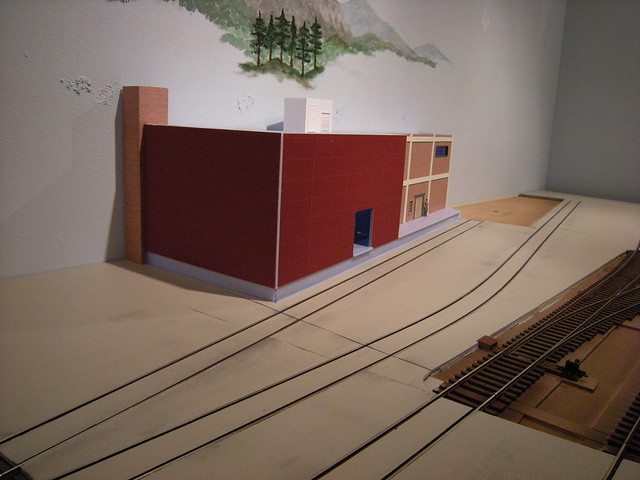
An overall view of the module

I’ve reworked them all in Paint.NET and uploaded a new set.

I’ve just checked the newer versions and these appear to be better. Sorry for any inconvenience, or for any unnecessary trips to the optometrist.

Andrew

Site seeing – January 18 – the ‘Perfect Storm’ but in a good way edition

I’ve had an idea for a small layout, running around the mouse wheel that I use for a brain, for a while now. What kicked the idea off was a 2013 plan published in the Model Railroader for the Glendale Freight House that Union Pacific built there during what I ‘believe’ was the early 1950s. Bruce Petty has already built a layout based on the real location and using the UP freight house in Glendale. Let’s take a look at that first to see where we start from.

Site 1: The Union Pacific freight station drawings

Step one of this plan is to get a copy of the plans. They are available for logged in users on the MR site by clicking the link above.

Modellers in HO scale will need to enlarge the drawing substantially (which is doable at a local copy store)to be able to build directly off the drawing.

Big thanks to my next site owner for the idea about doing that. He uses the protective sleeves (clear plastic ones) to build on.

The model once completed using liquid polystyrene cement does not stick to these plastic sleeves and Bruce simply lifts the completed side of the model off the sleeve. Plan protected, model free, what’s not to like about that? I just wish I’d thought of that all these many years later. I did mention that I have a mouse driving the wheel that powers the mental machinery, right?

Site 2: Bruce Petty’s LA River Railroads site

Bruce’s website is a trove of information on the railroads of LA. His layout looks fantastic too. Of most interest to me was his article on the Glendale freight house build which you access from the link above. Well worth reading the entire page and taking in the method of building it. Clever, clever man!

This building rests on his Glendale module. When speaking to him via email earlier this week he told me: “… the modules for my layout are 18 inches wide and 5 feet long. If I ever move the layout goes with me easily taken down. All structures
and small detail parts come off the layout. On the Glendale module only the loading dock stays as it is concrete. No big deal to take this module down off the shelf brackets, it’s the end of the UP Glendale Branch.

Essentially the layout is an Inglenook (and exactly as the original). Bruce says that just like the original “… it gets switching crews from Southern Pacific and Union pacific. It’s a fun module to switch on and I can take it to shows.” What more do you need?

In the next post I’ll be taking a look at how I’d like to model this location as a stand alone layout. I’ll be taking a slightly different tack to Bruce’s excellent representation. I’ve been thinking about using an interesting technique to cover off the gaping hole in the wall exit to the fiddle yard that ought to work perfectly for this design; and all in 8 feet.

Additional resources:

Bruce has kindly provided me with images of the layout module. My thanks to Bruce for his kindness in being so willing in talking to a stranger and being willing to take photos of his layout especially for me to share with you.

All included images above are copyright of the creator and author: Bruce Petty. Used with permission on Andrew’s Trains.

Site seeing January 16 – The Bart Van Doorn edition

Back in very late December 2015 I showcased Bart’s then pretty new O (1/48th) scale layout – 33rd Street. It’s been just over 12 months and he’s been making improvements the entire time. And they’re very, very good improvements.

That was then:

DSCN4104

This is now:

33 Street yard at night fall

Image 1: Bart’s eye candy

See what I mean?

Site 1: Bart’s flickr stream

Click over to Bart’s flickr site and get acquainted with his work. Some really good stuff here for the model builder, especially those of us bitten by the O scale bug to see what can be achieved in a relatively small space.

In addition since I last visited his site he’s extended the track plan somewhat giving himself more room to play in. Enjoy and keep a watch on his stream. He updates his images fairly regularly.

Site 2: Bart’s YouTube page has updates too

This is just one of his posted videos. There are more available after the jump -just click the YouTube logo to go to Bart’s YT page.

Take a look around and enjoy. It’s a great idea for a layout in any scale. Looking forward to giving his street light a go.

Site seeing – January 15 – the too dirty may not be dirty enough edition

In the past I’ve seen a lot of weathering done that I said was too heavy, unrealistic. Something that you’d never see in the wild. Today I reviewed one of Adrian Nicholls photos on his photostream on flickr.

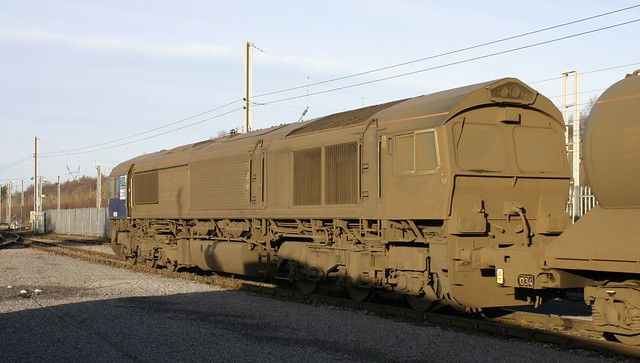
Dirty Diesel Season. 66 301 at Kingmoor TMD.Image courtesy Adrian Nicholls – via flickr

I take it all back. Adrian says on the site: “66 301 catches the late afternoon sunshine at Carlisle Kingmoor TMD after its 21 hour diagram on train 3J11 the North West RHTT circuit, (17.15 to 14.05). The loco has just been fuelled and is waiting while the water jetter generator and rear loco (66 427) are dealt with. It will then do the whole circuit again hence the accumulation of filth on the locomotive as there is little depot down time on this circuit for cleaning. Never a very pleasant time of the year to deal with locos in such a condition as what every you touch is covered in filth off the track and a drivers railway uniform can soon resemble a fitters overalls if you are not careful.

I guess you really have to model from the prototype. I would never have thought of making a locomotive this filthy. But there you have it.

The year that was, the year coming

A very big thank you to all of you this year for reading and taking part at Andrew’s Trains. I’ve not been able to achieve all of my goals for the site, however I’m pleased to have achieved what I have. There’s only me at the other end of the keyboard, no production team, no writers, designers or PR people swilling champagne (thankfully). Just me.

I’ve already prioritised projects for 2017. Among them are:

  • A smaller HO scale layout (for use inside the house and on the Australian exhibition circuit
  • A re-purposing of the 3 4′ x 2′ boards in the garage to an O scale layout specifically for exhibition (and the occasional playing session at home when the weather is nice, and
  • Completion of all the outstanding model building articles

None of these are in any specific order, they are on my hit list.

It’s been a good year

It’s been a good year for me on Andrew’s Trains. I’ve managed to more than double visitor numbers and page views. And that is very pleasing. While the year’s final numbers are not in, just yet, I’ve already reached my personal goals for this site in 2016 calendar year.

What I’d like to focus on during 2017

I have some woodworking projects to complete this year. I need to finish the design of my exhibition saw-horse stands and make a couple of test units to prove the concept. Then there’ll be more wood working for the book shelves in the house where the new HO scale layout will live inside the house (where it’s warm, and nice during Ballarat winters). And from where I can run my fun sessions with the family when we feel the mood take us.

Track laying in O scale will be the next thing to learn. It’s something that I’ve wanted to learn for a very long time. Now I’m finally brave enough to give this a go.

Finally, all the best to you for the year ahead. I hope that you have an enjoyable, fulfilling and worthwhile year. I’m aiming to live the hell out of 2017. See you their next year.

Site update – December 12, 2016 – Weathering page additions

I’ve had a lot of fun weathering cars this month. I’ve photographed as I’ve gone along and added pages for diesel era weathering of freight cars. This is because I do not model the steam era. There’ll be additional content uploaded as I go through the month. In addition I’ll be making videos for all parts of the process on the next piece of work using the multi-media weathering techniques outlined.

To get started head up to the menu and look for Modelling Articles > Weathering > Multi-Media Weathering. There are two pages completed and these are the:

I hope you enjoy the articles. If you have any questions post a comment on the page. I’ll get back in touch with you pronto.

Site seeing – December 7 2016 – Aussie Streamliners in Action

Goulburn NSW, once a major service centre for trains on the main southern line into and out of Victoria, played host to another type of rail event in early October: Streamliners 2016.


Image courtesy John C Benson

It was a big deal with a whole gaggle of locomotives coming in from all over Australia to celebrate 65 years of active service of the Streamliners on Australia rails. You can also visit the Facebook page for more images and information. What happened after the event though is just as important.

On December 2 this year Southern Shorthaul Railroad train 4578S departed Northern Power Station at Port Augusta South Australia heading for New South Wales. Consisting of 90 empty hoppers formerly used on the Leigh Creek coal train, it was the second of two transfers. Hauling the train were five of the Streamliners from Goulburn (all operated by Southern Shorthaul Railroad:

  • B61 ‘Bernie Baker’,
  • S317,
  • GM27,
  • GM10, and
  • S302.

This video has some great vision and sound of the train departing the power station, being passed by several other trains before approaching and then crossing Mambray Creek. The last scene, between Gladstone and Caltowie, shows the train struggling on the 1 in 80 (1.25%) grade accompanied by the sounds of locos working hard and doing what they’ve done (in regular revenue service) for just on 65 years. Enjoy!

Late Addition: Need more Streamliner love? Follow this link to a YouTube search page for the event. Lots of vision there!

Site update: 02 December – More weathering photos

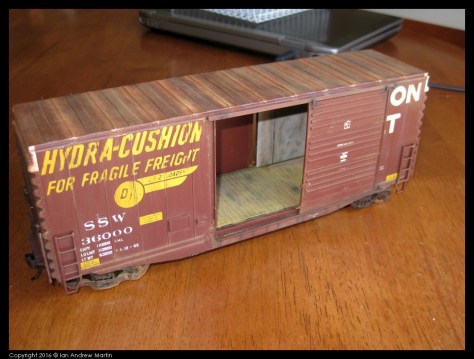
I’ve completed the remaining weathering of the body of the 40 foot Hi-Cube. There may be one or two more minor tweaks that I’ll make to get that just right look, overall I am very happy with this cars look. As an experiment using multiple techniques that I’ve not used altogether before I’m very happy and will try this next on a HO scale car. Where are we up to?

Flash on showing most of the car completed

The second round of body and roof weathering has gone on. Keeping in mind that this car ran mostly in the dryer states and most of that in Texas in my modelling location there is a preponderance of dust and rust and not a lot of rain weathering. I believe that I have another of these cars in my O scale stash and will document the weathering as I go in the next week for all of you.

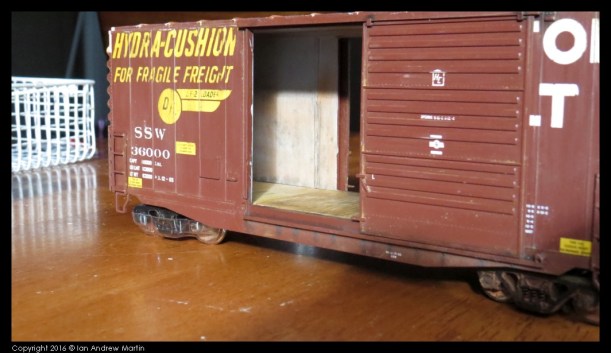
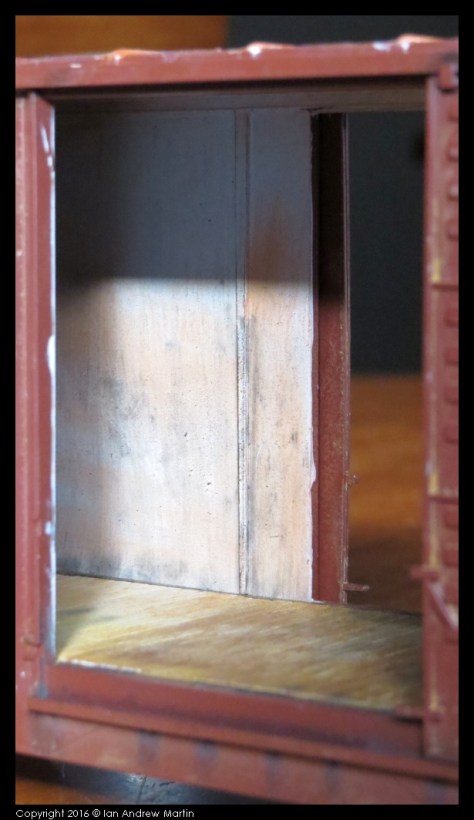
Interior shot showing the walls and weahtering
Interior shot showing the walls and weathering

I am particularly pleased with the internal look of the car. I hand painted the interior since I wanted a little tooth on the interior of the car, adding some Acrylic Painting Medium to the cheapo acrylic paint to thin and help it settle.

Close up of the wall and floor weathering

Minor touch ups to the door openings remain, to add the dings and rusting, prevalent around boxcar doors. Overall I’m pretty happy with the outcome. There are still the trucks to do, but we’re getting close. More again soon.

Small Layouts Designed to Work since 2003

Proto48 Modeler

Proto48 Modelers brings you the best resources, news and information about our hobby.

Leigh Edmonds little box of stuff

Writing History - Making Models - Other Stuff

apassion4books

For people who love to Read & Share

The Model Railway Show

A journey through the hobby, by Trevor Marshall

A Library Companion

It's about the books I'm reading or have just read

roundtree sidings

the development of a model railway