Category Archives: Scales

All scale information

Site Seeing – August 7 – Master class: Operating Session

A recent post on the Model Railroad Hobbyist site by Tim Garland and the associated video (see below) shows the realism and enjoyment that can be achieved by operators with little cost beyond the time to set up and the time to operate.

What I enjoyed most out of this operating session video was the way that both Tim (who works as an Engineer for NS) and Tom Klimoski (the layout owner) work together as a team to get the ‘work’ done in a professional way, without hassle, in a small layout space, all the time working the layout to get the switching work done. Better was the way that you cannot see the engineer (Tom in this case) only the conductor on the ground working the cars into place.

Watch the video below and share your thoughts here or on Facebook.

At the Recent Ballarat Model Railway show (June 2017) I managed to catch up with a long time railway mate and his layout. When I saw this video I forwarded it onto Neil as a teaching tool to help him get operations going on his own layout. I think that what Tom Klimoski has recorded is the gold standard for small layout operations. It shows how (and I’m guessing on time) over a shorter operating session two people can work and have a lot of fun switching. Maximising the usefulness of a small layout by following the rules as set out, and by opening and closing gates, calling out the moves, and so on makes such a difference. I hope that you enjoy the video as much as I did.

Additionally there is a great post by Tim going on over at the MRH site about this video. Click the link at the top of the post for more. Lots of really good stuff in that post for the operator as well.

Site Seeing – March 18 – The ‘other’ Glendale freight layout edition

It’s been a while since my last post and that is thankfully due to being fully employed for the first time in two and a half years. A full-time job is a very satisfying thing. But I digress.

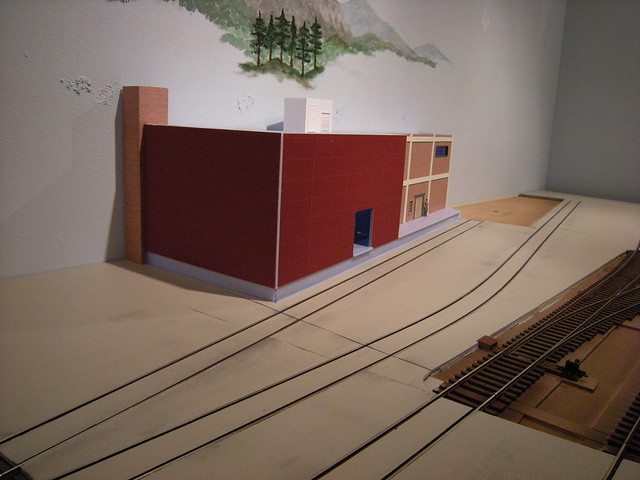
As I wrote in my March 6th post I’ve worked up another idea for the Glendale Freight layout. Let me say from the outset, that this is not one of my better ideas; especially after seeing Bruce Petty’s original layout. There’s merit in the ideas expressed in the design certainly – it just doesn’t have that vibe going on as Bruce’s layout does in spades. Before I go on to tear my work apart let’s take a look at a 1/12th scale model and why I find them so useful for designing a layout.

So what’s wrong with this layout idea?

  • Firstly the central theme of the design is not the freight station, it is the entrance from staging onto the layout.
  • I wanted to have the train enter through a portal of buildings, cross the street and then go about its business. It’s a pretty skimpy idea right? There’s no meat on the bones though.
  • Why this means to enter onto the layout instead of some other way? Is there some missing story about this means of entrance; did the city grow up around the freight station for example? But isn’t this supposed to be Glendale CA, right? Well, is it?

The layout is overall 8 feet long (2400mm) and each square is 12 x 12 inches (300 x 300 mm). It is 2 feet (600mm) wide. And it’s very linear.

So what would I do different now that I’ve built this mini layout?

  1. Angle the entrance onto the layout,
  2. Angle the buildings and the street to the long axis of the layout,
  3. Cluster the switches near the end of the run around, and finally
  4. I’d make a transition between the industrial area on ‘main street’ at the entrance end and the other end of the layout – making it more suburban

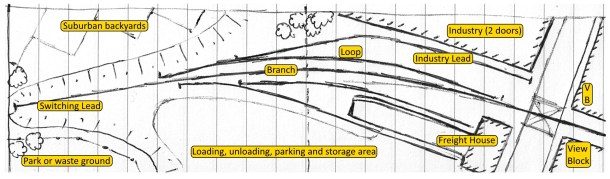
And having had a while to think on how I’d make those changes here’s a rough drawing of the layout that ‘could’ spring from this thought experiment.

This design has gravitas. It is the last bastion of railroading in the inner city, and the edge of the suburbs. Sure there are some strange curves, and I’d rework the industry lead and the industry back wall too. But it is much more interesting and tells much more of a story than the first layout.

This layout could be setup as is with the industries, it could be modified for a single industry layout (say an industrial workplace such as a foundry), or it could be something that I’ve not considered and that you already have swimming around in that pool of ideas in your head. As an aside, I videoed the first layout build process. If interested in seeing that video let me know in the comments and I’ll post it here over the next week or so.

Site seeing – March 06 – Bruce Petty’s Glendale Freight house Module Redux edition

In a post on January 18, 2017 I made mention of Bruce Petty’s excellent module of the end of the Union Pacific’s Glendale Branch and the freight station located there. Bruce’s Module is 5 feet (1500mm) x 18 inches (450mm) but to my eye looks much bigger because of the great use of the space he has made. There is no crowding, no feeling of busyness, only the feeling of a warm summers afternoon in Los Angeles sometime during the 1960s or 1970s. This small scene is evocative and places you immediately in the place and time, even if that is coloured by your chosen time period.

The majority of my layout designs fit into an 8 foot space Bruce’s layout module with the addition of a 3 foot fiddle yard fits right in the space available and would make an excellent display or exhibition layout. More importantly it would fit with any time period from the late 1940s – early 1950s (when I believe that the freight house was built) through to the mid to late 1980s when I believe the freight house fell out of use.

As I said in the previous post I’ve pondered over how to use Bruce’s track plan in other ways. I’ve even worked the design up into a 1/12th scale model to see how it might work. I’ll come back to the alternative in my next post; for now let’s revisit Bruce’s excellent module.

A closer look at Bruce’s module

While this module is a part of Bruce’s larger railroad forming the end of the UP’s Glendale branch it can also stand alone as a layout in its own right. At its heart it is an Inglenook layout. Each of the freight house roads can take two 40 foot boxcars against the dock. For those of you interested in modelling this layout at a later stage it is highly likely that the Freight station never hosted more than 2 x 50 foot boxcars at any one time. If it did so then they would be placed on the right most track with the second car either unloaded directly into trucks as shown in Photo 1 above or set off spot on the left most track and switched out once a suitable space was available at the dock. Lots of switching possibilities here.

Of particular note in the photo above is the connecting piece to the rest of the layout. I like this little yet important touch. The wooden insert which allows the module to join the layout has been disguised as a typical UP/SP bridge. Very smart and ensures that the layout and the module appear to be a single whole and not something that Bruce built later on.

Operation

Operations on this layout would be pretty good too. As we’ve discussed before on the blog Inglenooks are completely prototypical and often used by railroads in tight places. Operating with a locomotive pushing in – pulling out switching focuses on the industry or industries served. The longest track on Bruce’s layout I would use as my switching storage and sorting track. The incoming train pulling outbound cars before spotting them on the long track. Cars would then be switched according to requirement on the remaining two car tracks at the docks. Any cars from those pulled needing to be spotted back at the dock could then be spotted before the locomotive crew pick up the remaining outbound cars and head back across the bridge and back to the yard. And here endeth the session.

Short, clear, easy to achieve, enjoyable and within the 30 minutes to 1 hour per day play time that a small layout should give you. Whether you use a single person (driver/engineer only) or two person (driver/engineer and conductor) crew to do the work the time taken will remain roughly the same. I prefer a two person crew simply because it makes the play time more fun when family or friends get involved.

Hope that this revisit has been of some use. If you like the blog don’t forget to Like and Subscribe. PLease comment if you are looking for more information on layout designs or on the designs I’ve previously posted. And of course take the time to visit the “further reading and resources” links below.

Further Reading and Resources

Site seeing – January 18 – the ‘Perfect Storm’ but in a good way edition

I’ve had an idea for a small layout, running around the mouse wheel that I use for a brain, for a while now. What kicked the idea off was a 2013 plan published in the Model Railroader for the Glendale Freight House that Union Pacific built there during what I ‘believe’ was the early 1950s. Bruce Petty has already built a layout based on the real location and using the UP freight house in Glendale. Let’s take a look at that first to see where we start from.

Site 1: The Union Pacific freight station drawings

Step one of this plan is to get a copy of the plans. They are available for logged in users on the MR site by clicking the link above.

Modellers in HO scale will need to enlarge the drawing substantially (which is doable at a local copy store)to be able to build directly off the drawing.

Big thanks to my next site owner for the idea about doing that. He uses the protective sleeves (clear plastic ones) to build on.

The model once completed using liquid polystyrene cement does not stick to these plastic sleeves and Bruce simply lifts the completed side of the model off the sleeve. Plan protected, model free, what’s not to like about that? I just wish I’d thought of that all these many years later. I did mention that I have a mouse driving the wheel that powers the mental machinery, right?

Site 2: Bruce Petty’s LA River Railroads site

Bruce’s website is a trove of information on the railroads of LA. His layout looks fantastic too. Of most interest to me was his article on the Glendale freight house build which you access from the link above. Well worth reading the entire page and taking in the method of building it. Clever, clever man!

This building rests on his Glendale module. When speaking to him via email earlier this week he told me: “… the modules for my layout are 18 inches wide and 5 feet long. If I ever move the layout goes with me easily taken down. All structures
and small detail parts come off the layout. On the Glendale module only the loading dock stays as it is concrete. No big deal to take this module down off the shelf brackets, it’s the end of the UP Glendale Branch.

Essentially the layout is an Inglenook (and exactly as the original). Bruce says that just like the original “… it gets switching crews from Southern Pacific and Union pacific. It’s a fun module to switch on and I can take it to shows.” What more do you need?

In the next post I’ll be taking a look at how I’d like to model this location as a stand alone layout. I’ll be taking a slightly different tack to Bruce’s excellent representation. I’ve been thinking about using an interesting technique to cover off the gaping hole in the wall exit to the fiddle yard that ought to work perfectly for this design; and all in 8 feet.

Additional resources:

Bruce has kindly provided me with images of the layout module. My thanks to Bruce for his kindness in being so willing in talking to a stranger and being willing to take photos of his layout especially for me to share with you.

All included images above are copyright of the creator and author: Bruce Petty. Used with permission on Andrew’s Trains.

Site seeing January 16 – The Bart Van Doorn edition

Back in very late December 2015 I showcased Bart’s then pretty new O (1/48th) scale layout – 33rd Street. It’s been just over 12 months and he’s been making improvements the entire time. And they’re very, very good improvements.

That was then:

DSCN4104

This is now:

33 Street yard at night fall

Image 1: Bart’s eye candy

See what I mean?

Site 1: Bart’s flickr stream

Click over to Bart’s flickr site and get acquainted with his work. Some really good stuff here for the model builder, especially those of us bitten by the O scale bug to see what can be achieved in a relatively small space.

In addition since I last visited his site he’s extended the track plan somewhat giving himself more room to play in. Enjoy and keep a watch on his stream. He updates his images fairly regularly.

Site 2: Bart’s YouTube page has updates too

This is just one of his posted videos. There are more available after the jump -just click the YouTube logo to go to Bart’s YT page.

Take a look around and enjoy. It’s a great idea for a layout in any scale. Looking forward to giving his street light a go.

Site update: 02 December – More weathering photos

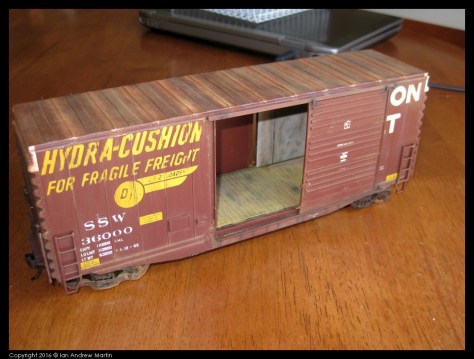
I’ve completed the remaining weathering of the body of the 40 foot Hi-Cube. There may be one or two more minor tweaks that I’ll make to get that just right look, overall I am very happy with this cars look. As an experiment using multiple techniques that I’ve not used altogether before I’m very happy and will try this next on a HO scale car. Where are we up to?

Flash on showing most of the car completed

The second round of body and roof weathering has gone on. Keeping in mind that this car ran mostly in the dryer states and most of that in Texas in my modelling location there is a preponderance of dust and rust and not a lot of rain weathering. I believe that I have another of these cars in my O scale stash and will document the weathering as I go in the next week for all of you.

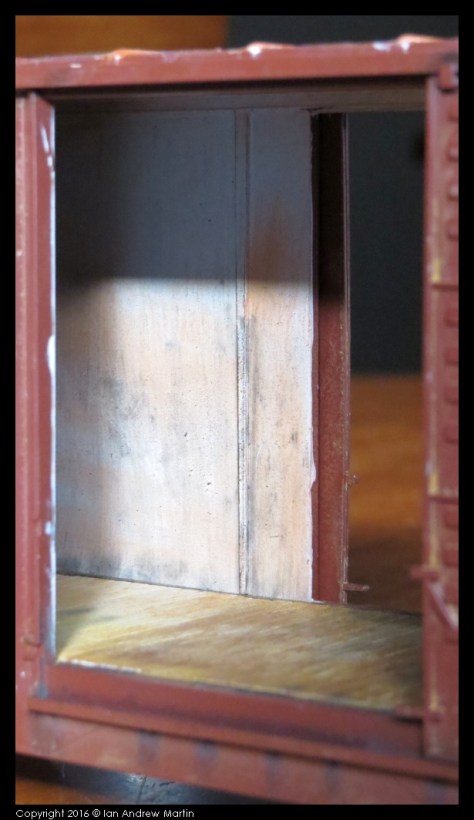
Interior shot showing the walls and weahtering
Interior shot showing the walls and weathering

I am particularly pleased with the internal look of the car. I hand painted the interior since I wanted a little tooth on the interior of the car, adding some Acrylic Painting Medium to the cheapo acrylic paint to thin and help it settle.

Close up of the wall and floor weathering

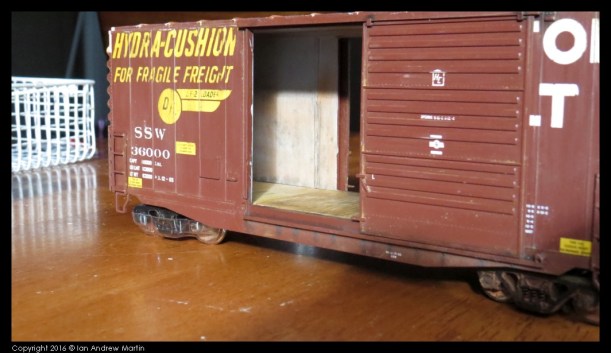
Minor touch ups to the door openings remain, to add the dings and rusting, prevalent around boxcar doors. Overall I’m pretty happy with the outcome. There are still the trucks to do, but we’re getting close. More again soon.

Site update – November 29

I’ve been laid up the last two days due to some (hopefully) simple skin surgery to remove another unusual mole. Being unable to lift or move too much this week gave me some much-needed time to catch up on some modelling that I’ve put off for far too long. Today’s work has been added to the weathering section, and shows Atlas O’s completely incorrect model of the Cotton Belt 40 foot Hi Cube.

A little history

The real SP & SSW cars in SP class B-70-36 are both small in number and used in captive service for high volume – low weight appliance service from major appliance manufacturers to distribution centres. The cars were 40′-6″ long hi-cube box cars; they were all built by Pacific Car & Foundry in 1966 and had 5001 cubic foot capacity, Hydra-Cushion underframes and 10′-6″ Youngstown sliding doors.

Image courtesy T. E. Cobb via railgoat.railfan.net

They came to be nicknamed the “Ugly Ducklings” due their awkward appearance. Built for appliance service and used later in their life for other roles the SP cars in class B-70-36 were numbered as follows:

  • SP 659100-659111 and had DF-B loaders

The Cotton Belt cars (the highest number) in class B-70-36 were numbered as follows:

  • SSW 36014-36126 DF, DF-B, Car Pac loaders

The car being weathered, as provided by Atlas, is car number 36000 which was a wooden sheathed car of a completely different class. The car is actually a Pullman-Standard built Hi-Cube boxcar built for the D&RGW in November of 1967 (see image below). Built for Whirlpool appliance service D&RGW’s 67422 (shown below) had Equipco load dividers and was assigned to load on the Erie Lackawanna at Marion, Ohio. 67422 was also equipped with Pullman-Standard’s ‘Damage Free’ Hydroframe and was painted in the Grande’s contemporary ‘Action Road’ livery.

Image courtesy of James Belmont via railpictures.net

Weathering the model

On this model I’ve tried a multi-disciplinary approach. I’ve used just about everything in my weathering tool chest. Oils, Acrylics, RustAll and Weathering Powders. It’s a bit of an experiment in seeing how to integrate all the different techniques I’ve used. You can head on over to the new page now or take a look at a couple of images of the work today.

Early afternoon shot of the weathering on the roof
Lower resolution image showing the weathering on the floor

I’ll be posting more photos tomorrow as I work on finishing this car. Enjoy the full-page.

Site Seeing – October 10 – Hornby’s new Peckett W4 Saddle Tank

First off I’ve got to give a shout out to Oly Turner and Chris Matthews’ blog for highlighting this model; one of their recent posts bought this little gem to light. Many of you may have guessed that I focus more on the North American and Australian scene in HO and O scales than the UK. However, I have a deep love of the UK industrial steam era and especially the four and six coupled locomotives that served these industrial railways for many years.

I don’t get very excited, very often about new releases from Hornby in the UK. I am getting very excited however by the release of their new 0-4-0 Peckett W4 Saddle Tank in 4mm ‘OO’ scale. If you are into small layouts, and or industrial layouts in a small space then I think that you should be too. And here’s the reason:

What’s not to like. It’s small, well proportioned and perfect for the type of small industrial layout that most of us can afford and fit in our homes these days. They are all DCC ready and would appear to be able to fit sound – if through a somewhat small speaker.

They look like they’ll be a red-hot seller. In fact I noticed that all the pre-orders have already sold out. Here’s hoping that Messrs Hornby ramp up production and keep this item in the catalogue for some time as it will form the basis for many conversions to come.

Like to see it running in engineering guise?

You can find out more about the development of the model from Hornby.

Site seeing – 10 September – All you ever wanted (or needed) to know about Inglenooks

Since we’re on somewhat of a roll with the Inglenook this week and it’s uses in small layout design let’s go to the source of all things Inglenook.

Site 1: Adrian Wymann’s “The Model Railways Shunting Puzzles website”

If you’ve not heard of Adrian’s site before then you are in a for a treat. This site has everything that you ever wanted to know about shunting puzzles, including the Timesaver and the Inglenook.

Image courtesy of Adrian Wymann

Of interest for those of us thinking of building a layout using the Inglenook design is the discussion on the design of operation and movement for the layout. Additionally there is the mechanics of designing and building the layout also. Very well worth the look.

Site 2: Adrian Wymann’s layout “Little Bazeley-By-The-Sea

Putting the Inglenook to work Adrian’s great little layout deserves a look. Well designed, well executed and well presented Adrian walks you through the design and build process and provides a lot of insight into the process.

Image courtesy of Adrian Wymann

Head on over to the websites and do a bit of reading – you’ll not be disappointed.

Site seeing: August 31 – Winter is going (at least down here)

Winter is over, although where we live in Ballarat at 420m (1370 feet) above sea level, you’d be hard pressed to tell that change of season has arrived. Our mornings are still cold, the winds are still lazy (they go through and not around you), and the weather is not shiny or happy. However, my seasonal allergies have kicked in, and the Wattle has been in full bloom for about 3 weeks now. I’m sniffling, my eyes are streaming and I look like I’ve gone five rounds with the late, great Muhammad Ali. My allergies and the weather are not the reason for today’s end of Winter post…

Site 1: Croft on the ScaleFour society’s website

Built as a shunting puzzle (Inglenook) and based loosely upon the real Croft goods (Darlington, NER, not Leicestershire LNWR), Croft is a magnificent example of simple effective display and operation. The image below courtesy of RMWeb and Steve Taylor.

I could go on at length about this layout, or I can let you soak up the atmosphere of this image and then follow the ScaleFour link above.

Site 2: RMWeb’s Croft Gallery

Go, look, mind blown.

Hope that this gets your creative juices flowing. Looking forward to the Southern Spring.