Category Archives: HO Scale

HO Scale modelling articles and posts

Site seeing – August 10th

Yesterday was all about passenger service; today is all about freight. Chris Gilbert pointed this video out, on his YouTube page. However the producer is ChicagoJoe28. But enough words let’s get to the video.

Site 1: Mike switches Batory Foods Chicago Terminal railroad

Video 1: Batory Food Switching on the Chicago Terminal

A little history

Located at 2234 W 43rd St, Chicago, IL 60609, Batory Foods began trading in 1979 when Abel Friedman opened Chicago Sweeteners. As a single source supplier of basic food ingredients such as sugar, flour, salt, starch, milk, oats, honey and corn syrup. Chicago Sweeteners expanded its product offering over time, as food manufacturers sought to develop healthier products.

With success in the greater Chicago market, the Company brought its broad line model to food manufacturing centres around the country. Some of the growth came with the original business; some by way of acquisition with:

  • Sugar Incentives bought in 1995,
  • Ingredients International in 2006,
  • Quality Ingredients in 2008,
  • LSI in 2009,
  • Industrial Ingredients in 2009,
  • Massey Fair in 2011, and
  • Mac Source in 2011.

Recently, the various names were consolidates into the single name: Batory Foods.

The layout idea

The site’s switched as an Inglenook. The two on-site spurs lead to undercover augers (I’m assuming here of course) for unloading powdered or granulated product.

Batory Foods Chicago - An Inglenook you can model

Image 1: The unloading spots (courtesy of Bing)

The storage track goes to other industries further down the track, but does not show recent use from my quick look. The loco has to push the cars into the site so you have a simple, prototypical Inglenook that won’t take up too much space. It is small enough that you could model any date from 1979 on in HO, S or O scale.

SCORE! What are your thoughts?

Thanks to Chris Gilbert for the vision, and to ChicagoJoe28 for filming it.
Site seeing – August 9th

Just the one site to see today, on YouTube, and the background idea for a future layout design. Let’s away!

Site 1: Bacchus Marsh, Victoria

Whenever I travel to Melbourne on the train I pass through Bacchus Marsh (it’s around the halfway point between Ballarat and Melbourne). I recently found a new channel on YouTube featuring Trams and Trains from around Melbourne. Watching the operations in the video below at Bacchus Marsh led me to thinking about an exhibition layout. With the wealth of Ready to run (RTR) rolling stock available and the intensive working of the passenger service (especially the storage of train sets) this could have the makings of a great medium-sized exhibition layout.

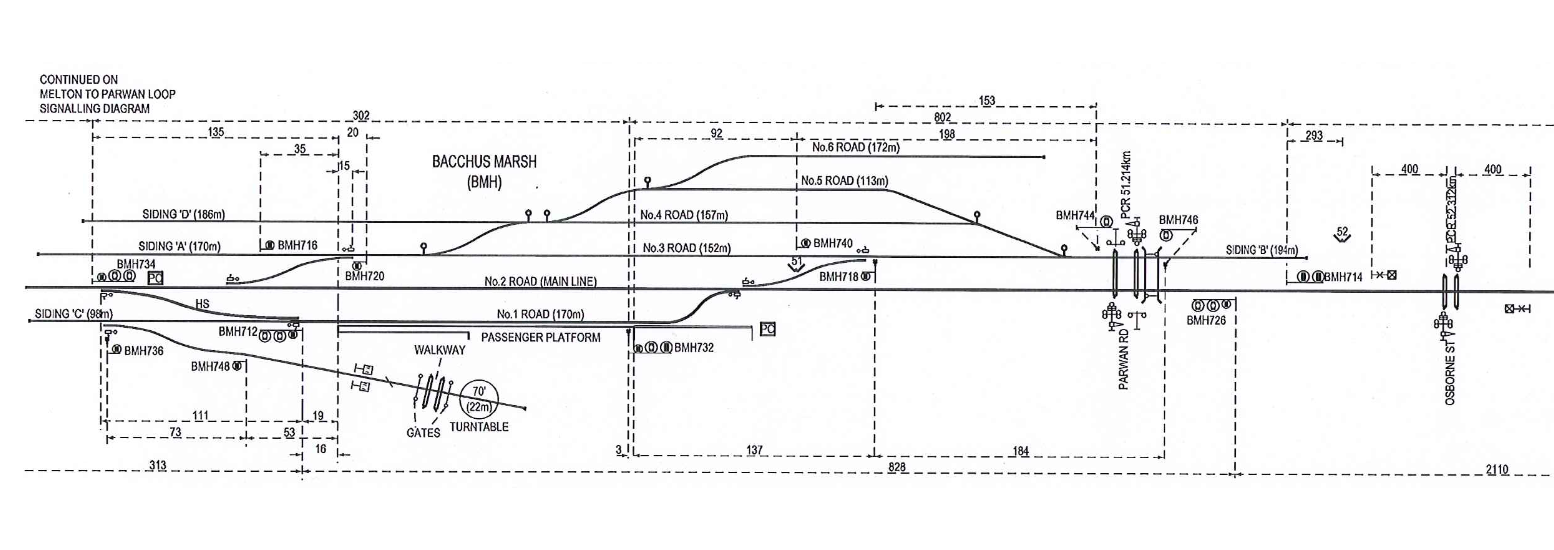
First watch the video and then take a look at the signalling diagram below.

Video 1: V/Line Variety at Bacchus Marsh Railway Station in 2012

Bacchus March Signalling & Track Layout

Image 1: The Bacchus Marsh signalling diagram & Tram layout

I think that there is plenty enough in the track layout to keep an exhibition crew going all weekend. With the station being both a single platform terminus and through platform (with the right hand side going through to Ballarat and beyond) this could be nirvana for DMU & Loco hauled railway modellers. Your thoughts?

Site seeing – July 8

Obsessive, obscure, observant and even excessive; all these monikers I’ve worn in my modelling career. And then just when you feel that you need to back off the scratchbuilding fanaticism along comes someone to restore my faith in the obsession.

Site 1: Scratch building a HO scale mattress box spring [Link –>]

Over on the FreeRails forum there is a build I just had to showcase. Sean W needed a box spring mattress for a scene. Not able to find one from a manufacturer he did what he had to do – scratchbuilt.

Sean W's HO scale box-spring mattress

Image 1: Sean W’s scratchbuilt box-spring mattress (

Visit the link above to see how he did it. Great work Sean!

Why I chose not to design my layout – Part 3

I wanted to show my working (as my Math teacher always encouraged me to do) on the layout design as it evolves to meet my needs. I was not happy with the way the original design performed when I looked at the yard throat design. There was an ‘irksome’ separation between the mainline and the branchline running into the future Industrial park extension. Image 1 below, shows my attempt to fix that issue; a simplified version of the first track layout.

New Layout Design - Take 2
Image 1: Take 2 on the layout design

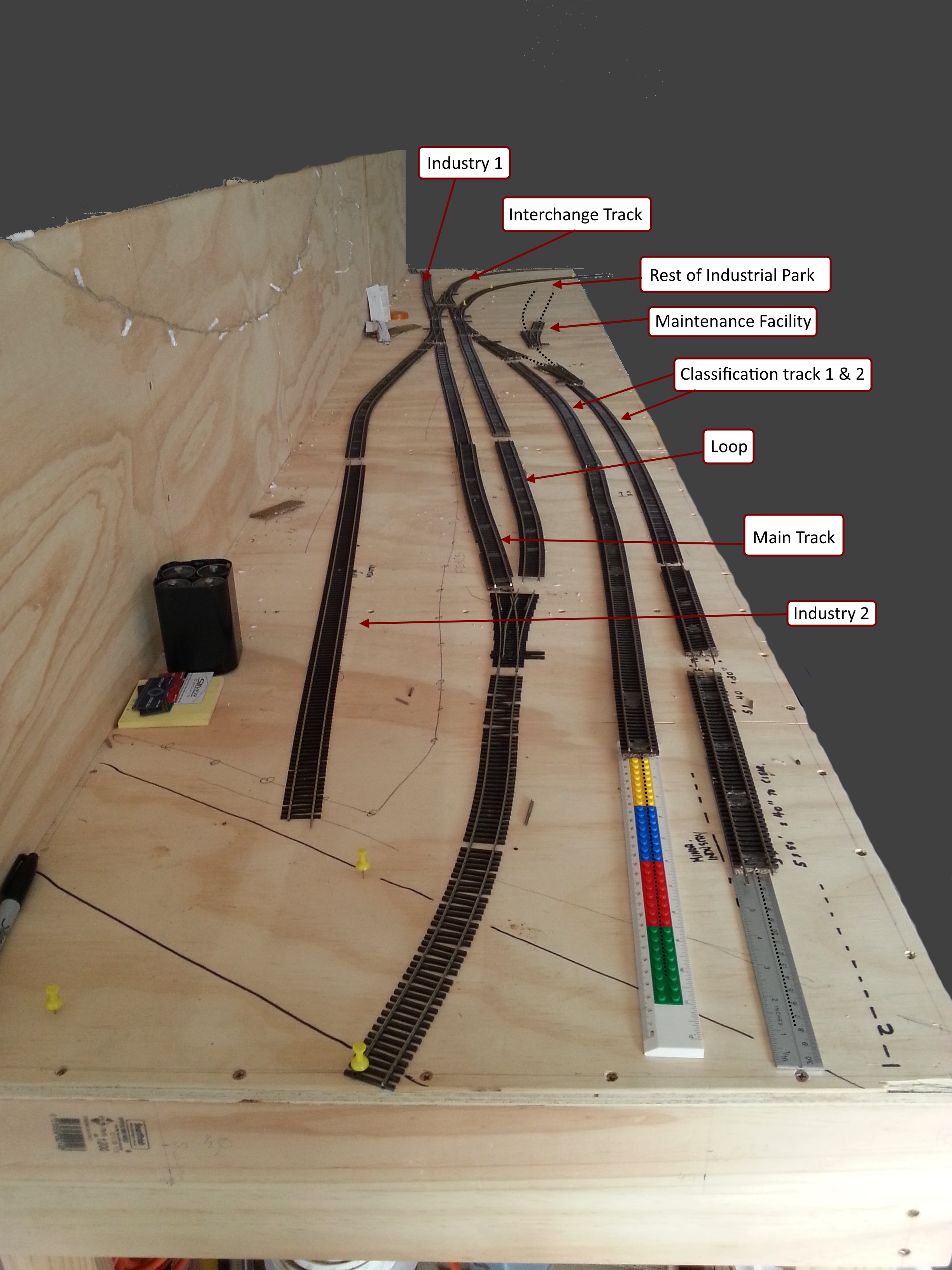
The throat area is the set of switches around the Interchange track and the branch out to the rest of the industrial park. In mock operating sessions the biggest issue I had on the fist design was the lead out to the rest of the industrial park had crept down quite a way onto the upright of the L shaped boards. Keep in mind here that the other boards are not yet attached to the three boards in the image.

Additionally, I wanted to have a better yard throat, that was easier to switch through and took up less space.  After due reflection, the layout just didn’t look right for a small, smart industrial line with the smarts to build their own industrial park out of a couple of abandoned branch lines. Thus we arrive at version 3.

New Layout Design - Take 3
Image 2: Take 3 of the layout design

First there’s a better use of space,and visual appeal (to me anyway) with the long classification track #1, and the maintenance lead / class track # 2 being at the front end of the board.

All of it coming direct off the old main (now the interchange track). It simply feels better, and right in a way that the previous versions did not. I’ve run a quick thought exercise ops session on the new layout, and it also makes it easier to do business on the new layout. I’ll post the results of that a few days in the future once I have some other modelling work that I have to complete done.

On reflection I will be moving the switch (currently a Wye that will be replaced with a left #5) further back toward the camera to extend the run-around on both the main and the loop. This will stop just short of the road overpass and ensure that a loco can pull clear of the switch to allow the run-around move to take place. Additionally it will allow the

That’s it for me at the moment. Talk to you all later. If you have any questions let me know.

Site seeing March 18

So much for catching up! I had promised to catch up on my posts after a long week of the flu; Sun Tzu was right – no plan survives first contact with an adversary (or a past time).

Site 1: BobbyPitts44 build of a flexiflow car

Over on the FreeRails forum (Link Here) there’s a brief discussion on the work done to take what is essentially a 1960s era toy freight car and turn it into a scratchbuilding masterpiece.

While the forum does not have a lot of information on the build, luckily his Flickr site does. Everything is back – to – front, but there is some really amazing work there to be viewed.

View the Flickr site (Link here)

It’s great work and well worth a view.

Site seeing – March 7

Introduction

Lance Mindheim is a force in the design of operational layouts. Today’s site seeing tour takes us to an article on his views and to his new website (built on WordPress no less).

Site 1: Railroad Model Craftsmen

In this article (offsite link) Lance talks about the play value in our layouts, and how without the play value, the layout will in the long run fail to please.

Site 2: Lance Mindheim’s new site

Lance has moved his site (offsite link) across to a new platform that finally allows searching. He’ll be updating and moving older content across to the new site over time. But for the moment the link I’ve provided takes you straight to the blog. This is where most of the content is right now.

Site Seeing February 21

It’s all operations Saturday, thanks to Martin Hogg, the owner and operator of Brett.

Site 1: Brett – a full operating session video

Martin Hogg’s released a new video (Brett’s been featured recently on the blog).

This time you get to see a full operating session from start to finish.

This video shows just how much enjoyment you can derive from switching on a relatively small layout with a reasonably simple track plan.

I’m guessing the operating session lasted around 25 – 30 minutes from start to finish. As soon as I get some feedback from Martin I’ll update this post and let you know for sure.

Good work that man! On you Martin.

Update 1:
I talked with Martin Hogg today and he confirmed that the operating session takes about 25 minutes (although he says its heard to be sure as he was busy phaffing around with the camera to be sure). He’ll be running another session to confirm that but I’m pretty sure that it’ll be right around the 25 minute mark, depending on the work to be done.

Layout Builders of Note – Chris Gilbert

Introduction

I’ve known Chris Gilbert for many years thanks to the Internet, specifically RMWeb. Chris has always managed to be a great mentor on things model railroad, even if he was not aware of his mentorship. He’s been successful in building, exhibiting and publishing a range of model small exhibition layouts over the last several years. What gets me is how quickly he puts these model marvels together.

Florida Springs (V 2.0) – An HO Scale exhibition layout

Chris in his own style said that he started the layout on Tuesday the 10th of February with a trip to his local hardware store.

Within five days he was at this stage:

As if that was not enough to make me feel like I need to pick up my game, his detailing is exquisite. If you take a link at post number 5 (link here) you’ll see what I mean.

Every time I see what Chris can do in so short a time, I am simply bowled over. He thinks about something and then he gets it done. It’s something that I am going to aim for in my modelling this year.

Before I can get there though I have to complete some other modelling projects to finish for my local model club show in April (you can read more about that on the Modellers of Ballarat blog (link here).

I’ve listed other sites in the resources section below. Enjoy having a look at Chris’ layouts. They really are magnificent works of art.

Resources

· You can find out more about the O scale Fort Smith Railroad layout (External Link) here.

· You can visit Chris’ YouTube channel (link here) – and watch his videos of Haston and North Haston – great stuff.

The new layout boards are complete!

Originally Posted on the Old HVL blog March 24, 2013

OK, so a little about the design and build of the layout boards.
In general all wood is fine quality pine dressed all round (DAR). The board top is 12 mm ply (1/2 inch), while the sky board is 6mm (1/4″) ply. THe legs are “L” girders using 1×2 and 1×3 DAR pine glued and screwed on the along their length. At the base of the leg is a glue bock of 2×1 DAR pine which is used to locate a T nut, with a 5/16″ bolt as a leveller. The nut for the 5/16th bolt mounts on the top of the glue block locking the bolt in place once you’ve levelled the board. I’ll be building a better foot arrangement at some point in the future that is easier on the floor, most likely a wooden ball with a 5/16″ nut through the centre of the wooden ball.

All of the side and end rails are 3 x 1 DAR pine and these have not been glued, but have been Kreg pocket screwed together. The ply was then glued and screwed to the box. Nice, tight and very rigid. There is one rail across the board in the centre  of 2×1″ DAR pine, this has also been Kreg pocket screwed to the sides and the top was glued and screwed tothis also. The skyboard is glued and screwed to 1×2 pine DAR which acts as a stiffener and mounting point on the back of the main board. Mounting to the rear of the main boards is achieved using Kreg pocket screws.

The legs are mounted to the main board using 3 screws on each side to the sides. The top horizontal board bears the weight of the main board above; while the bottom horizontal board acts as a bearing face between boards and allows the boards to lock together using a wooden clamps from offcut of the hozontal boards and 1 x 2 DAR pine. Think an inverted U locking the two legs together. Nice, tight, simple and about 3 months in the planning.

Overall what are my impressions? Very happy to be over the hump of the work. The boards are light and strong. I can lift them fork lift style on my own without hurting myself and as I have a 50 year old back; this is a good thing. Thanks to my wife (Janette) for suggesting the mounting height for the sky boards. At 400mm above the plane of the board they are high enough to be at or just below my eye height, and with the 2×1 stiffeners behind allow easy mounting of lights that will hang out over the board for better simulation of daylight.

I’ve a few sketches and such to put on the gallery site later in the week. This should give you an idea of how the parts look. More photos will be coming before I paint everything later this month or during April, depending on the weather. Well a great day in all, now some remedial work on the old boards to bring them up to spec and height, and then my work is done.