Category Archives: This Site

Ops, TT&TO, invective, and blah-blah-blah

It’s been a while since my last post. Life has become hectic with lots of work (as the opposite to none at all for quite some time) so to keep the blog moving I thought I’d cross post my response to Joe Fugate’s recent editorial: Secret to needing less layout on page 11 of the June 2017 edition of the e-zine ‘Model Railroad Hobbyist’. I found that as I read through the responses there was a lot of heat being generated by those for and against the smaller layout ethos. A recent kind email from a new model railroading friend Charles Malinowski got me to thinking about the original post on Joe’s editorial and the thought that perhaps it might be time to draw that line in the sand on this blog too.

If you can, take a moment, to read of some of the initial responses to Joe’s posting. Then either read my post on the MRH  site or as reproduced below. Don’t be shy. Got something to say, then comment and start the conversation here. It’s the only way we all learn.

Am I missing something? Did the hobby just become a pain in the butt during this discussion (and I’m not through reading all the responses yet)? Timetable and train orders, and… all to much work for me. While I understand that model railroading is all things to all people I don’t need all of that other stuff to make a me a happy modeller or operator.

I like small layouts. I live in rented accommodation, and will likely for the remainder of my life due to circumstances beyond my control. My wife loves the idea of me ‘not’ cluttering the place up with ugly wooden stuff that takes over the space, so I have to consider the aesthetic of any layout design as well as the piece of furniture it must also purport to be.

I’m limited in space, money and the time I have available to actually build the thing. So a long time ago I took the first mile, last mile approach to railway modelling. I model industries and locations where there is a lot of work to go on (switching) at an industry or location (such as a team track facility) getting the loads in and out in an efficient and useful way.

Do I care about Timetable and Train Order operation? Nope. Does it affect me as either the modelled customer or as an operator? Nope. And lastly, does it affect my enjoyment of the hobby? Nope. Would I love to model TT&TO operations? I’d love to but I cannot afford it.

I use paperwork, operations plans and rule books to model, and there’s a reason for this. I like my crew (usually my son and I) to feel the need to get the work done efficiently and with haste. There’s a train to catch out there somewhere and our cars need to be on it. I love operating by real railroad rules and with prototypical operations paperwork.

I focus on the things that matter to me, and that is the first mile and the last mile. What happens in between where the rail line curves away from my business – is none of my business. I put a lot of thought into what makes operations work for me. And I’ve shared that online as well. And it is not all that hard to achieve, especially in a small space. You can read more about that on my blog.

Joe’s TOMA approach I like. It means that it is achievable, in space, time and money. It gets you working quickly and allows for interests to develop as your skills and knowledge develop. Big TOMA, small TOMA, even in between TOMA… who cares? The idea is to get something going that allows you to play, find out what you enjoy the most and do that with the effort you have available.

Thanks Joe for sharing that article. I’ve been following along with the TOMA approach because it mirrors what I’m already doing and because it makes sense from my son’s perspective (Dad can we get something running now, I want to play with the trains again).

I appreciate that others do things differently. It’s a good thing. Let’s not get so focused on the forest that we forget about the trees. Happy modelling from Ballarat in Victoria.
Site update – May 23 – TSE Boxcars – additional lading and operation information added

Who says that asking for help doesn’t work?

When I wrote the TSE Boxcars page, about images I took back in 2005 in Austin Texas, I had no idea about the operational nature of the cars. Thanks to Paul, who is familiar with the cars, their loads, and operations I now can share a little more information with you.

This morning (AEST) Paul wrote the following: “Those cars came in empty. We would spot six at a time Balcones Recycling and they would be loaded with waste paper. There was about 30 of these cars that were in captured service. We would send the loaded cars out on the UP. They did not come in loaded with lumber. East end lumber is now long gone, and it has been at least 40 years since they received rail service.

My thanks go out to Paul for sharing his time and knowledge with me. One of the reasons I love the Model Railway community is their willingness to share. Greatest hobby in the world? I’d like to think so.

I’ve updated the page with the information Paul has provided. Good to know finally what they were there for, and the operation cycle they used.

Site update: 12 April 2017 – the geographically challenged edition

It’s been very busy getting back to work after the long period of ‘under-employment’ as our government describes it. My time has been totally focused on getting through the day and making the changes that will allow for eventual success down the track. Having said all that I got a lovely comment from Peter Walker who is a committee member of the Corio Club.

Peter wrote:

Andrew,
Thanks for the positive report on our 2017 exhibition. By way of feedback the exhibition hall this year was in BELMONT (not Corio). We felt this venue handled the show crowd better and, with support from City of Geelong, have now been able to book that venue again for 2018. Hope your readers don’t look for us in Corio next year?

In reply I wrote:

Thanks for the correction. I’ll make sure to update the post and publish an update to make sure to get people to the right spot next year. Keep me up to date on what’s going on for 2018. Glad to help get the word out for the show.

I don’t mind people pointing out my geographical faux pars. I navigate mostly by visuals and not by map, compass or any other known means of getting from one place to another. I’ve found that often the thrill of the journey is discovering somewhere or something you never knew was there.

Thanks to Peter for bringing my error to light. I really did enjoy the show this year. I know also how difficult it can be for a club (small or large) to find a new premisies, cover your insurance and venue costs, and still make a little something to support your club or the charity of choice. I applaud the committee for being able to pull this move off so well, and from the outside at least,  make it look so effortless.

With Peter and the Committee’s support I hope to bring you more information about the next show in January 2018.

Site update – 20 March – Updated 12 foot home layout design page

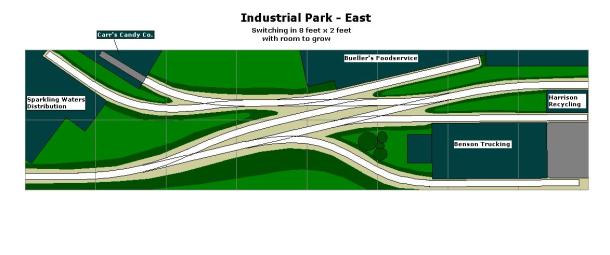
There has been a lot of thoughtful experimentation going on at Andrew’s Trains of late. While I was ‘reasonably happy’ with my Mk 72 layout design I wasn’t joyous about it. Recently while rediscovering some of my older layout designs I came across the design for ‘Industrial Park East’, as shown below, from somewhere about 2006-7.‘. Something in this design called out to me and so I set off on a slight redesign from the Mk 72 to Mk73 version. The changes I made have allowed me to get the ‘flow’, and the look that I wanted. I know this all sounds like something ‘the Dude’ would say from the Big Lebowski at this point but if it doesn’t work for you while you’re designing it, then it sure won’t work for you once you’ve committed track to plywood.

There’s a lot more information on the what, the why and the wherefore on the additional layout design page (yes I added another one to keep it all straight in my head). If your interest is peaked and you’d like to see more click the link in the line above and head on over to read on.

Thanks for reading – now it’s back to your regularly scheduled programming.

Site Seeing – March 18 – The ‘other’ Glendale freight layout edition

It’s been a while since my last post and that is thankfully due to being fully employed for the first time in two and a half years. A full-time job is a very satisfying thing. But I digress.

As I wrote in my March 6th post I’ve worked up another idea for the Glendale Freight layout. Let me say from the outset, that this is not one of my better ideas; especially after seeing Bruce Petty’s original layout. There’s merit in the ideas expressed in the design certainly – it just doesn’t have that vibe going on as Bruce’s layout does in spades. Before I go on to tear my work apart let’s take a look at a 1/12th scale model and why I find them so useful for designing a layout.

So what’s wrong with this layout idea?

  • Firstly the central theme of the design is not the freight station, it is the entrance from staging onto the layout.
  • I wanted to have the train enter through a portal of buildings, cross the street and then go about its business. It’s a pretty skimpy idea right? There’s no meat on the bones though.
  • Why this means to enter onto the layout instead of some other way? Is there some missing story about this means of entrance; did the city grow up around the freight station for example? But isn’t this supposed to be Glendale CA, right? Well, is it?

The layout is overall 8 feet long (2400mm) and each square is 12 x 12 inches (300 x 300 mm). It is 2 feet (600mm) wide. And it’s very linear.

So what would I do different now that I’ve built this mini layout?

  1. Angle the entrance onto the layout,
  2. Angle the buildings and the street to the long axis of the layout,
  3. Cluster the switches near the end of the run around, and finally
  4. I’d make a transition between the industrial area on ‘main street’ at the entrance end and the other end of the layout – making it more suburban

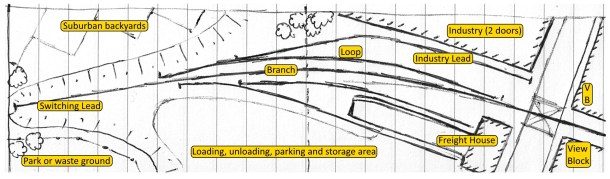
And having had a while to think on how I’d make those changes here’s a rough drawing of the layout that ‘could’ spring from this thought experiment.

This design has gravitas. It is the last bastion of railroading in the inner city, and the edge of the suburbs. Sure there are some strange curves, and I’d rework the industry lead and the industry back wall too. But it is much more interesting and tells much more of a story than the first layout.

This layout could be setup as is with the industries, it could be modified for a single industry layout (say an industrial workplace such as a foundry), or it could be something that I’ve not considered and that you already have swimming around in that pool of ideas in your head. As an aside, I videoed the first layout build process. If interested in seeing that video let me know in the comments and I’ll post it here over the next week or so.

Site seeing – March 06 – Bruce Petty’s Glendale Freight house Module Redux edition

In a post on January 18, 2017 I made mention of Bruce Petty’s excellent module of the end of the Union Pacific’s Glendale Branch and the freight station located there. Bruce’s Module is 5 feet (1500mm) x 18 inches (450mm) but to my eye looks much bigger because of the great use of the space he has made. There is no crowding, no feeling of busyness, only the feeling of a warm summers afternoon in Los Angeles sometime during the 1960s or 1970s. This small scene is evocative and places you immediately in the place and time, even if that is coloured by your chosen time period.

The majority of my layout designs fit into an 8 foot space Bruce’s layout module with the addition of a 3 foot fiddle yard fits right in the space available and would make an excellent display or exhibition layout. More importantly it would fit with any time period from the late 1940s – early 1950s (when I believe that the freight house was built) through to the mid to late 1980s when I believe the freight house fell out of use.

As I said in the previous post I’ve pondered over how to use Bruce’s track plan in other ways. I’ve even worked the design up into a 1/12th scale model to see how it might work. I’ll come back to the alternative in my next post; for now let’s revisit Bruce’s excellent module.

A closer look at Bruce’s module

While this module is a part of Bruce’s larger railroad forming the end of the UP’s Glendale branch it can also stand alone as a layout in its own right. At its heart it is an Inglenook layout. Each of the freight house roads can take two 40 foot boxcars against the dock. For those of you interested in modelling this layout at a later stage it is highly likely that the Freight station never hosted more than 2 x 50 foot boxcars at any one time. If it did so then they would be placed on the right most track with the second car either unloaded directly into trucks as shown in Photo 1 above or set off spot on the left most track and switched out once a suitable space was available at the dock. Lots of switching possibilities here.

Of particular note in the photo above is the connecting piece to the rest of the layout. I like this little yet important touch. The wooden insert which allows the module to join the layout has been disguised as a typical UP/SP bridge. Very smart and ensures that the layout and the module appear to be a single whole and not something that Bruce built later on.

Operation

Operations on this layout would be pretty good too. As we’ve discussed before on the blog Inglenooks are completely prototypical and often used by railroads in tight places. Operating with a locomotive pushing in – pulling out switching focuses on the industry or industries served. The longest track on Bruce’s layout I would use as my switching storage and sorting track. The incoming train pulling outbound cars before spotting them on the long track. Cars would then be switched according to requirement on the remaining two car tracks at the docks. Any cars from those pulled needing to be spotted back at the dock could then be spotted before the locomotive crew pick up the remaining outbound cars and head back across the bridge and back to the yard. And here endeth the session.

Short, clear, easy to achieve, enjoyable and within the 30 minutes to 1 hour per day play time that a small layout should give you. Whether you use a single person (driver/engineer only) or two person (driver/engineer and conductor) crew to do the work the time taken will remain roughly the same. I prefer a two person crew simply because it makes the play time more fun when family or friends get involved.

Hope that this revisit has been of some use. If you like the blog don’t forget to Like and Subscribe. PLease comment if you are looking for more information on layout designs or on the designs I’ve previously posted. And of course take the time to visit the “further reading and resources” links below.

Further Reading and Resources

Site seeing – January 27 – The ‘times they are a changing’ edition

I received an email from Shawn Branstetter earlier this week announcing that his site http://shortlinemodelers.com/ would be closing down very shortly. I was, to say the least devastated. Shawn’s site is a treasure trove of useful articles and ideas.

I contacted Shawn for comment and post it here in its entirety: “Unfortunately it is true Andrew. I’m not exactly sure what I’m going to do with the content however, the Facebook page will remain active. Whiteriver Productions has expressed interest in hosting the content and I don’t want the name to go away I just don’t have time to be a developer, writer, very poor editor and illustrator by myself and find time to build. It’s just too much. Somehow I will make sure all content is available to everyone. As soon as I figure that out, I’ll let you know.”

Site 1: Get it before it is gone – Shortline Modelers

Go see it and grab anything you can now. Not sure how long this will remain available or where it may move to. Check out his cement modelling articles – they are outstanding.

Site 2: Shortline Modelers on Facebook

Head on over to the Facebook page and follow him there if you have a Facebook account. This will keep you in touch with Shawn for the future.

Site update – January 21 – No you don’t need an optometrist visit

In my last post the photos that I uploaded seemed to behave poorly once uploaded through WP.

An overall view of the module

I’ve reworked them all in Paint.NET and uploaded a new set.

I’ve just checked the newer versions and these appear to be better. Sorry for any inconvenience, or for any unnecessary trips to the optometrist.

Andrew

Site seeing – January 18 – the ‘Perfect Storm’ but in a good way edition

I’ve had an idea for a small layout, running around the mouse wheel that I use for a brain, for a while now. What kicked the idea off was a 2013 plan published in the Model Railroader for the Glendale Freight House that Union Pacific built there during what I ‘believe’ was the early 1950s. Bruce Petty has already built a layout based on the real location and using the UP freight house in Glendale. Let’s take a look at that first to see where we start from.

Site 1: The Union Pacific freight station drawings

Step one of this plan is to get a copy of the plans. They are available for logged in users on the MR site by clicking the link above.

Modellers in HO scale will need to enlarge the drawing substantially (which is doable at a local copy store)to be able to build directly off the drawing.

Big thanks to my next site owner for the idea about doing that. He uses the protective sleeves (clear plastic ones) to build on.

The model once completed using liquid polystyrene cement does not stick to these plastic sleeves and Bruce simply lifts the completed side of the model off the sleeve. Plan protected, model free, what’s not to like about that? I just wish I’d thought of that all these many years later. I did mention that I have a mouse driving the wheel that powers the mental machinery, right?

Site 2: Bruce Petty’s LA River Railroads site

Bruce’s website is a trove of information on the railroads of LA. His layout looks fantastic too. Of most interest to me was his article on the Glendale freight house build which you access from the link above. Well worth reading the entire page and taking in the method of building it. Clever, clever man!

This building rests on his Glendale module. When speaking to him via email earlier this week he told me: “… the modules for my layout are 18 inches wide and 5 feet long. If I ever move the layout goes with me easily taken down. All structures
and small detail parts come off the layout. On the Glendale module only the loading dock stays as it is concrete. No big deal to take this module down off the shelf brackets, it’s the end of the UP Glendale Branch.

Essentially the layout is an Inglenook (and exactly as the original). Bruce says that just like the original “… it gets switching crews from Southern Pacific and Union pacific. It’s a fun module to switch on and I can take it to shows.” What more do you need?

In the next post I’ll be taking a look at how I’d like to model this location as a stand alone layout. I’ll be taking a slightly different tack to Bruce’s excellent representation. I’ve been thinking about using an interesting technique to cover off the gaping hole in the wall exit to the fiddle yard that ought to work perfectly for this design; and all in 8 feet.

Additional resources:

Bruce has kindly provided me with images of the layout module. My thanks to Bruce for his kindness in being so willing in talking to a stranger and being willing to take photos of his layout especially for me to share with you.

All included images above are copyright of the creator and author: Bruce Petty. Used with permission on Andrew’s Trains.

Site update: 02 December – More weathering photos

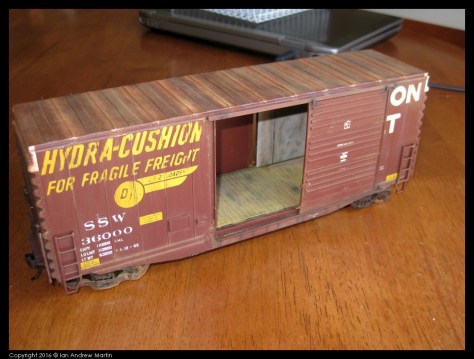
I’ve completed the remaining weathering of the body of the 40 foot Hi-Cube. There may be one or two more minor tweaks that I’ll make to get that just right look, overall I am very happy with this cars look. As an experiment using multiple techniques that I’ve not used altogether before I’m very happy and will try this next on a HO scale car. Where are we up to?

Flash on showing most of the car completed

The second round of body and roof weathering has gone on. Keeping in mind that this car ran mostly in the dryer states and most of that in Texas in my modelling location there is a preponderance of dust and rust and not a lot of rain weathering. I believe that I have another of these cars in my O scale stash and will document the weathering as I go in the next week for all of you.

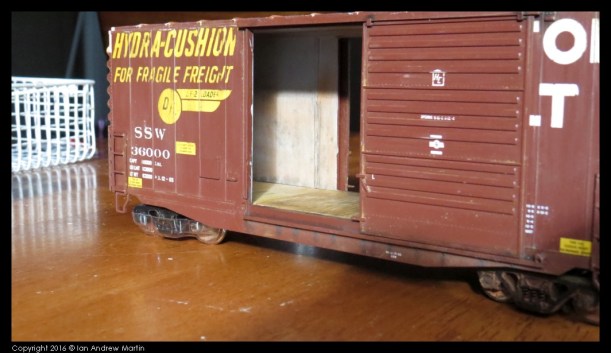
Interior shot showing the walls and weahtering
Interior shot showing the walls and weathering

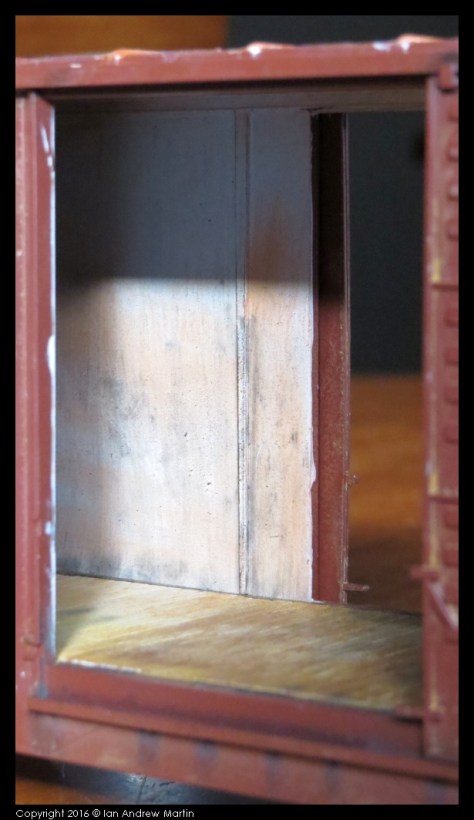
I am particularly pleased with the internal look of the car. I hand painted the interior since I wanted a little tooth on the interior of the car, adding some Acrylic Painting Medium to the cheapo acrylic paint to thin and help it settle.

Close up of the wall and floor weathering

Minor touch ups to the door openings remain, to add the dings and rusting, prevalent around boxcar doors. Overall I’m pretty happy with the outcome. There are still the trucks to do, but we’re getting close. More again soon.