Category Archives: Sites of interest

Involving specific sites mentioned in daily posts

Site seeing – June 2

Small layouts ‘can’ present a problem should the builder underestimate the impact of the types of industries chosen for the layout. For example, a grain elevator may have 20 car spots to be either loaded or unloaded. It sounds like a lot of work to get that grain elevator switched out. However, unless there’s specific switching movements required this job could well be long (as you wait for the first car to be loaded or unloaded, then move forward, and repeat the process over again) and could turn out to be very boring.

NOTE: There is an example of one such elevator in Melbourne, Victoria that I’ll share that proves the exception to the rule.

On the other hand, a single siding with say six spots, each having a specific commodity billed to the spot, can need more brain power and work to complete in a session. This  may provide the answer those who are looking to add more play value in the game that we call Model Railway Operations.

Site 1: Spot order and small layouts [+ Link Here]

Recently on the Port Rowan blog, Chris Mears talked about this same issue. In this post he describes what simply the concept I mentioned above and gives some great references for you to take away and think about for those industries on your own layout.

I hope that you enjoy the read. If you do leave a comment for Chris. He loves them and answers every one.

Site seeing – June 1

Over on Gene’s P48 (Proto 48 – Fine US O Scale) blog he’s building the first of a series of Wilson meat reefers.  Today’s first post provides some information about the series of cars that he is building. The following articles are bringing the build process up to date so far.

While the articles are about building a car in American Proto 48 O Scale there is much to be learned about scratchbuilding from gene that can be applied to any scratch build or bash project you might have in the work. Take the time and take a look around. I’ll be applying the techniques Gene’s been writing about to my future modelling work.

Site 1: Commentary – Meat Reefers [+ Link Here]

This article provides a run down of the types of reefer and some of the inaccuracies in existing models of this type.

Site 2: Modeling: Meat Reefers [+ Link Here]

This is the first article on building the reefer. The focus of this article is on the basics of the design and starting the body.

Site 2 Modeling: Next step on the reefer [+ Link Here]

The second article focuses on the steps to complete the basic body. This includes some really great ideas on how to complete the sub-roof for structural integrity and the visible roof.

Site 3: Modeling: Refining the door and the roof [+ Link Here]

In the third instalment of this series Gene focuses on fixing a problem with the door, take note, after he had already built it, and focuses on refining the final roof structure.

Site 4: Modeling: Simple Fixture for Roof [+ Link Here]

Gene shows the fixture he built for measuring and cutting the roofing boards.

Site 5: Modeling: Wilson Underframe Construction [+ Link Here]

Gene goes on with the build this time focusing on the under frame.

Site 6: Modeling: Progress on the Wilson reefer [+ Link Here]

Gene continues with the under frame, focusing on building the bolsters.

Sight seeing – May 26 (Albury, NSW)

Apart from better weather, warmer temperatures, gentler breezes and being in NSW, Albury has nothing on Ballarat. Well except for the better weather, warmer temperatures, gentler breezes, being in NSW and the recent Murray Valley Modellers exhibition that was held last weekend on 22-23 May 2015.

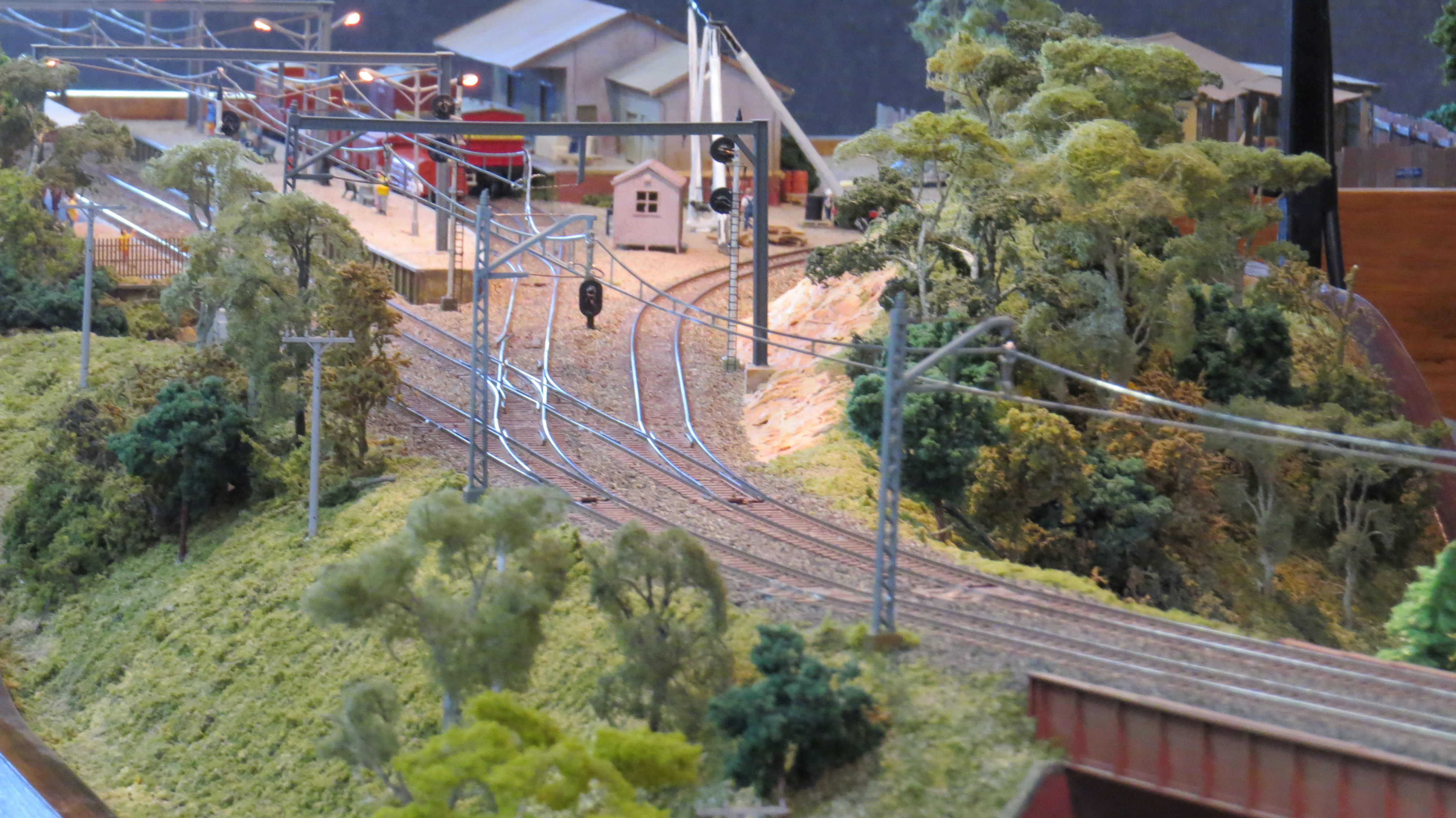
One of the junctions on Town and Country

Image 1: My current favourite exhibition layout – Town and Country

It was a relatively large show, for a country show, with a lot of vendor support from around the region.

Layout’s of note

1. Town and Country – HO scale – Gavin Shuttleworth

Town and country is a fictional HO scale layout of the Victorian railways 1970’s to 1980’s era where the country meets the city with a suburb in between. The structures are either scratch or kit built from timber and styrene while the power is from a mixture of analogue and DCC with computer controlled automation.

I think the best part of the layout is that we have electric heavy rail, running under wires. There’s a lot of pictures for you to see, as I took quite a lot of the layout this time. I only managed to get a few shots in when I first saw the layout at the Geelong West show in January.

You can see all of the photos here [ + Link ] .

Batlow - in HO Scale model form

Image 2: the standard of modelling on Batlow is outstanding

2. Batlow – HO scale – Andy Lawson

Batlow, a small town in the foothills of the snowy mountains is famous for its apples.
Featuring a packing house and cannery as the two main industries as well as the goods
yard this small layout has lots of shunting to be done. This layout depicts the railway
as it was from the mid 1960’s following the days of steam.

Image 3: a track diagram of Batlow (Source NSWRail.net)

The only issue I had was with the control of the layout. It looks like the layout is DC controlled; the lack of DCC and sound really hampered the layout in gaining my vote for best layout.

The shunter (a new model Alco 48 class) shot off from a standing start, screeched to a stop and had all of the problems of those nostalgic layouts I remember from my youth. The modelling however was first rate. As you’ll see in image 4 below.

IMG_0929

Image 4: The packing house

For the Batlow gallery click here [ + Link ]

If you got the chance to go, I’d be interested in finding out what you liked.


Site seeing – May 23

I’ve mentioned before how much I love taking my time when I’m working my layout. While reading Lance Mindheim’s blog [ + Link Here ] the other day I came across one of his older posts talking about exactly that; so I thought that I’d share Lance’s words on the subject.

Site 1: Lance Mindheim’s ‘Capturing the Essence of Industrial Switching Operations

I’ve followed Lance’s thoughts for a long time and while I don’t always agree with everything he writes I do agree with this article.

Specifically he writes: “Industrial switching operation is characterized by a slow, purposeful, rhythmic cadence. Locomotive crawl at a few miles an hour as they pull cars from the deck and deal them with precision to the customer’s door. The atmosphere is one of mass, momentum, and the sound of 2000 horsepower prime movers constantly throttling up and then cycling down…over and over and over.”

While it is a long post, there is a lot for the person interested in switching, but lacking in the understanding of what really goes on in the real railway world to absorb. Hope that you enjoy the article. It’s 4 years old, yet still as valid today for the switching minded as when it was written. I dare say it will remain as valid for many years to come.

Image 1: An image of one of Lance’s switching layouts

Site seeing – May 22

Off to the Albury model train show this weekend (a 4.5 hour drive north of home). Looking forward to that. If you get the chance drop in. I hope to be there on Saturday morning. I’ll be the big boof-headed Ballarat bloke wearing a big green hoody. Say hello. More on the layout next week.

Site 1 – Murray Railway Modellers [ + Link ]

Yep – it’s on again this weekend, and I’m going. Could not get there last year, but this year I am going.

You can see the program here (a very forward thinking club they’ve put the program guide online as a PDF – well done that club). Saving paper and time as you know what’s there before you go.

Site seeing – May 1

A month down the track and I am on the mend after discovering the joys and pitfalls (and there are no joys) of kidney stones. Not being in constant pain is allowing me to get back to normal operation; thanks to the skill of the urology team at the Ballarat Base Hospital.

But enough of me, and on to the first of this month’s site seeing.

I grew up with a very Scottish grandfather, very Scottish. I listened in awe as a child to his stories of the highlands. Working for the railways (in Australia) all his working life, it was perhaps fated that I should fall in love with the Scottish highland railway lines. One particularly holds me in awe all these years later – the line out to the Kyle of Localsh.

In the very early 1980s Michael Palin’s Great Railway Journey’s travelled the line, and quite apart from being a fan of Michael Palin this program only made my yearning to travel it greater. It still is on the top of my railway journeys bucket list.

Over the years there’s been a couple of great layouts on the highland lines. Two that come to mind are presented today.

Site 1: Portchullin – a layout by Mark Tatlow

I love the sound of diesel engines working, doing what they are supposed to do; industry, grime and dust. Hearing a diesel notch up, lifting its train, from station, industry or yard reignites my passion for modelling. I don’t know why; it just does.

While ‘tubing recently I came across Portchullin. It ticks all the boxes for me on how a great North of Scotland layout should be built and come to life.

You can watch “A day’s trainspotting at Portchullin” here:

Best of all the creator of the layout has a great website with lots of useful posts (which I’ve just begun to follow) here: (Offsite link)

If you are a signalling buff like I am, you’ll enjoy the excellent working signalling on the layout too. Mark also sells (albeit as a small run manufacturer) parts for signals, which you can also find on his website.

Site 2: Kyle of Tongue – a layout by Steve Flint

Featured in the February 1990 Railway Modellers magazine, this layout was completely immersive. You could feel the cold coming off the highland hills, and leaching into your bones. Unfortunately images are hard to come by on the web. However this image shows Port Pennan also by Steve Flint I believe.

This ought to give you an idea of the layout style that Steve is famous for.

Resources:
Great Railway Journeys – Confessions of a train spotter

Why I carry a camera on every trip out and about

You never know what you are going to capture with your camera. Sometimes you’ll get a photo, and unprecedented access to things that you might never have believed would happen. Other times you manage to get a great series of photos just before a major event happens in the life of your chosen subject, after which event, things are never the same.

Just after we cam be back to Australia from the United States in 2006, my wife asked me why I bothered to take all of these photos of trams and trains. I told her that it was simple: “Today’s photo is tomorrow’s history”.

Over on the Rails West blog there are two recent posts that follow in just this theme.  Zip on over for a 1979 trip through the SP’s Hardy Street shops in Houston Texas.

Click the link to take you there: A trip to the Roundhouse…(Part I).

Site Seeing – April 17

Extreme weathering on our models is sometimes criticised as being unrealistic, and to a degree I can understand why many people would say that. But, that is not always the case so long as you have a modelling situation, or photographic evidence to the contrary. Today’s site seeing looks at prototypical examples of extreme weathering.

Site 1: Railpictures.net – image by Logan Allen

In the first image by Logan Allen an ex ATSF CF7 #2627 returns to service on August 8th 2014 after being “dead-lined” for months prior, due to engine and truck issues. Click on the image for the full size photo.

To be noted in this photo are:

  • Faded and worn out paint surfaces, note the mismatched colours and faded nature of all of the surfaces
  • Rust patches and rain marks from the large surface rust patches under the degraded paint
  • Dirt, dust and grime on the undercarriage and trucks, specific to the area (note the light brown colour of the dirt matches the dust on the unit)

Thanks to Logan Allen for allowing the use of the image.

Site 2: Railpictures.net – image by Joe Vittitoe

This photo is of former Southern Railway SW 9 (SOU 1177) as she sits in a scrap yard in Harriman, Tennessee on April 20 1988. Items of note on the locomotive:

  • Rusting on the bottom of the hood doors, and lower body side nearest the photographer
  • Dirt and dust picked up on the coupler face – note how the painted stripes have worn off by the abrasive nature of the stuff
  • On the top of the hood there’s oil and dirt and soot, and its run down the side of the hood due to rain
  • Extreme fading of the originally black paint to a dusty grey, and the same applies to the bogies and under carriage all are now a standard dusty grey

I’ve sent Joe an email from the Railpictures site asking him for permission to use the image, but have not heard from him by post time. Image is copyright Joe Vittitoe. Let me know if you have any information on the photographer. If needed I may have to take the image down if later contacted.

Site 3: Railpictures.net – Image by Ron Flanary 

Quite apart from the great rust and weathering detail in the picture there’s lots of history. L&N 2376 was new in 1941 when purchased by the Nashville, Chattanooga & St. Louis. Then she carried the number 1, the lines first ever diesel-electric locomotive.

When that road merged into the L&N in 1957 the loco became L&N number 30. The last change for the old girl was during the late 1960s when she was re-engined with an EMD 567-C prime mover from a retired E-unit.

This photo taken in 1974 shows the EMD 567 engine shoe horned into the hood. Three years later in 1977 number the railroad retied and scrapped 2376. Here endeth the history lesson.

Onto the weathering lesson:

  • Faded paint all over the body, note the different shade on the top of the loco by comparison to the sides,
  • There’s roof rust here too but not so much as the RS-3 in the background (at least I’m pretty sure it’s an RS-3)
  • Oil spills and dirt accumulation around the base of the cab near the walkways as well as road-grime and muck on the trucks, under-body and on the coupling faces, and finally
  • Look at all the rain weathering dragging down the sides of the locomotive

Thanks go to Ron Flanary for allowing me to share the photo.

I hope that you enjoyed the photos and the weathering lessons that you can learn from them. Drop me a line in the comments if you feel so inclined. All the best and a good Friday night from a cold and rainy Ballarat.

Site seeing – March 31

If you’re a regular reader of the blog, you’ll know that I’ve had some health challenges in the last week. It is perhaps fitting today, for the last day of March, that we look at objects other than me in need of repair.

I love a good wrecked model railcar, especially when they’re done right. Unfortunately scaling down a wreck is not easy. Plastic is not steel, especially in scale and so plastic tends to be an order of magnitude thicker than steel would be in a scale model. Getting it right is more an art form than a science. Which leads us to today’s sites…

Site 1: Model railroad hobbyist forum (Link here)

Over on the MRH Forum there’s a thread running on ‘Train Wreck Experiments with a heat gun and weathering’.  I really like the work that went into this unit. And there’s some great advice on modelling wrecks from those in the know on this thread.

Site 2: Model railroad hobbyist forum (Link here)

Also on the MRH forum is another thread at the moment on dents and dings on cars. There are some reall good comments starting to come out in the conversation, and some great pictures as well like this one by Verne Niner:

Read on for some more great ideas.

Site 3: Jeff Eggert’s Yard Office (Link here)

I’ve vistited Jeff’s website again, and again, and again. His scratchbuilt grain hopper (linked here) is a masterpiece, and in line with today’s dent, bent and rent theme. I hope that you enjoy.

Talk to you again in April.

Site Seeing March 22

Bound for South Australia

Small, smart, practical exhibition layouts are not as easy to find as I’d like in Australia. Most club layouts are huge affairs, requiring many willing hands, a box trailer or van, and a pioneering spirit to move from home to exhibition to home.

Site 1: “Commercial Road” – 1960s South Australian Railways (Link Here)

One such layout that just popped up on my radar on Thursday is the Commercial Road layout of Gavin Thrum of South Australia. If you’ve not come in contact with the railways of South Australia before then you are in for a real treat.

Commercial Road – view the website for more great pictures of the layout

The South Australian railways are an interesting study in Multiculturalism. Originally built to English standards,  and operating practices, in 3 gauges (Irish Broad at 5′ 3″, Standard Gauge at 4′ 8 1/2″, and Narrow Gauge at 3′ 6″) the states rail system was a hodge-podge of types and wooden bodies goods and freight wagons until 1922 when the state’s worst financial deficit reared its ugly head.

To the rescue rode Commissioner William Webb (of the Missouri Kansas and Texas RR) and from 1922 Mr Webb revolutionised railroading in the south.

Engine 502 – 1953 – Public Domain Image courtesy of Wikipedia (more detial below)

Speed signalling, large steam engines, metal freight cars, Brill railcars, and more became the norm. Today there are still three gauges in use and lots of action through the state and in Adelaide where electrification has finally arrived (link here); Very similar to the Victorian VLocity diesel railcar (link here) that I travel in down to Melbourne. (I love electric traction)

But I digress; back to the layout. It’s a great small layout measuring 10′ 10″ long by just 13″ wide. Hop on over to his site and take a look at the images and the modelling. Really well worth a visit.

Resources

Wikipedia article on the SAR – Link Here

More on the big steamers of the Web Era