While tooling around my favourite TV channel (YouTube) the other day I came across more videos showing the loading and unloading processes for rail served industries.
Site 1: Gravel Supply by Rail – Alberta Train
Standard General’s Windfall Gravel Pit is located along the Athabasca River Valley, north of the town of Whitecourt and near Fox Creek, Alberta. Loading is completely automated and takes place by way of a system of conveyor belts that transport gravel to a tipple that fills each car with gravel. About 100 rail cars, holding roughly 10,000 tonnes of gravel can be loaded in 4 hours at Windfall. Once the cars are fully loaded, they then make their way onto Acheson, Standard General’s new unloading facility and asphalt plant.
Offers some great modelling potential for those with an N scale or larger HO scale layout. Hope you enjoy the video.
As a modeller, especially half a world away from the trains I model, what I find hardest to visualise is how freight car loading and unloading affects the design of a facility. One industry in particular has confounded me for some time: lumber.
Site 1: Kuiken Brothers Lumber Delivery by Rail
When I worked in Austin, TX back in the early late 1990s through late 2000 I was very close to the Vinson (Bergstrom) Lead. A couple of mile long industrial track operated by the SP, and then the UP after the Merger our of New Braunfels yard. There was a large lumber dealer on the lead taking multiple centerbeam cars, but no boxcars that I ever saw in my time there.
Thankfully, Kuiken Brothers Lumber posted a video on YouTube back in 2011 showing exactly how the Morristown & Erie’s number 18 delivered the two cars into the facility before setting out the centerbeam and boxcar. Then they go on to show you how the boxcar is unloaded.
Take note of the appliances used to unload the cargo and the work done to unload by the work crew. Skidding the load around with the forks answered my question of how they made enough space to get into the car.
After I reblogged Rails West’s San Fernando Valley Branch post on December 7th I took a look around the web to see if there were other sites that had information on this very interesting branch line. Luckily I found one. I could not find a SPINS book in my stash of SP paperwork to cover the area however you could certainly find this information from many of the online dealers (found at the last link) today.
There’s a week’s worth of information here and I hope you enjoy reading through it all.
Bruce Petty’s website has some really fine information (including lots of photos) of the branch in the early 1908s that would of interest should you decide to model the branch or one just like it. It includes the names of the industries served and the car lengths of the spurs.
Another of Bruce’s pages this time with photographs of the freight stations along sections of the line. Nice if you wanted to model any of these buildings specifically.
Bruce has a model railroad covering a portion of the branch that was featured in the 2007 Great Model Railways (Kalmbach Publications). Take a good look around and take a look at some of the links on the page for the modelling articles there. Really goo stuff.
A great site with a huge range of detail and links about the SPINS system and the TOPS system. And yes UK modellers that is the same system BR purchased from the SP in the 1960s.
Today is also marks my brother’s birthday – so Happy Birthday Scott. Hope that you get the message. More importantly I hope that you are reading the blog! But enough of me and onto the site seeing!
Site 1: One turnout layout variation
I’ve mentioned Chris Mears’ site in the past. His current post provides some interesting thoughts on variations among other thoughts on the “One turnout layout” posited by Lance Mindheim in the May 2013 edition of the Model Railroad Hobbyist Magazine.
Read the article, and then read, and take part if you’re willing, in the discussion at the end of the post. It’s been thoughtful reading. Not saying that I agree with it all, but it has been thought provoking.
Yesterday was all about passenger service; today is all about freight. Chris Gilbert pointed this video out, on his YouTube page. However the producer is ChicagoJoe28. But enough words let’s get to the video.
Site 1: Mike switches Batory Foods Chicago Terminal railroad
Video 1: Batory Food Switching on the Chicago Terminal
A little history
Located at 2234 W 43rd St, Chicago, IL 60609, Batory Foods began trading in 1979 when Abel Friedman opened Chicago Sweeteners. As a single source supplier of basic food ingredients such as sugar, flour, salt, starch, milk, oats, honey and corn syrup. Chicago Sweeteners expanded its product offering over time, as food manufacturers sought to develop healthier products.
With success in the greater Chicago market, the Company brought its broad line model to food manufacturing centres around the country. Some of the growth came with the original business; some by way of acquisition with:
Sugar Incentives bought in 1995,
Ingredients International in 2006,
Quality Ingredients in 2008,
LSI in 2009,
Industrial Ingredients in 2009,
Massey Fair in 2011, and
Mac Source in 2011.
Recently, the various names were consolidates into the single name: Batory Foods.
The layout idea
The site’s switched as an Inglenook. The two on-site spurs lead to undercover augers (I’m assuming here of course) for unloading powdered or granulated product.
The storage track goes to other industries further down the track, but does not show recent use from my quick look. The loco has to push the cars into the site so you have a simple, prototypical Inglenook that won’t take up too much space. It is small enough that you could model any date from 1979 on in HO, S or O scale.
SCORE! What are your thoughts?
Thanks to Chris Gilbert for the vision, and to ChicagoJoe28 for filming it.
Just the one site to see today, on YouTube, and the background idea for a future layout design. Let’s away!
Site 1: Bacchus Marsh, Victoria
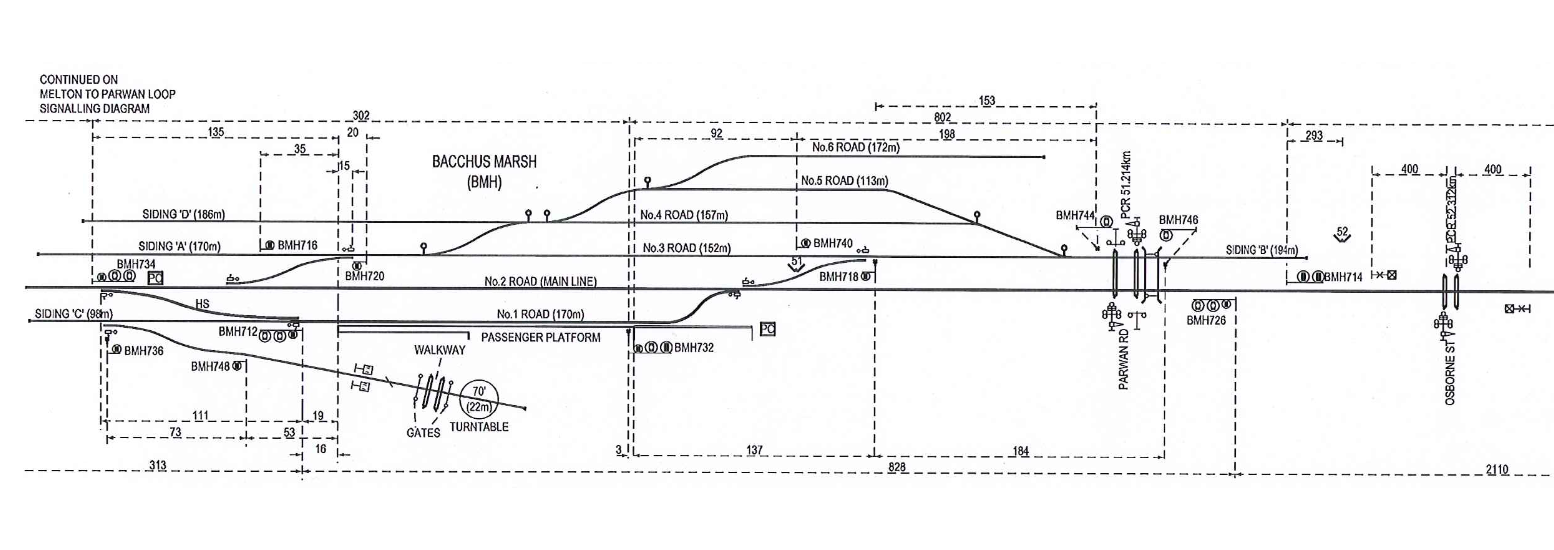
Whenever I travel to Melbourne on the train I pass through Bacchus Marsh (it’s around the halfway point between Ballarat and Melbourne). I recently found a new channel on YouTube featuring Trams and Trains from around Melbourne. Watching the operations in the video below at Bacchus Marsh led me to thinking about an exhibition layout. With the wealth of Ready to run (RTR) rolling stock available and the intensive working of the passenger service (especially the storage of train sets) this could have the makings of a great medium-sized exhibition layout.
First watch the video and then take a look at the signalling diagram below.
Video 1: V/Line Variety at Bacchus Marsh Railway Station in 2012
Image 1: The Bacchus Marsh signalling diagram & Tram layout
I think that there is plenty enough in the track layout to keep an exhibition crew going all weekend. With the station being both a single platform terminus and through platform (with the right hand side going through to Ballarat and beyond) this could be nirvana for DMU & Loco hauled railway modellers. Your thoughts?
Over on the model railroad hobbyist forum, at the outer end of the western spiral arm, is a discussion going on about the ”Challenges of working in a small space’. Sprinkled in and among that discussion are some of the best ideas I’ve seen for organisation yet.
I won’t say that the solutions are available in your country however, they do give great food for thought and we can all work to come up with something similar. Some of the best ones I’ve seen are so simple I wish I’d thought of them.
If you get the chance head over to the link and take a read through. I’m looking at building that second stand. Without an inside modelling location at the moment (I normally model in the garage during late spring, summer and early autumn) I have to be mobile in my modelling approach.
I’m always looking for interesting ideas for small layouts. Interchanges especially can provide a great way to represent the rest of the world on a small layout. And so I segue into today’s site of interest. Note the image below is from the RailPictures.Net site and published courtesy of the photographer Tom Sink. Those GPs sure look handsome in those colours though…
Two South Orient Railroad GP9s (former DRGW) lead a train east of Alpine, TX in 1994 on the former ATSF San Angelo Subdivision.
Recently over on the Rails West blog B. Smith has written about his time on the South Orient. From late 1992 he was the conductor on the railroad working out of Alpine Texas. The list of articles are in the resources section below. One particular piece caught my eye however, in the most recent post:
“The cars coming to the South Orient in interchange are on the Mexican side, ready for us to couple into and bring into the United States, as soon as I unlock the gate.”
An international border, a bridge and an interchange all in one. Ooh I can feel a design coming on already. Inspiration is certainly where you find it, but I’m not sure I’ve been this inspired for some time.
The whole recollection series has interested me. Take the time to visit the blog and read about the line. There’s even a teaser talking about traffic patterns in the future.
For now I’ll leave you with a TxDOT video on the line’s revitalisation:
One of the things that I often wonder about is where things go to die. In my professional life I had a lot to do with the disposing of assets. Perhaps that explains the morbid nature of it all.
Having said all of that twaddle, let’s go on to today’s site seeing.
Site 1 – The Last Journey of Tram 58 (YouTube)
In this YouTube video, Melbourne Z1 class tram #58 shares its last journey from the tram depot to its permanent home at the new Victorian Emergency Management Training Centre in Craigieburn.
Shot in late 2013 this shows some of the places that our larger pieces of infrastructure go on to when their original working life ends.
Further resources
You can find out more about the Victorian Emergency Management Training Centre here in this YouTube video:


![20150730_201931[1]](https://andrews-trains.com/wp-content/uploads/2015/07/20150730_2019311.jpg)

 Andrew's Trains