Category Archives: Site seeing

Posts regarding site seeing for that day.

Site update – Operations pages updated

I’ve completed a complete rewrite of the introduction page to the operations section. In addition I’ve added another page to the ops section to improve the information flow. I wrote the original in September 2014 stating that it would be a living document, and so it has proved.

You can read the updated intro page here. That page then refers you to the new 101 – Ops Intro page which has more information on the subject moved on from the first page. I’ve updated several of the other pages also. There is still more work to do to make a better complete article. I’ll continue working on this section during January and February 2018. More information once I complete the new sections.

I don’t expect that you will agree with me on every point in this article series on Operations. For me it is about creating the conversation, and getting people to talk and think about the subject. I hope that you will use it as a jumping off point from which to refine your own vision of what model railroad operations means for you.

Make sure to comment and share your ideas with me. I love hearing what you have to say.

Site update – Tram pictures update – A2 Class edition

I’ve updated the Melbourne A2 class page with additional photos of the Southbank assigned units.

I’ll continue to update photos as I find or take them.

Site update – Tram pictures update – A1 Class edition

I’ve finished uploading and documenting all of my recent Melbourne A1 class tram photos. You can see the page here: https://wp.me/P47pPY-hi

All the photos are of Southbank trams (with some exceptions where I’ve not driven them). There are some Glenhuntly A1 class trams that I’ve not managed to get photos of – yet.

Keep coming back as I’ll be updating photos as I can get them. And I have a bunch that I’ve yet to get on the website. They’ll continue to come up as I can get the time to upload and write them up.


Site Seeing – January 1 – The new Everard Junction version

Everard Junction was a great finished model railway filling the loft of Richard Warren’s home in the UK (his YouTube channel can be watched here). However, he was unhappy with several key elements to the underlying baseboard design and issues with the loft space itself  that were causing running issues due to temperature and moisture. So he took what I consider to be a brave step and decided to start again from scratch.

With the loft area now completely reworked, insulated and ready to go, the work to build the new Everard Junction (Mark II?) is underway. As I write there are four videos in the current build series with more to come. With much detail each shows what ideas and issues Richard is solving as he builds the new layout. Richard’s baseboard design shows the very serious thought he has put into the new build. A couple of his ideas will make it into my next baseboard design, specifically allowing a removable backscene within the body of the baseboard.

Click the videos below to being watching, and if you find them interesting head over to the YouTube channel and like and subscribe. There’ll be more content about the build shortly and Richard is very good at presenting his ideas and showing his working method. Now onto the videos.

Videos

New Layout Build – Baseboards

Layout Update – November 2017

New Layout Build – Backscenes

New Layout Build – Fiddle Yard

There are a heap of videos on his channel that should be watched for their ideas and his modelling is outstanding. Enjoy Richard’s work; I do.

Site Seeing – 29 June – A new series from Model Railroader – Taking Care of Business

I’ve been quite hard on model railroader over the years. They’ve been very predatory in their behaviour over the years. I even got a cease and desist letter from them at one point because they thought I’d copied part of their intellectual property when I published a corner layout of my design. After to-ing and fro-ing and a level of “kiss my A##” from me since I was in the right, we’ve gotten along well ever since.

However, I may, and I stress only may, change my point of view if they keep up their new free to watch video venture – Taking Care of business. The basis of the idea is to ride along with a crew (in this video SMS Lines switching the Pureland Industrial Park in Bridgeport, New Jersey) as they go about their day-to-day work. The video was entertaining and informative. My concern is that if it doesn’t stay free I certainly won’t be putting up my money to pay for it. Lots of content providers share similar videos on YouTube and other sharing sites that help me understand as much.

Free is good as in beer, and speech. Hopefully MR keeps this series going as free to watch. There is some really interesting content, good production values and I enjoyed the narrative of the story showing the crew going about all of their tasks during their day.

Resources:

  • Video: To watch the video (while it is still free) head over to Taking Care of Business: SMS Rail Lines | ModelRailroaderVideoPlus.com
  • SMS Rail Lines: SMS Rail Lines restores, maintains and operates many historic Baldwin diesel locomotives (in fact I believe they have the largest fleet of Classic Baldwin’s in North America). It’s a labor of love to keep these rare and historic units in-service for future generations to witness. For more just search “SMS Baldwin” on YouTube.

Like this post?

Let me know your thoughts on this post. Like, comment and subscribe to the Hunter Valley Lines.

Site Seeing – May 25 – MRH Universal modelling sizes chart

If you have not become a reader and participant with the crew over at Model Railroad Hobbyist, now is certainly the time to do so. IN the current issue (May 2017) of their free online magazine they have great download: a universal modelling sizes chart.

Has all the major gauges in the chart in both PDF and Excel format free for download.

Go here for the download page.

Enjoy and have a great day.

Site update: 12 April 2017 – the geographically challenged edition

It’s been very busy getting back to work after the long period of ‘under-employment’ as our government describes it. My time has been totally focused on getting through the day and making the changes that will allow for eventual success down the track. Having said all that I got a lovely comment from Peter Walker who is a committee member of the Corio Club.

Peter wrote:

Andrew,
Thanks for the positive report on our 2017 exhibition. By way of feedback the exhibition hall this year was in BELMONT (not Corio). We felt this venue handled the show crowd better and, with support from City of Geelong, have now been able to book that venue again for 2018. Hope your readers don’t look for us in Corio next year?

In reply I wrote:

Thanks for the correction. I’ll make sure to update the post and publish an update to make sure to get people to the right spot next year. Keep me up to date on what’s going on for 2018. Glad to help get the word out for the show.

I don’t mind people pointing out my geographical faux pars. I navigate mostly by visuals and not by map, compass or any other known means of getting from one place to another. I’ve found that often the thrill of the journey is discovering somewhere or something you never knew was there.

Thanks to Peter for bringing my error to light. I really did enjoy the show this year. I know also how difficult it can be for a club (small or large) to find a new premisies, cover your insurance and venue costs, and still make a little something to support your club or the charity of choice. I applaud the committee for being able to pull this move off so well, and from the outside at least,  make it look so effortless.

With Peter and the Committee’s support I hope to bring you more information about the next show in January 2018.

Site update – 20 March – Updated 12 foot home layout design page

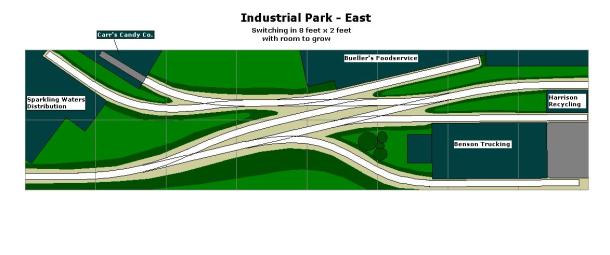
There has been a lot of thoughtful experimentation going on at Andrew’s Trains of late. While I was ‘reasonably happy’ with my Mk 72 layout design I wasn’t joyous about it. Recently while rediscovering some of my older layout designs I came across the design for ‘Industrial Park East’, as shown below, from somewhere about 2006-7.‘. Something in this design called out to me and so I set off on a slight redesign from the Mk 72 to Mk73 version. The changes I made have allowed me to get the ‘flow’, and the look that I wanted. I know this all sounds like something ‘the Dude’ would say from the Big Lebowski at this point but if it doesn’t work for you while you’re designing it, then it sure won’t work for you once you’ve committed track to plywood.

There’s a lot more information on the what, the why and the wherefore on the additional layout design page (yes I added another one to keep it all straight in my head). If your interest is peaked and you’d like to see more click the link in the line above and head on over to read on.

Thanks for reading – now it’s back to your regularly scheduled programming.

Site Seeing – March 18 – The ‘other’ Glendale freight layout edition

It’s been a while since my last post and that is thankfully due to being fully employed for the first time in two and a half years. A full-time job is a very satisfying thing. But I digress.

As I wrote in my March 6th post I’ve worked up another idea for the Glendale Freight layout. Let me say from the outset, that this is not one of my better ideas; especially after seeing Bruce Petty’s original layout. There’s merit in the ideas expressed in the design certainly – it just doesn’t have that vibe going on as Bruce’s layout does in spades. Before I go on to tear my work apart let’s take a look at a 1/12th scale model and why I find them so useful for designing a layout.

So what’s wrong with this layout idea?

  • Firstly the central theme of the design is not the freight station, it is the entrance from staging onto the layout.
  • I wanted to have the train enter through a portal of buildings, cross the street and then go about its business. It’s a pretty skimpy idea right? There’s no meat on the bones though.
  • Why this means to enter onto the layout instead of some other way? Is there some missing story about this means of entrance; did the city grow up around the freight station for example? But isn’t this supposed to be Glendale CA, right? Well, is it?

The layout is overall 8 feet long (2400mm) and each square is 12 x 12 inches (300 x 300 mm). It is 2 feet (600mm) wide. And it’s very linear.

So what would I do different now that I’ve built this mini layout?

  1. Angle the entrance onto the layout,
  2. Angle the buildings and the street to the long axis of the layout,
  3. Cluster the switches near the end of the run around, and finally
  4. I’d make a transition between the industrial area on ‘main street’ at the entrance end and the other end of the layout – making it more suburban

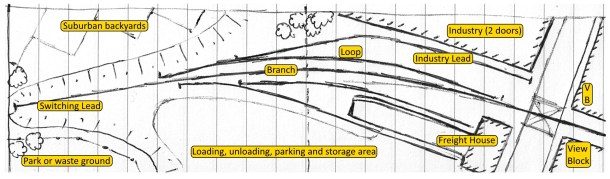
And having had a while to think on how I’d make those changes here’s a rough drawing of the layout that ‘could’ spring from this thought experiment.

This design has gravitas. It is the last bastion of railroading in the inner city, and the edge of the suburbs. Sure there are some strange curves, and I’d rework the industry lead and the industry back wall too. But it is much more interesting and tells much more of a story than the first layout.

This layout could be setup as is with the industries, it could be modified for a single industry layout (say an industrial workplace such as a foundry), or it could be something that I’ve not considered and that you already have swimming around in that pool of ideas in your head. As an aside, I videoed the first layout build process. If interested in seeing that video let me know in the comments and I’ll post it here over the next week or so.

Site seeing – March 06 – Bruce Petty’s Glendale Freight house Module Redux edition

In a post on January 18, 2017 I made mention of Bruce Petty’s excellent module of the end of the Union Pacific’s Glendale Branch and the freight station located there. Bruce’s Module is 5 feet (1500mm) x 18 inches (450mm) but to my eye looks much bigger because of the great use of the space he has made. There is no crowding, no feeling of busyness, only the feeling of a warm summers afternoon in Los Angeles sometime during the 1960s or 1970s. This small scene is evocative and places you immediately in the place and time, even if that is coloured by your chosen time period.

The majority of my layout designs fit into an 8 foot space Bruce’s layout module with the addition of a 3 foot fiddle yard fits right in the space available and would make an excellent display or exhibition layout. More importantly it would fit with any time period from the late 1940s – early 1950s (when I believe that the freight house was built) through to the mid to late 1980s when I believe the freight house fell out of use.

As I said in the previous post I’ve pondered over how to use Bruce’s track plan in other ways. I’ve even worked the design up into a 1/12th scale model to see how it might work. I’ll come back to the alternative in my next post; for now let’s revisit Bruce’s excellent module.

A closer look at Bruce’s module

While this module is a part of Bruce’s larger railroad forming the end of the UP’s Glendale branch it can also stand alone as a layout in its own right. At its heart it is an Inglenook layout. Each of the freight house roads can take two 40 foot boxcars against the dock. For those of you interested in modelling this layout at a later stage it is highly likely that the Freight station never hosted more than 2 x 50 foot boxcars at any one time. If it did so then they would be placed on the right most track with the second car either unloaded directly into trucks as shown in Photo 1 above or set off spot on the left most track and switched out once a suitable space was available at the dock. Lots of switching possibilities here.

Of particular note in the photo above is the connecting piece to the rest of the layout. I like this little yet important touch. The wooden insert which allows the module to join the layout has been disguised as a typical UP/SP bridge. Very smart and ensures that the layout and the module appear to be a single whole and not something that Bruce built later on.

Operation

Operations on this layout would be pretty good too. As we’ve discussed before on the blog Inglenooks are completely prototypical and often used by railroads in tight places. Operating with a locomotive pushing in – pulling out switching focuses on the industry or industries served. The longest track on Bruce’s layout I would use as my switching storage and sorting track. The incoming train pulling outbound cars before spotting them on the long track. Cars would then be switched according to requirement on the remaining two car tracks at the docks. Any cars from those pulled needing to be spotted back at the dock could then be spotted before the locomotive crew pick up the remaining outbound cars and head back across the bridge and back to the yard. And here endeth the session.

Short, clear, easy to achieve, enjoyable and within the 30 minutes to 1 hour per day play time that a small layout should give you. Whether you use a single person (driver/engineer only) or two person (driver/engineer and conductor) crew to do the work the time taken will remain roughly the same. I prefer a two person crew simply because it makes the play time more fun when family or friends get involved.

Hope that this revisit has been of some use. If you like the blog don’t forget to Like and Subscribe. PLease comment if you are looking for more information on layout designs or on the designs I’ve previously posted. And of course take the time to visit the “further reading and resources” links below.

Further Reading and Resources