Category Archives: Site seeing

Posts regarding site seeing for that day.

Site Seeing – The David Barrow fan boy edition – September 24, 2018

We moved back to Australia in 2006. So, I have to live through others when they visit David Barrow in Austin Texas, my wife’s hometown, and where we spent 10 years from 1997. Trevor Marshall visited recently and came away with a great post on the man and his layouts – including his new small (comparatively speaking) O scale layout which really piqued my interest.


David Barrow’s layouts

Hi – my name is Andrew – and I’m a David Barrow fan boy tragic…

I first remember reading about David Barrow’s Cat Mountain and Santa Fé layout in the 1980s in Model Railroader magazine. As a young man, dreaming about my large future model railway plans, David’s layouts (there were at my last count about 17 versions of the Cat Mountain) were my ideal. While I dream of those massive layouts still I took another path to small layout designs.

Recently David Barrow has followed down that rabbit hole, this time in O scale, with a new layout. You can read more about that in the second link below by Trevor Marshall.

David’s layout design and presentation skills are unique in the hobby. Not to everyone’s taste I’ll grant, yet having seen and operated on the layout once in 2005, I did not notice its minimal scenic treatment. I was too interested in the operational side of things.

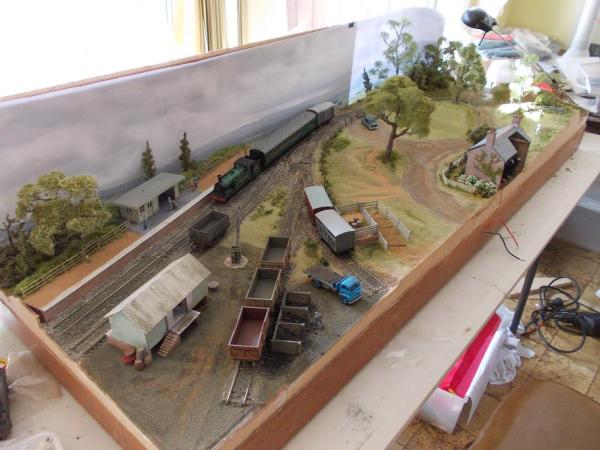
Image 1: Davids Barrow’s entire O Scale layout – battery-powered and operated by radio

Once again the layout design is the centre of attention and the scenic treatment is classic David Barrow – minimalist. However, you can use the design and then scenic it to your heart’s content. Hmmm – now let me see – I have 3 boards in the garage on which that layout design would fit perfectly…

You can out more on this layout in the Model Railroad Planning 2018 publication from Kalmbach.


Resources

Site seeing – the Second Hand Inglenook edition – September 20, 2018

I admire modellers who can get to the meat of a project, quickly and with vigour. Gazmanjack (Gary) on RMWeb used second-hand track, wood and other parts from his modelling left-overs to create a stunningly good small layout for operations. Read on for more.


Linden Ford – the second-hand layout

Gazmanjack (his handle on RMWeb) back in 2014 built an outstanding layout from left over bits and pieces, as an adjunct to his current layout, to give himself something to operate on during the other layout’s longer build. I’ve only just found it and wanted to share the forum post with you.

And what a cracker this layout is. I won’t go into too much detail here, as I think the adage of a picture telling a thousand words is true on this occasion. There is plenty of information in the post too on the build including scenery, tree armatures, and so on.

Image 1: Linden Ford – an outstanding small Inglenook layout

I hope that you find inspiration in the post. So much with so little that turned out so well. Well done Gary!


Resources

Site Seeing – The Super Duper Switch Stand Edition – 9 September 2018


Using Sunset Valley Railroad switch stands on the layout

Operating realism is very important to me. It ensures that those working my layouts move at a realistic pace and in a realistic way. Switch operation is a big part of that goal for me.


The source of inspiration – Port Rowan in 1:64

Originally inspired by a post on Trevor Marshall’s Port Rowan blog, I want to include these switch stands as a part of my operating realism approach.

I particularly like the fact that Trevor uses a single style of padlock to lock the switches along with a length of chain. This ensures that all switches must be unlocked before use, and relocked after use as happens on the 1:1 railroad.

As Trevor says in the blog post, they are more expensive than other simpler options. However, I think that if you have a small layout, and realistic operation is your thing, then the cost is worth it. And they’ll last forever.

I’ve wanted to share this post for a long time, but only recently found all the links again after long searching. I hope you enjoy reading about this and get inspired.


Resources

Site seeing – Op till you drop – Blue flag “Video” edition – August 26, 2018

In my August 18 post we looked at modelling and using Blue Flags for your operating sessions. Thanks to Charles Malinowski’s timely reminder, there’s an additional video for context.


MRR Video Series – Taking Care of Business

Model Railroader magazine has a series of videos (most are pay to play). However some of the best of them are free for you to watch. One of these focuses on the SMS Rail Lines industrial park in New Jersey.

I did try to embed their video (as they offer this as an option – like YouTube) however, it didn’t work. Instead you’ll find below the link for the video. THis will take you straight to the page and then play away.

The video is narrated and professionally shot and edited. It is really well done and shows the operations in the Industrial Park and the blue flag in action. Thanks to Charles for reminding me of the video. I hope that you all enjoy watching and learning.

Don’t forget to comment on and share this post with your friends.


Resources

Taking Care of Business: SMS Rail Lines

Site seeing – Loco dead line edition – August 20

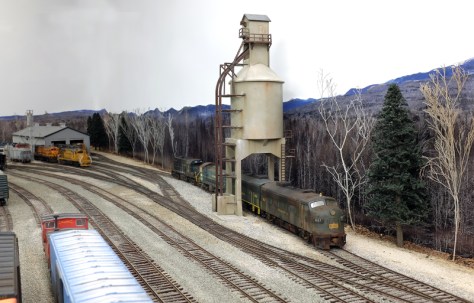
Locomotive dead lines make fascinating modelling subjects. One layout idea that has percolated along for the last couple of years relates to a locomotive rebuilder. A recent post by one of my favourite modellers, Mike Confalone, over on the Model Railroad Hobbyist forums, provides a great starting point.


Modelling a deadline

One layout idea that’s been percolating along for the last couple of years relates to a locomotive rebuilder. One aspect of that design is the deadline, that is, the line of locomotives waiting for work to begin on their rebirth, parts removal for donation to other units, and for some the final indignity – the cutters torch and a change of state to scrap metal. Fortuitously, a small project by Mike Confalone over on the Model Railroad Hobbyist forums has been focused on a deadline too.  Mike writes in the post that:

On the proto-freelanced Allagash, we have a caboose track at Madrid. With the move to 1984 a few years back, the caboose track is used less and less as cabooses begin to become less common. We still run them on most of the road jobs, but most of the locals go without, per the prototype in that era. So, I’ve converted the caboose track to a diesel deadline. Its a bit tight but it’s the only available real estate in the yard and I didn’t want to put them on a remote siding. I wanted the deadline near the engine house. Seemed to make sense.

Click the photo above to go straight to the MRH forum post

There’s five pages of comments and information there as of my writing this post. Being a fan of Mike’s work I may be biased. However, I find his work to be of the highest quality and well worth the time to review. I hope that you feel the same way after you’ve read through the thread.


Resources

  • There is a Megastructures documentary (Mega Breakdown – train overhaul) that is worth watching for an overview if you haven’t seen this type of operation before:


Site seeing – Op till you drop ‘Blue Flag’ edition – August 18

In this post we’ll be looking at blue flags; what they are, what they do and how to model them.


What blue flags are, and what they do

Blue Flags are used in the North American  railroading industry to show that railroad or other personnel are working, on, about, under or between railroad equipment and that the railroad equipment may not be connected to. These signs may be posted at the entry to the track upon which the vehicle sits or may be at, or close to, the railroad equipment itself.

Whoever places the flag is generally the only person that may remove said flag. However anyone from that same ‘craft’ may remove the flag. While this generally applies to railroad mechanical departments many customers have also begun to use the blue flag to ensure that cars loading or unloading have the same level of protection. Railroad crews are so used to dealing with these safety items that ‘everyone’ in the industry understands what their placement on a siding or spur means.

Canadian Pacific’s safety regulations state the following:

12.3.7 Blue flag protection is used to indicate that CP or Contractor Personnel are working on, under or between Railway Equipment and movement of trains or other Railway Equipment is prohibited. Blue flags must not be tampered with or obstructed. Blue flags can only be removed by the person or group of persons who originally applied it. Application, use, and removal of blue flags, when appropriate, may only be done under the authorization and guidance of the Manager in Charge.


Modelling blue flags

Have you considered adding ‘blue flag’ operations on your layout? Adding prototype processes to an operating session provides two important benefits:

  1. It makes the time you spend on the layout more meaningful through the application of, and adherence to the rules, and
  2. It slows down the session and forces you to work in real-time.

Over on the Model Railroad Hobbyist blog of Craig Thomasson he recently described how he builds HO scale blue flags for operations and how they are used on his layout. I found his blog post interesting and think that you might find as interesting and useful as I did.

Resources

If you’ve not met Blue Flags in the operations sense before here are some resources that you might find useful:

Site Seeing – the Switching small customers edition

There was an interesting video posted by Danny Harmon (who goes by the handle of Distant Signal on YouTube).

He focuses on the increasingly rare small switching customer. Once upon a time it was the core of railroading. And while it is harder to find, in some places it can still be found as Danny presents in this video.

Enjoy the video! And if you like Danny’s videos as much as I love his voice then like the video and subscribe to his channel. I have no affiliation with Danny other than as a happy viewer of his content.

Site seeing – Saturday morning video watching edition

It’s been a while since I’ve had the time to post. A range of reasons you’re all familiar with – work, tiredness, time pressure and the needs for others among them. And then that this is at the moment a hobby and not my primary income source (sigh).

While taking a little time out for myself in the early morning (before the sun came up on a very chilly day in Ballarat) I rediscovered the video produced by the folks over at Model Railroader on model railroad operations. Hosted by the late (and greatly lamented Andy Sperandeo) this video is a great introduction to operations, without all the paperwork, and other stuff that can hamper your entry into the realm.

I hope you enjoy, and it is great to share with you Andy’s wit and personality. I miss being able to chat with him as I did every now and then online about operations and the finer points he knew from a lifetime of modelling. Have a great weekend.

Site seeing – the oil soaked track edition – April 15

Mike Cougill over at OST Publications is an inspiration when it comes to modelling track. His work is in O scale sure, his techniques however can be used in any scale to spruce up, or in this case make a mess of, otherwise perfectly good track.

His recent post about modelling oil soaked track is a point in case. Simple, presented in a straightforward style and always willing to experiment Mike’s technique provides a great result.

Image courtesy of Mike Cougill

Mike’s site is full of great articles and ideas. Very well worth the time taken to visit.

Site Seeing – the I’ve got a model room edition – April 1

I’ve been without a modelling space, a dedicated out of the line of fire, not on the kitchen table, leave all your stuff out, style space since the late 80s. A recent move has seen us in a larger space with two spare rooms and a space for our library.

Over my 2 week break from work I’ve gone through my boxes, trying to find all of my collected modelling tools, and I have for the most part succeeded. I’m still missing some critical stuff like my Chopper 2 and Duplicutter along with my set of beading tools that I use to cut a range of river heads. There in a box somewhere but for the life of me I cannot find the blessed thing. Same goes for the NWSL products. I know they’re there, I just cannot say quite where that is for now.

I’ve emptied my mobile toolkits (large and small fishing tackle boxes, and carry totes) to get all of my tools and bits out of the dark and onto the table – making the space look like a the remains of a tornado. So no photos yet – I do have some pride. However, in the short space of time I’ve managed to part complete three little rebuilds from Athearn BB kits, which is more modelling that I have been able to complete in quite a while.

There is a bit of work to get the room into shape. I have a list of honey-dos among them is to build bookcases for our library room. I will add to that list as I need some in my modelling room. These will serve their obvious purpose as well as a base for the switching layout that will be permanently setup in there. More on that in a couple of weeks when I find a tape measure to measure up the room and begin to design something that fits inside the house, and not in the soon to be very cold garage.

I managed to pick up a glass top work desk for $35 Aussie from a local thrift shop (similar to the image on the left). A couple of twists to tighten screws and the judicious use of my allen keys to tighten everything up and the thing is as good as new. The glass top will aid in making scratchbuilt items too.

It has been fun working with my Waldron punch sets and the Historex Hex punch sets and I have to restock all of my depleted punched out bolt heads, and circle plates (great for diesel detailing) from the different grades of styrene.

I’ll post some photos over the next week or two as I get things sorted out. All the best.