Category Archives: Publishing

Site seeing – February 16 – The traction faction edition

Having grown up in a city with electric railways there is always that part of me as a modeller wanting to recreate what I remember as a kid. Watching the sparks pull away from the station and hearing the sounds of the motors change as they reached the limit of adhesion, especially on a wet day, can make me a very happy-chappy when I hear them. You can read more about the history of Sydney’s electric trains at the operator’s site “Sydney Trains“. Being an avid reader of technical stuff when I find really useful information about modelling overhead and trams, trains and trolleys I like to share. Thus onto todays site seeing journey.

Site 1: The East Penn Traction Club

This is not the only useful page on the site, it is however among the most giving pages on the site with a large range of downloads available on all areas of overhead modelling. A large proportion of you are US-based and for those interested directly in modelling trolley systems this is a treasure trove. For the rest of us, a large range of highly useful documents on improving HO model performance, modelling tips and articles and a set of standards that certainly could be adapted to your need without major change can be downloaded.

Site 2: Roundtrees Sidings
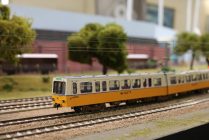
In the mood for traction action today we come to Roundtrees Sidings. Based on Fawdon (Newcastle) on the Tyne & Wear Metro in the 1980s features a working representation of the Tyne and Wear Metro system.

The original linked page had a lot of detail of the design and creation of the model. Sadly that original page is gone from their site, However, there are still some basic details of the model to help you understand size and scope. There is no track plan which would have helped. There are lots of videos available on YouTube however that give a reasonable idea of the model.

There are also, on our favourite video site, a lot of driver’s eye view videos of the Tyne and Wear Metro that are well worth the watch. Especially if you enjoy cab rides.

I hope you get some use out of today’s sites. Leave a comment if you find them useful or have other places of interest you’d like to share.

(Updated on 2023-07-11 by Andrew)

Site seeing – February 13 – The Clamp it edition

Despite what you might be thinking (for those of us old enough to remember this television show) this is not about the family made rich through an accident during hunting for dinner. This post is about creative solutions shared on one of my favourite sites when building to a hard right angle. So despite wanting to tell you a story about a man named Jed it’s time to launch into today’s site seeing adventure.

Site 1: Model Railroad Hobbyist – Clamps for assembling structures

I have thought for some time about buying a right-clamp for assisting building my structures. Especially so since I do a lot of scratchbuilding. When I saw this pop up on my email feed from MRH I just had to share some of the ideas here.

My favourite one (since I have most of these available now) is this creative use of Lego:

Image courtesy of MRH Forums

Head on over to the post and see some of the other great ideas presented there. I have to say though that this one really ticked all the boxes for me.

Site seeing – February 11 – The load of scrap edition

Update and explanation

There has been  a shortage of posts on Andrew’s Trains during February, due to a couple of factors. First and most importantly my eldest is moving to another city and beginning at University. Mum and I have put in a lot of work to get her ready for the transition during January and so far in February. This has included multiple trips back and forth looking for accommodation, signing of leases, paying rent, bond and the government related tasks that need to be done to get your adult life underway. The second reason in my output has been extreme heat events we’ve suffered in regional Victoria over the last couple of weeks. Most homes in town don’t have air conditioning. Ballarat’s climate (being nearly 1500 feet above sea level with usually low humidity) means that apart from a few days each year we don’t need it. However, when the air temperature gets over 35 degrees Celsius (this week over the 40 degree Celsius mark) there is simply nowhere to hide from the heat. February is Victoria’s hottest month and the most dangerous. Enough of all of that for now – on to the modelling.

Site 1: The Design Build Op Blog – Scrap Steel Loads

Image courtesy of designbuildop.hansmanns.org

Mike Weiss, one of the Wheeling Freight Terminal crew members has a very clever method of creating scrap steel loads for gondolas. His approach takes on industry standards, rather than the usual articles in model railroad magazines about making scrap steel loads. Often these articles don’t provide an easy way to remove the loads without a wire loop or hidden magnet. In this article Mike addresses both issues. There is a lot of great information on the blog beyond this post. Take the time to look around. Very well worth the effort.

Site seeing – January 30 – The PowerPoint and PDF edition

Edward Traxler is someone I’ve read about for a while. Only recently did I visit his website. Where I found today’s interesting set of resources.

Site 1: Edward Traxler’s The Deep River Railroad – PDFs and PPTs page

It’s just what the name says folks. A few really good clinic presentations and PDF files for building all sorts of interesting things. Plans for loading ramps, piers, and links to other resources for the interested.

Site 2 – as for site 1 – Building cardstock models the modern way

Also on Edwards site is a great tutorial on building using cardstock (thicker grades of paper). Both a PDF and PPT file are available for download and there is an overview on the page in the link above also.

Site seeing – January 27 – The ‘times they are a changing’ edition

I received an email from Shawn Branstetter earlier this week announcing that his site http://shortlinemodelers.com/ would be closing down very shortly. I was, to say the least devastated. Shawn’s site is a treasure trove of useful articles and ideas.

I contacted Shawn for comment and post it here in its entirety: “Unfortunately it is true Andrew. I’m not exactly sure what I’m going to do with the content however, the Facebook page will remain active. Whiteriver Productions has expressed interest in hosting the content and I don’t want the name to go away I just don’t have time to be a developer, writer, very poor editor and illustrator by myself and find time to build. It’s just too much. Somehow I will make sure all content is available to everyone. As soon as I figure that out, I’ll let you know.”

Site 1: Get it before it is gone – Shortline Modelers

Go see it and grab anything you can now. Not sure how long this will remain available or where it may move to. Check out his cement modelling articles – they are outstanding.

Site 2: Shortline Modelers on Facebook

Head on over to the Facebook page and follow him there if you have a Facebook account. This will keep you in touch with Shawn for the future.

Site update – January 21 – No you don’t need an optometrist visit

In my last post the photos that I uploaded seemed to behave poorly once uploaded through WP.

An overall view of the module

I’ve reworked them all in Paint.NET and uploaded a new set.

I’ve just checked the newer versions and these appear to be better. Sorry for any inconvenience, or for any unnecessary trips to the optometrist.

Andrew

Site seeing – January 18 – the ‘Perfect Storm’ but in a good way edition

I’ve had an idea for a small layout, running around the mouse wheel that I use for a brain, for a while now. What kicked the idea off was a 2013 plan published in the Model Railroader for the Glendale Freight House that Union Pacific built there during what I ‘believe’ was the early 1950s. Bruce Petty has already built a layout based on the real location and using the UP freight house in Glendale. Let’s take a look at that first to see where we start from.

Site 1: The Union Pacific freight station drawings

Step one of this plan is to get a copy of the plans. They are available for logged in users on the MR site by clicking the link above.

Modellers in HO scale will need to enlarge the drawing substantially (which is doable at a local copy store)to be able to build directly off the drawing.

Big thanks to my next site owner for the idea about doing that. He uses the protective sleeves (clear plastic ones) to build on.

The model once completed using liquid polystyrene cement does not stick to these plastic sleeves and Bruce simply lifts the completed side of the model off the sleeve. Plan protected, model free, what’s not to like about that? I just wish I’d thought of that all these many years later. I did mention that I have a mouse driving the wheel that powers the mental machinery, right?

Site 2: Bruce Petty’s LA River Railroads site

Bruce’s website is a trove of information on the railroads of LA. His layout looks fantastic too. Of most interest to me was his article on the Glendale freight house build which you access from the link above. Well worth reading the entire page and taking in the method of building it. Clever, clever man!

This building rests on his Glendale module. When speaking to him via email earlier this week he told me: “… the modules for my layout are 18 inches wide and 5 feet long. If I ever move the layout goes with me easily taken down. All structures
and small detail parts come off the layout. On the Glendale module only the loading dock stays as it is concrete. No big deal to take this module down off the shelf brackets, it’s the end of the UP Glendale Branch.

Essentially the layout is an Inglenook (and exactly as the original). Bruce says that just like the original “… it gets switching crews from Southern Pacific and Union pacific. It’s a fun module to switch on and I can take it to shows.” What more do you need?

In the next post I’ll be taking a look at how I’d like to model this location as a stand alone layout. I’ll be taking a slightly different tack to Bruce’s excellent representation. I’ve been thinking about using an interesting technique to cover off the gaping hole in the wall exit to the fiddle yard that ought to work perfectly for this design; and all in 8 feet.

Additional resources:

Bruce has kindly provided me with images of the layout module. My thanks to Bruce for his kindness in being so willing in talking to a stranger and being willing to take photos of his layout especially for me to share with you.

All included images above are copyright of the creator and author: Bruce Petty. Used with permission on Andrew’s Trains.

Site seeing – January 15 – the too dirty may not be dirty enough edition

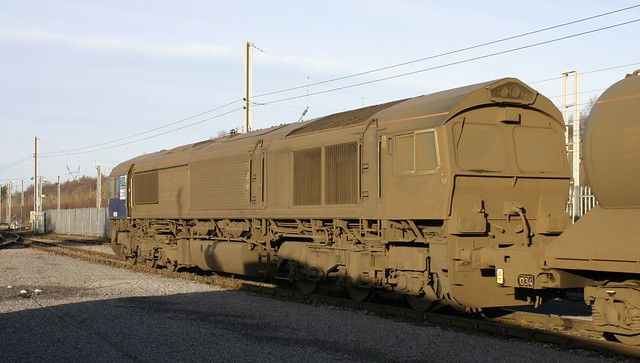
In the past I’ve seen a lot of weathering done that I said was too heavy, unrealistic. Something that you’d never see in the wild. Today I reviewed one of Adrian Nicholls photos on his photostream on flickr.

Dirty Diesel Season. 66 301 at Kingmoor TMD.Image courtesy Adrian Nicholls – via flickr

I take it all back. Adrian says on the site: “66 301 catches the late afternoon sunshine at Carlisle Kingmoor TMD after its 21 hour diagram on train 3J11 the North West RHTT circuit, (17.15 to 14.05). The loco has just been fuelled and is waiting while the water jetter generator and rear loco (66 427) are dealt with. It will then do the whole circuit again hence the accumulation of filth on the locomotive as there is little depot down time on this circuit for cleaning. Never a very pleasant time of the year to deal with locos in such a condition as what every you touch is covered in filth off the track and a drivers railway uniform can soon resemble a fitters overalls if you are not careful.

I guess you really have to model from the prototype. I would never have thought of making a locomotive this filthy. But there you have it.

Site update: 02 December – More weathering photos

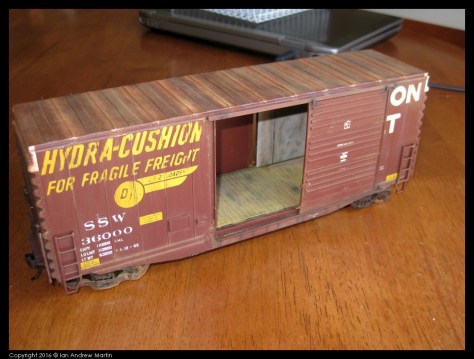
I’ve completed the remaining weathering of the body of the 40 foot Hi-Cube. There may be one or two more minor tweaks that I’ll make to get that just right look, overall I am very happy with this cars look. As an experiment using multiple techniques that I’ve not used altogether before I’m very happy and will try this next on a HO scale car. Where are we up to?

Flash on showing most of the car completed

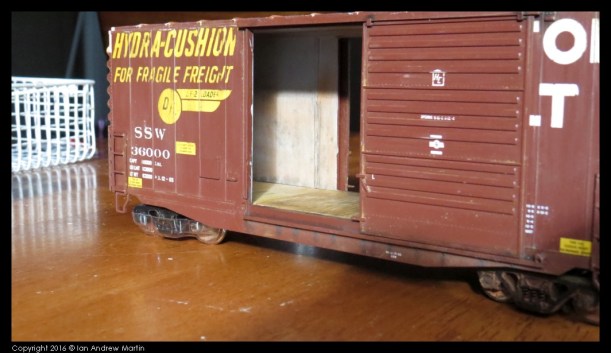
The second round of body and roof weathering has gone on. Keeping in mind that this car ran mostly in the dryer states and most of that in Texas in my modelling location there is a preponderance of dust and rust and not a lot of rain weathering. I believe that I have another of these cars in my O scale stash and will document the weathering as I go in the next week for all of you.

Interior shot showing the walls and weahtering
Interior shot showing the walls and weathering

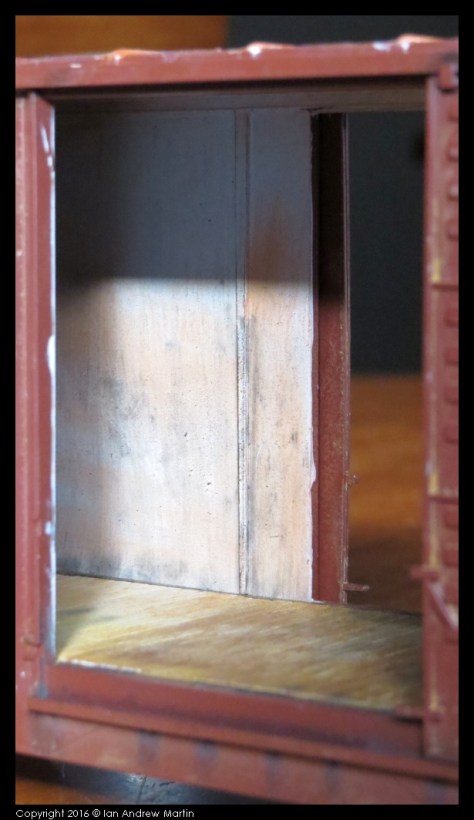
I am particularly pleased with the internal look of the car. I hand painted the interior since I wanted a little tooth on the interior of the car, adding some Acrylic Painting Medium to the cheapo acrylic paint to thin and help it settle.

Close up of the wall and floor weathering

Minor touch ups to the door openings remain, to add the dings and rusting, prevalent around boxcar doors. Overall I’m pretty happy with the outcome. There are still the trucks to do, but we’re getting close. More again soon.

Site update – November 29

I’ve been laid up the last two days due to some (hopefully) simple skin surgery to remove another unusual mole. Being unable to lift or move too much this week gave me some much-needed time to catch up on some modelling that I’ve put off for far too long. Today’s work has been added to the weathering section, and shows Atlas O’s completely incorrect model of the Cotton Belt 40 foot Hi Cube.

A little history

The real SP & SSW cars in SP class B-70-36 are both small in number and used in captive service for high volume – low weight appliance service from major appliance manufacturers to distribution centres. The cars were 40′-6″ long hi-cube box cars; they were all built by Pacific Car & Foundry in 1966 and had 5001 cubic foot capacity, Hydra-Cushion underframes and 10′-6″ Youngstown sliding doors.

Image courtesy T. E. Cobb via railgoat.railfan.net

They came to be nicknamed the “Ugly Ducklings” due their awkward appearance. Built for appliance service and used later in their life for other roles the SP cars in class B-70-36 were numbered as follows:

  • SP 659100-659111 and had DF-B loaders

The Cotton Belt cars (the highest number) in class B-70-36 were numbered as follows:

  • SSW 36014-36126 DF, DF-B, Car Pac loaders

The car being weathered, as provided by Atlas, is car number 36000 which was a wooden sheathed car of a completely different class. The car is actually a Pullman-Standard built Hi-Cube boxcar built for the D&RGW in November of 1967 (see image below). Built for Whirlpool appliance service D&RGW’s 67422 (shown below) had Equipco load dividers and was assigned to load on the Erie Lackawanna at Marion, Ohio. 67422 was also equipped with Pullman-Standard’s ‘Damage Free’ Hydroframe and was painted in the Grande’s contemporary ‘Action Road’ livery.

Image courtesy of James Belmont via railpictures.net

Weathering the model

On this model I’ve tried a multi-disciplinary approach. I’ve used just about everything in my weathering tool chest. Oils, Acrylics, RustAll and Weathering Powders. It’s a bit of an experiment in seeing how to integrate all the different techniques I’ve used. You can head on over to the new page now or take a look at a couple of images of the work today.

Early afternoon shot of the weathering on the roof
Lower resolution image showing the weathering on the floor

I’ll be posting more photos tomorrow as I work on finishing this car. Enjoy the full-page.