Category Archives: Publishing

Site seeing – June 18

Cutting Costs and Styrene

The costs of buying sheet styrene has gone up a lot recently. Let me say that I love my Evergreen styrene; I could not model what I model without them. I recently updated and added to my modelling stash of shapes for upcoming projects. Luckily I found a local supplier who is among the cheapest in Victoria for Evergreen.

However, when you need a lot of sheet styrene buying multiple packs of 40 thou (1.0 mm) and 20 thou (0.5 mm) styrene gets expensive very quickly. A business friend bought the local plastic company here in town a couple of years ago and he has these thicknesses of styrene I use most often (called HIPS in the trade in Australia) available in 8′ x 4′ (1200 x 2400 mm) sheets. At around $A22.00 for that size of 20 thou sheet and double that for 40 thou sheet you can see that there is some serious savings to be had buying that way.

Site 1: General Plastics Ballarat [+ Link]

Dale, the owner of General Plastic in Ballarat, is always helpful to modellers and a lot of modellers use his services to get what they need in the Western Victorian region. Dale has a full set of products and can get whatever you need. More importantly Dale has added a Laser Cutter and can cut whatever you need directly from your CAD file. If you live close by drop in and say hello.

Site 2: Harper’s Hobbies and Collectibles  [+ Link]

Harper’s’ Hobbies in Wendouree is becoming a really great place to visit. Ballarat is not short of good model sellers. What makes the difference is that Harper’s has the basics you need to scratchbuild, along with a really good tool choice. That makes a difference. Also they have begun to stock the Warhammer 40K range of kits that my son is right into.

While the sites are really Western Victorian focused today, perhaps you’d like to share your favourite modelling suppliers. Leave a comment and share.

Takeaway

If you buy larger sheets of styrene, one big problem is storage. Here’s what I do:

  • Cut the sheet into 4 pieces across the sheet with shears of large scissors
  • Using plastic clamps, join all four sheets to keep them under control.
  • That way when you need it you simply cut off what you need, and then rehang the remaining pieces.

Talk to you later.

Site seeing – June 10

I love YouTube.

It has changed the way we see a lot of our entertainment. As a modeller I now have access to the widest array of videos both current and historical that I could want. While tooling around today I found the following videos that I thought would be of interest for those modelling from the mid 1930s through to the 1960s in the UK, specifically in the quarrying industries.

Site 1: YouTube Video – Teeth of Steel

It is a great video created during the war, in colour no less, showing a lot of pit operations, including moving walking drag lines.

https://www.youtube.com/watch?v=hQKtrZXSE4E

Site 2: YouTube video – Steel

This second video goes into detail of the British steel industry. Filmed right at the end of the war, with all the rebuilding works about to kick in it showcases the quality and craftsmanship of the British steel industry. Watch for the scenes of Ironstone railways.

https://www.youtube.com/watch?v=62QuEiD6R_k

I hope that you enjoyed these videos. There is a lot in there for the modeller to take note of especially with the older mechanical tools of the time period.

Site seeing – June 6 and 7 – SUFE – what it is and why we’re dealing with it

Unlike my other posts this one is extremely personal. My aim is to highlight a condition that is affecting children around the world and that has serious repercussions for their long term health, physical and mental, and their long-term well being. They say that we know around 2500 people as friends, relatives, neighbours and acquaintances.

SUFE affects approximately 10 per 100,000 children. SUFEs are most common in adolescents 11–15 years of age and affects boys more frequently than girls. The left hip is more often affected than the right. Over half of cases may have involvement on both sides (bilateral). The chances are that someone in your sphere of influence knows of or has a child suffering with SUFE.

Our story

When my daughter was only 12 she had her SUFE; not only did she have this serious medical condition, but also Avascular Necrosis – the most serious form of the disease. She turns 17 later this month and her youth has been unlike that of most of her contemporaries. She had complained of a sore knee for perhaps 3 months before the onset of SUFE and we attributed it to her love of Netball; unfortunately we were wrong in our understanding and assessment.

Just after her 12th birthday, we heard the femur and the ball in the hip part company, it sounded like a snap of the fingers. It is a sound that I hear every night. I relive that moment often. What followed was a journey of ambulances, hospitals, hip surgeries, screws, pins, scars, tears, pain, long and painful physio, recoveries and the incredible guts, determination and bravery of the young woman who carries my genes forward.

This last Friday and Saturday she and I spent more time together in Melbourne’s Royal Children’s Hospital in Melbourne for what we hope is her final teenage surgery. We think that the next surgery for my daughter means a total hip replacement. Her surgeon and her mother and I are all hoping that we can stave this off for as long as possible. Right now our aim is to get her to 25 before that surgery. But nothing in life is a certainty.

Site 1: What is a SUFE [+ Link]

According to the website of her surgeon Slipped Upper Femoral Epiphysis (SCFE or SUFE) is a very common condition in the rapidly growing child. It results in effect a slippage of the femoral head (ball) from the rest of the femur. It is like a fracture through the ball/neck junction, but it behaves very differently. This is due to weakness of the growth plate. Most often, it develops during periods of accelerated growth, shortly after the onset of puberty.

Site 2: What is Avascular Necrosis [+ Link]

Avascular necrosis (AVN), also called osteonecrosis, bone infarction, aseptic necrosis, and ischemic bone necrosis, is cellular death (necrosis) of bone components due to interruption of the blood supply. Without blood, the bone tissue dies and the bone collapses. If avascular necrosis involves the bones of a joint, it often leads to destruction of the joint articular surfaces. Read more about it at the link above.

What we can all do about SUFE and other diseases like them

The best way we can find cures and better treatment regimes for our children and grand children is to make sure that our local Children’s Hospital gets fully funded. That means raising funds and awareness of the medical needs of children. My wife Jan has worked with our local, state and federal politicians to advocate for the disease to be recognised as a critical care incident, and to make sure that it is considered as a serious long term problem that needs to be addressed.

Each year our family help the Royal Children’s Hospital in Melbourne by assisting with the Good Friday Appeal [+ Link]. In addition to raising funds on the streets of Melbourne, we also as a family donate to the cause that has given so much back to our daughter.

Further Reading and Resources

From the Royal Children’s Hospital website:

Alex’s Surgeon’s SUFE Page

A UK website on SUFE

Final words

There is nothing worse than planning for the worst, while hoping for the best. It is soul destroying, despite being very pragmatic. Alexandra has been through so much in her life. So far she has spent more than a day and a half (about 37 hours) on the operating table to try and save her hip. Despite all our best efforts her Doctor’s have advised that her hip is old and aged, and they cannot give her any real idea of when it will fail.

It’s not often that I’ve seen someone given bad news take it so well. Even more so when you are almost 17 and looking forward to your Debutante’s ball. Last night she cried long and hard. Tonight and in a different way it is my turn. Thanks for letting me cry out.

Site seeing – June 3

I’ve made mention and blogged about weathering on the HVL before. I consider good weathering to be the epitome of model railroad painting and finishing. Without some weathering freight cars and passenger cars simply do not look lived in, run and used. Thus on to today’s site…

Site 1: Model Railroad Hobbyist Forum – Weathered Covered Hoppers for the L&IN [+ Link]

Do I need to say any more?

Make sure your Tetanus shot is up to date, put on your overalls and get stuck into this thread. Amazing stuff and Tom Johnson’s tutorial is outstanding.

You can skip straight to the tutorial by clicking the link here: [+ Link]. My advice thought is not to. This thread is like a great steak, or a nice chocolate cake, it should be enjoyed, and not devoured.

All the best and read the entire thread, this is really a master class in weathering in Oils.

Site seeing – June 2

Small layouts ‘can’ present a problem should the builder underestimate the impact of the types of industries chosen for the layout. For example, a grain elevator may have 20 car spots to be either loaded or unloaded. It sounds like a lot of work to get that grain elevator switched out. However, unless there’s specific switching movements required this job could well be long (as you wait for the first car to be loaded or unloaded, then move forward, and repeat the process over again) and could turn out to be very boring.

NOTE: There is an example of one such elevator in Melbourne, Victoria that I’ll share that proves the exception to the rule.

On the other hand, a single siding with say six spots, each having a specific commodity billed to the spot, can need more brain power and work to complete in a session. This  may provide the answer those who are looking to add more play value in the game that we call Model Railway Operations.

Site 1: Spot order and small layouts [+ Link Here]

Recently on the Port Rowan blog, Chris Mears talked about this same issue. In this post he describes what simply the concept I mentioned above and gives some great references for you to take away and think about for those industries on your own layout.

I hope that you enjoy the read. If you do leave a comment for Chris. He loves them and answers every one.

Site seeing – June 1

Over on Gene’s P48 (Proto 48 – Fine US O Scale) blog he’s building the first of a series of Wilson meat reefers.  Today’s first post provides some information about the series of cars that he is building. The following articles are bringing the build process up to date so far.

While the articles are about building a car in American Proto 48 O Scale there is much to be learned about scratchbuilding from gene that can be applied to any scratch build or bash project you might have in the work. Take the time and take a look around. I’ll be applying the techniques Gene’s been writing about to my future modelling work.

Site 1: Commentary – Meat Reefers [+ Link Here]

This article provides a run down of the types of reefer and some of the inaccuracies in existing models of this type.

Site 2: Modeling: Meat Reefers [+ Link Here]

This is the first article on building the reefer. The focus of this article is on the basics of the design and starting the body.

Site 2 Modeling: Next step on the reefer [+ Link Here]

The second article focuses on the steps to complete the basic body. This includes some really great ideas on how to complete the sub-roof for structural integrity and the visible roof.

Site 3: Modeling: Refining the door and the roof [+ Link Here]

In the third instalment of this series Gene focuses on fixing a problem with the door, take note, after he had already built it, and focuses on refining the final roof structure.

Site 4: Modeling: Simple Fixture for Roof [+ Link Here]

Gene shows the fixture he built for measuring and cutting the roofing boards.

Site 5: Modeling: Wilson Underframe Construction [+ Link Here]

Gene goes on with the build this time focusing on the under frame.

Site 6: Modeling: Progress on the Wilson reefer [+ Link Here]

Gene continues with the under frame, focusing on building the bolsters.

Sight seeing – May 26 (Albury, NSW)

Apart from better weather, warmer temperatures, gentler breezes and being in NSW, Albury has nothing on Ballarat. Well except for the better weather, warmer temperatures, gentler breezes, being in NSW and the recent Murray Valley Modellers exhibition that was held last weekend on 22-23 May 2015.

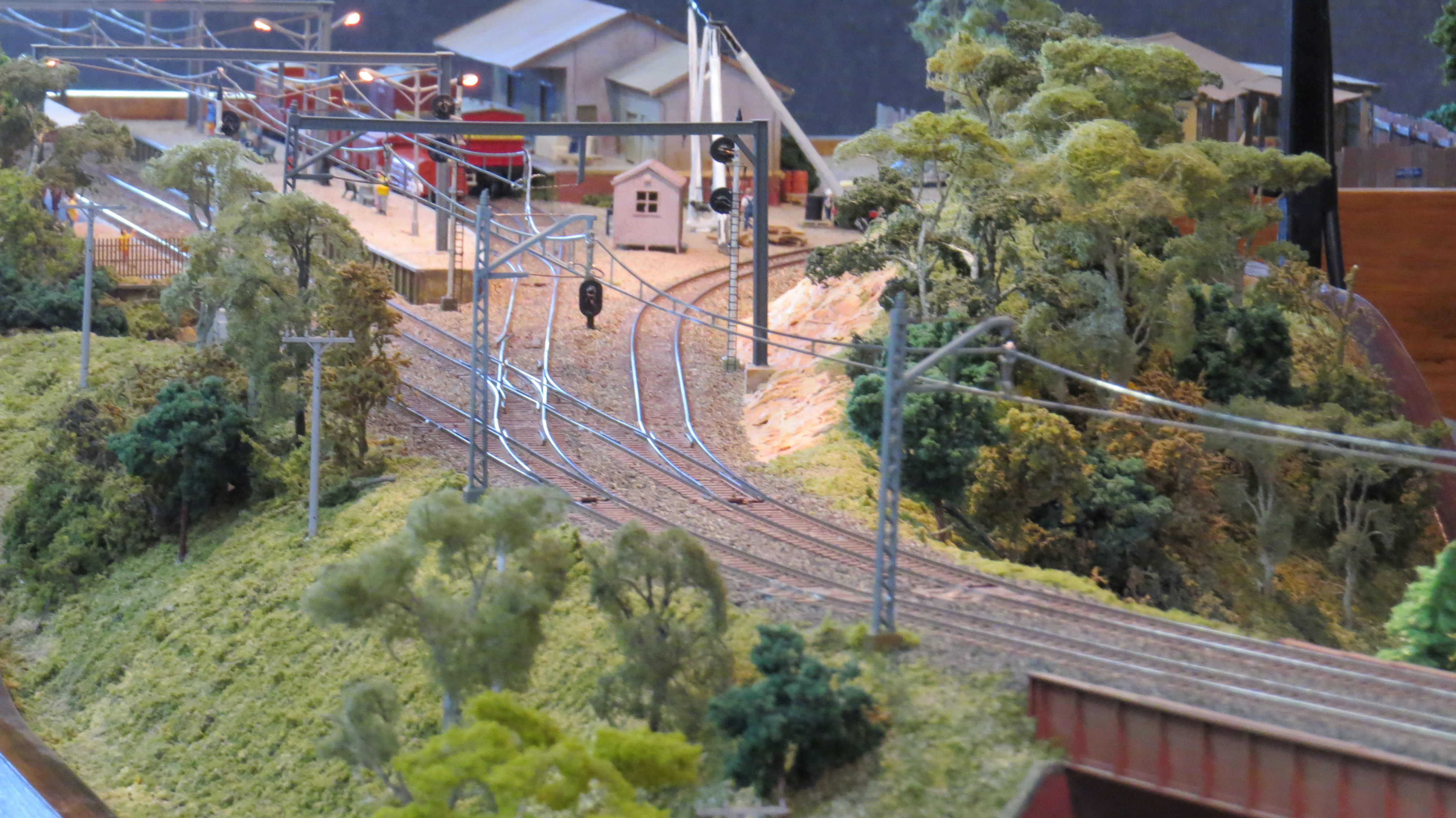
One of the junctions on Town and Country

Image 1: My current favourite exhibition layout – Town and Country

It was a relatively large show, for a country show, with a lot of vendor support from around the region.

Layout’s of note

1. Town and Country – HO scale – Gavin Shuttleworth

Town and country is a fictional HO scale layout of the Victorian railways 1970’s to 1980’s era where the country meets the city with a suburb in between. The structures are either scratch or kit built from timber and styrene while the power is from a mixture of analogue and DCC with computer controlled automation.

I think the best part of the layout is that we have electric heavy rail, running under wires. There’s a lot of pictures for you to see, as I took quite a lot of the layout this time. I only managed to get a few shots in when I first saw the layout at the Geelong West show in January.

You can see all of the photos here [ + Link ] .

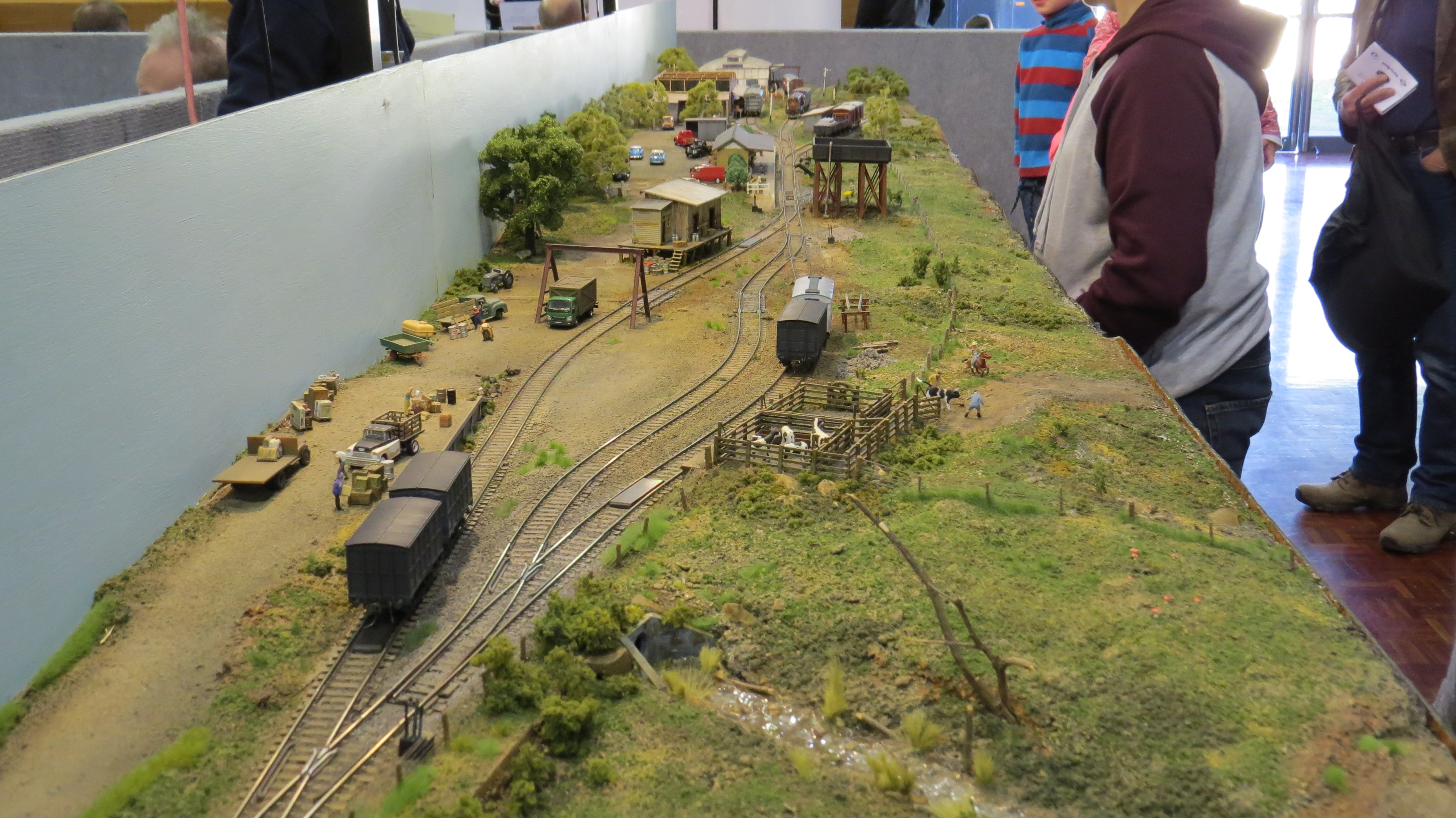
Batlow - in HO Scale model form

Image 2: the standard of modelling on Batlow is outstanding

2. Batlow – HO scale – Andy Lawson

Batlow, a small town in the foothills of the snowy mountains is famous for its apples.
Featuring a packing house and cannery as the two main industries as well as the goods
yard this small layout has lots of shunting to be done. This layout depicts the railway
as it was from the mid 1960’s following the days of steam.

Image 3: a track diagram of Batlow (Source NSWRail.net)

The only issue I had was with the control of the layout. It looks like the layout is DC controlled; the lack of DCC and sound really hampered the layout in gaining my vote for best layout.

The shunter (a new model Alco 48 class) shot off from a standing start, screeched to a stop and had all of the problems of those nostalgic layouts I remember from my youth. The modelling however was first rate. As you’ll see in image 4 below.

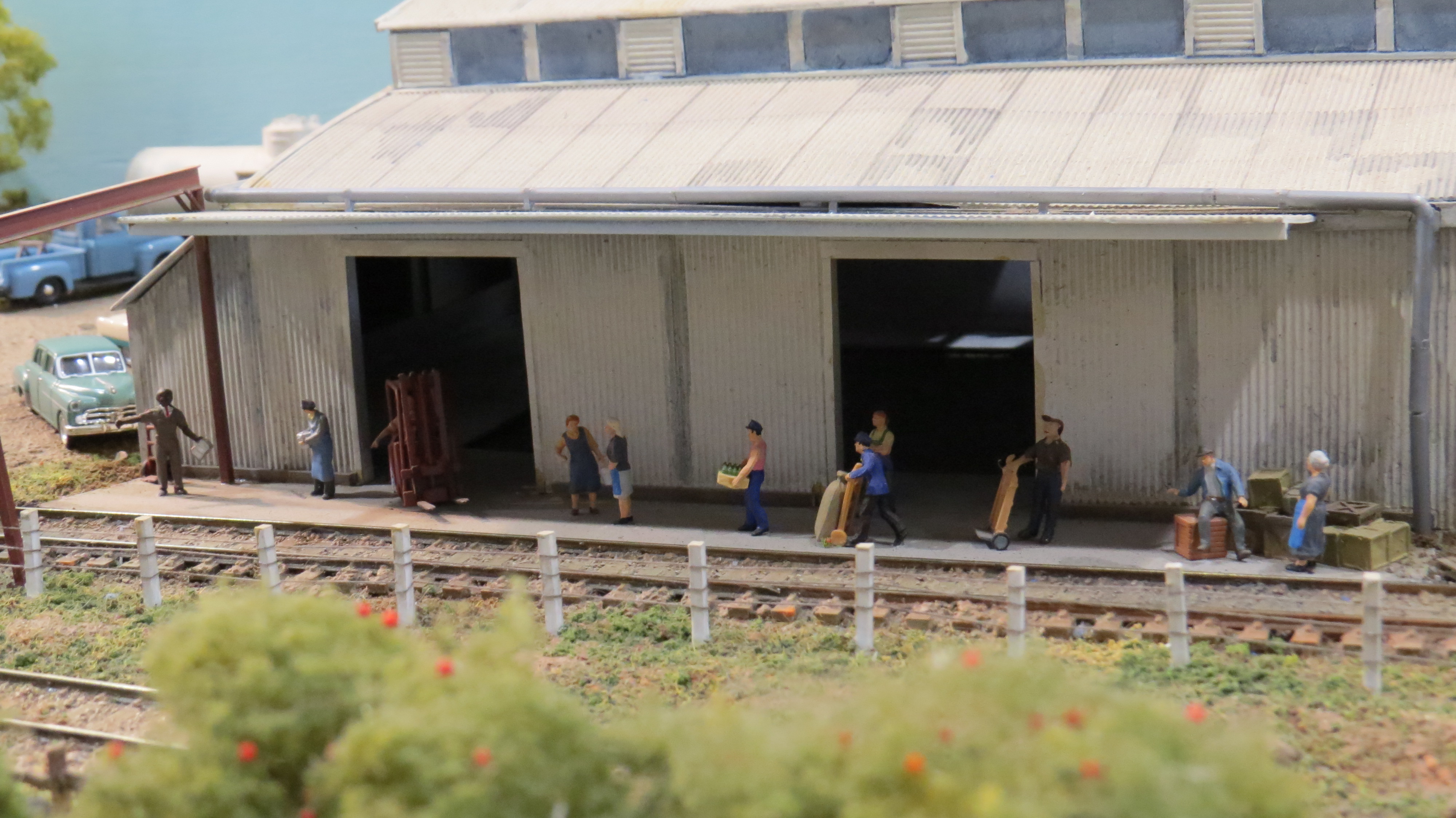
IMG_0929

Image 4: The packing house

For the Batlow gallery click here [ + Link ]

If you got the chance to go, I’d be interested in finding out what you liked.


Site seeing – May 23

I’ve mentioned before how much I love taking my time when I’m working my layout. While reading Lance Mindheim’s blog [ + Link Here ] the other day I came across one of his older posts talking about exactly that; so I thought that I’d share Lance’s words on the subject.

Site 1: Lance Mindheim’s ‘Capturing the Essence of Industrial Switching Operations

I’ve followed Lance’s thoughts for a long time and while I don’t always agree with everything he writes I do agree with this article.

Specifically he writes: “Industrial switching operation is characterized by a slow, purposeful, rhythmic cadence. Locomotive crawl at a few miles an hour as they pull cars from the deck and deal them with precision to the customer’s door. The atmosphere is one of mass, momentum, and the sound of 2000 horsepower prime movers constantly throttling up and then cycling down…over and over and over.”

While it is a long post, there is a lot for the person interested in switching, but lacking in the understanding of what really goes on in the real railway world to absorb. Hope that you enjoy the article. It’s 4 years old, yet still as valid today for the switching minded as when it was written. I dare say it will remain as valid for many years to come.

Image 1: An image of one of Lance’s switching layouts

Site seeing – May 22

Off to the Albury model train show this weekend (a 4.5 hour drive north of home). Looking forward to that. If you get the chance drop in. I hope to be there on Saturday morning. I’ll be the big boof-headed Ballarat bloke wearing a big green hoody. Say hello. More on the layout next week.

Site 1 – Murray Railway Modellers [ + Link ]

Yep – it’s on again this weekend, and I’m going. Could not get there last year, but this year I am going.

You can see the program here (a very forward thinking club they’ve put the program guide online as a PDF – well done that club). Saving paper and time as you know what’s there before you go.

Site seeing – May 1

A month down the track and I am on the mend after discovering the joys and pitfalls (and there are no joys) of kidney stones. Not being in constant pain is allowing me to get back to normal operation; thanks to the skill of the urology team at the Ballarat Base Hospital.

But enough of me, and on to the first of this month’s site seeing.

I grew up with a very Scottish grandfather, very Scottish. I listened in awe as a child to his stories of the highlands. Working for the railways (in Australia) all his working life, it was perhaps fated that I should fall in love with the Scottish highland railway lines. One particularly holds me in awe all these years later – the line out to the Kyle of Localsh.

In the very early 1980s Michael Palin’s Great Railway Journey’s travelled the line, and quite apart from being a fan of Michael Palin this program only made my yearning to travel it greater. It still is on the top of my railway journeys bucket list.

Over the years there’s been a couple of great layouts on the highland lines. Two that come to mind are presented today.

Site 1: Portchullin – a layout by Mark Tatlow

I love the sound of diesel engines working, doing what they are supposed to do; industry, grime and dust. Hearing a diesel notch up, lifting its train, from station, industry or yard reignites my passion for modelling. I don’t know why; it just does.

While ‘tubing recently I came across Portchullin. It ticks all the boxes for me on how a great North of Scotland layout should be built and come to life.

You can watch “A day’s trainspotting at Portchullin” here:

Best of all the creator of the layout has a great website with lots of useful posts (which I’ve just begun to follow) here: (Offsite link)

If you are a signalling buff like I am, you’ll enjoy the excellent working signalling on the layout too. Mark also sells (albeit as a small run manufacturer) parts for signals, which you can also find on his website.

Site 2: Kyle of Tongue – a layout by Steve Flint

Featured in the February 1990 Railway Modellers magazine, this layout was completely immersive. You could feel the cold coming off the highland hills, and leaching into your bones. Unfortunately images are hard to come by on the web. However this image shows Port Pennan also by Steve Flint I believe.

This ought to give you an idea of the layout style that Steve is famous for.

Resources:
Great Railway Journeys – Confessions of a train spotter