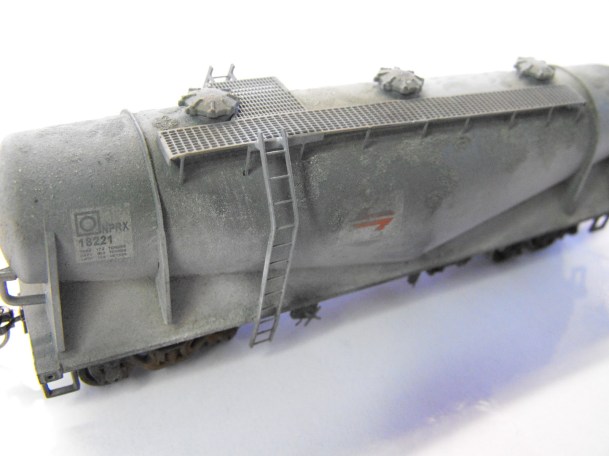
Category Archives: Publishing

Site seeing – September 12 – The photography of Weston Langford

I recently discovered the work of Weston Langford through another model railway blog. All of his work has been released under the Creative Commons Attribution-NoDerivatives 4.0 International License.

Site 1: Weston Langford Railway Photography

Subtitled as “Documenting railways and related infrastructure since 1960” the website is now being maintained by Weston’s son-in-law, Andrew Godfrey. And what a treasure trove it is.

Image courtesy of http://www.westonlangford.com/

Weston had a long career as an engineer in and about the railways in Australia and interestingly on the Canadian Pacific Railway. His life in pictures (all 38,325 of them) is a gift passed down to us. And something that we should be thankful for and respectful of when using them.

The only niggle that I have – and I know this is a personal issue – is that you cannot search all images of a location – without knowing some information about the image. Wildcard searches are not allowed. Apart from that though, by looking at his CV you can get an idea of where he was and therefore narrow down the search by using the year and month to reach the results that you want.

Take a look around and enjoy the images and not only of Australia but across the working world of Weston Langford.


Site seeing – September 11 – The cause weathering is cool edition

Weathering is cool. Having said that, it is an art that takes time and experience to master. Today’s modeller has a very skilful eye and has nailed so many subjects that I just had to share.

Site 1: Dean Bradley’s Rails in Scale blog

Courtesy of Dean Bradley (http://railsinscale.blogspot.com.au/)

Focused primarily on NSW railways in the years between 1986 and 1989 Dean’s work is very skilful. I showed a teaser image at the end of my post from September 09 this year of one of his 46 class electric locos. Got some nice feedback from that and having had the time to look over Dean’s other posts wanted to share his work.

There are not a lot of ‘instructions’ regarding his weathering technique which is a shame. However, Dean’s results speak for themselves. About the best blog post for understanding Dean’s full weathering process is from 24 October 2013 and titled ‘On Track models NHEF Hopper – weathering tips‘.

Site 2: Dean’s Facebook page

Apart from being a very good modeller and weathering artist, Dean is also a manufacturer and contract weatherer. Have a look at his Facebook page for more information and for lots of model photos of his work.

Site seeing – 10 September – All you ever wanted (or needed) to know about Inglenooks

Since we’re on somewhat of a roll with the Inglenook this week and it’s uses in small layout design let’s go to the source of all things Inglenook.

Site 1: Adrian Wymann’s “The Model Railways Shunting Puzzles website”

If you’ve not heard of Adrian’s site before then you are in a for a treat. This site has everything that you ever wanted to know about shunting puzzles, including the Timesaver and the Inglenook.

Image courtesy of Adrian Wymann

Of interest for those of us thinking of building a layout using the Inglenook design is the discussion on the design of operation and movement for the layout. Additionally there is the mechanics of designing and building the layout also. Very well worth the look.

Site 2: Adrian Wymann’s layout “Little Bazeley-By-The-Sea

Putting the Inglenook to work Adrian’s great little layout deserves a look. Well designed, well executed and well presented Adrian walks you through the design and build process and provides a lot of insight into the process.

Image courtesy of Adrian Wymann

Head on over to the websites and do a bit of reading – you’ll not be disappointed.

Site seeing – September 09 (the follow-on Inglenook folio edition)

Yesterday we looked at Yandilla Sidings, an excellently presented Australian Inglenook exhibition layout (read more about that post here). Today we have another Inglenook that jumped out at me on the Micro/Small Model RR Layouts group on Facebook.

Site 1: Ben Gray’s “Rozelle Street” layout

First we need a little context before we get to the layout’s brilliance. As a Western Sydney boy, I regularly saw long and short freights during the 1970s come through Blacktown in Sydney’s west before and after school. Living in Marayong on the Richmond branchline we had regular freights to and from the Riverstone Meatworks, and further up the line to Richmond itself.

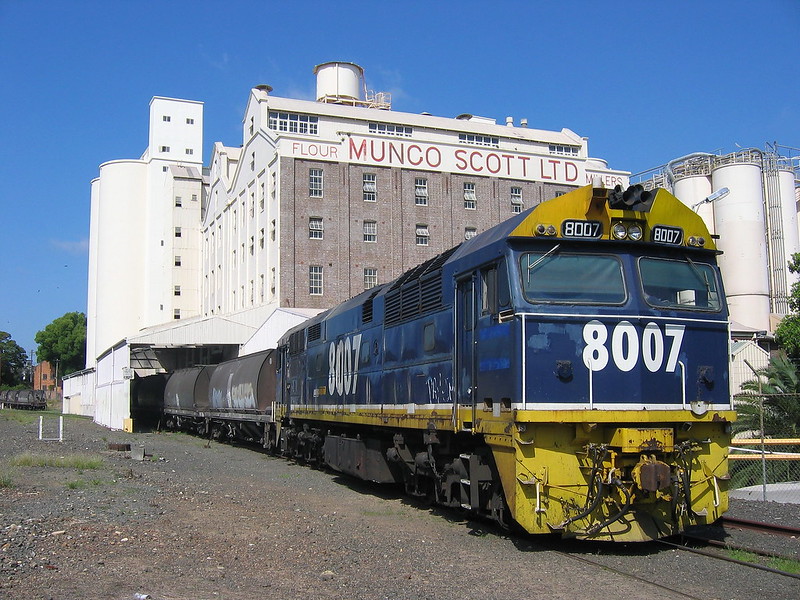
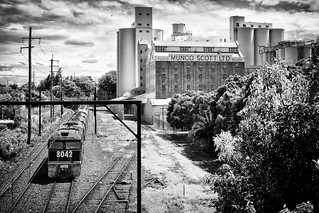
In the inner west (when I could wrangle a train trip into the city) I saw several locations that I always thought I’d like to model. The Mungo Scott flour mill siding for one as shown below seemed ideal. It was inner-city, working class, railway grit that has had me fascinated all my life. Here’s two examples from that location.

Image courtesy of Rob Cook

8042 at Mungo Scott

Image courtesy of Trent Nicholson

So now that you have a visual context of the type of layout that I’d always wanted to build let’s take a look at Ben Gray’s vision of inner city railway industry in a small space (not that you’d notice).

Image courtesy of Ben Gray

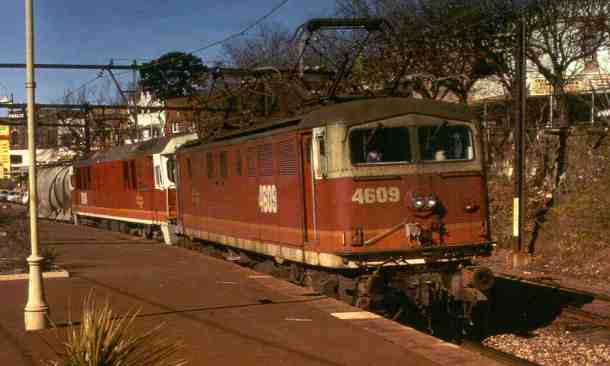
The image above caught my eye immediately. First, I loved seeing these 46 class electric locos working freight and passenger traffic around the Sydney network. Designed for heavy freight drag work out of the Sydney basin and over the ranges to our west, these locomotives were built by Metropolitan-Vickers and its partner Beyer, Peacock and Company in England for the New South Wales Government Railways. For many years these were the most powerful locomotives in Australia with a one-hour rating of 3,780 horsepower (2,820 kW) and the ability to deliver more over short periods. They are to me the most beautiful locomotives (electric or diesel) built and look fantastic on this Inglenook (if only there were overhead wire – sigh).

There are some very clever uses of visual trickery here. The layout is just an Inglenook but it is so much more because the focus is not on the Inglenook; rather the focus is on the concept of the viewer’s experience of the layout. You have to be an inner city kid, who saw locomotives similar in appearance, doing what locomotives do with freight cars. And how it worked on me. Good one Ben and well done on taking me back 30 years with one photo.

Enjoy another view of the layout. Follow the links above and if you’re a Facebook user head on over to the group and join in the small layout love. Finally see if you can work out some of the clever tricks used in the design of the layout.

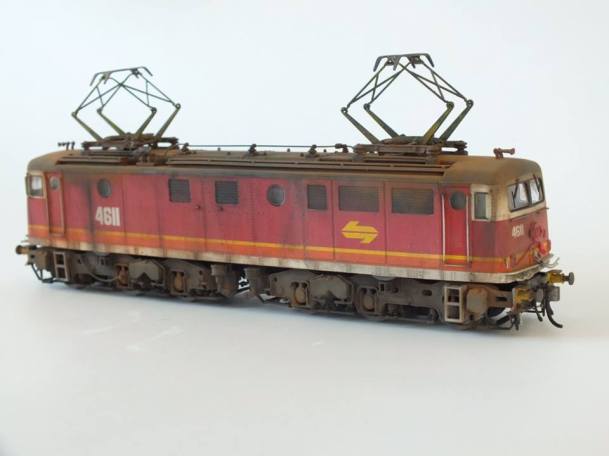
Now for a little more 46 class locomotive weathering porn (model first, prototype last):

Image courtesy of Dean Bradley

And

Image courtesy of http://nswrailrambler.blogspot.com.au/

The lovely old 46’s were notorious for getting and staying grubby, but really what’s not to like eh? All the best see you over the weekend.

Site seeing September 8 (Inglenook folio edition)

The reason the Inglenook is such a popular subject for small layouts is simple: it works on many levels to enable operations. Today let’s look at one recently found Australian design.

Site 1: Yandilla Sidings

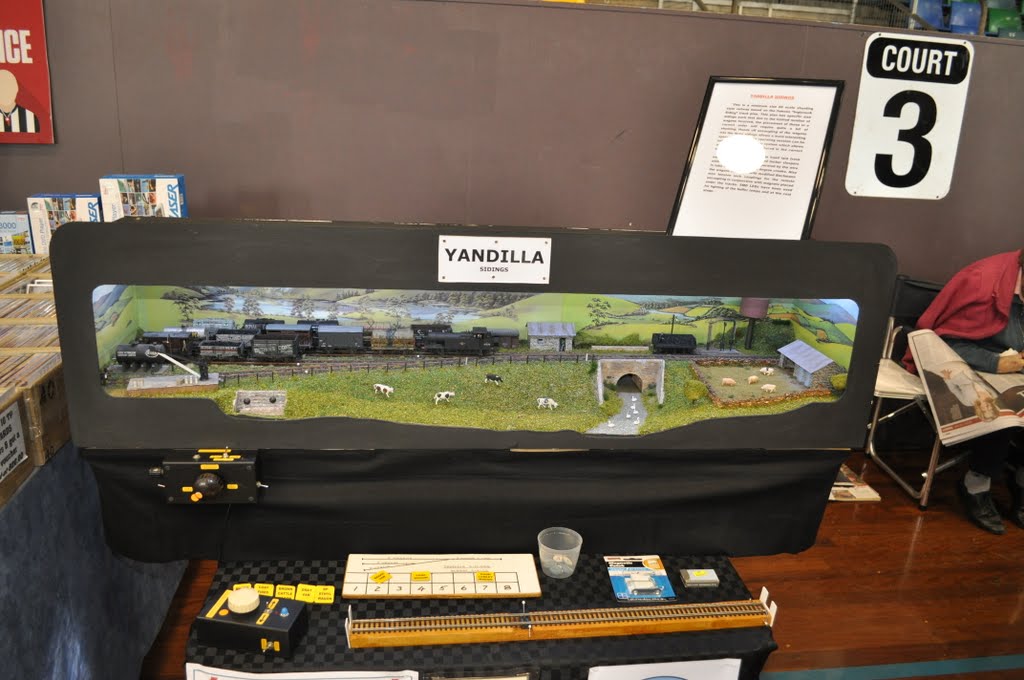
Captured and photographed by David Bromage at the Gold Coast Model Train Show in or around June 2016 at the Carrara Indoor Sports Stadium this layout shows what can be achieved in a small space with great presentation and attention to detail.

Image courtesy of David Bromage

In this overall image  you see the entirety of the layout. What it shows to me is that you can have a small layout (in this case with UK prototype trains) that keeps the interest of the viewer and the operator, allows interactivity between the viewer and the operator (and should you choose to do so) allow the viewer to become the operator.

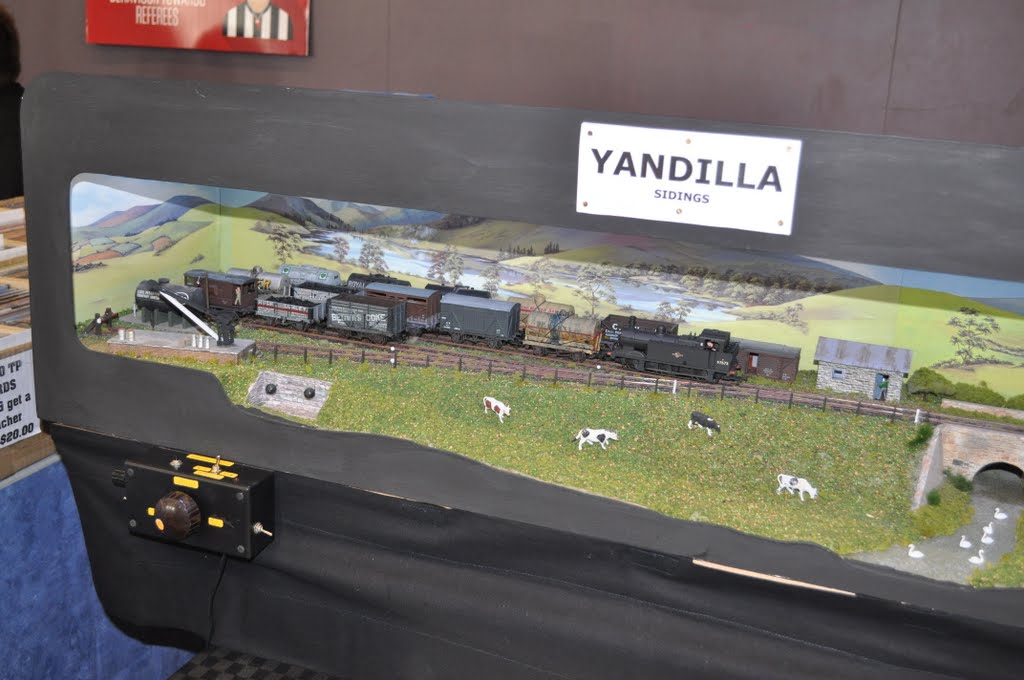
Image courtesy of David Bromage

In addition you can build the layout board and case quickly, with little effort if using pre-built (Ikea style) components. Then you can go to town on the detail in the viewable scene. If you want more than you can add more into the scene, or as the operator has, show the operating scheme to the public at large.

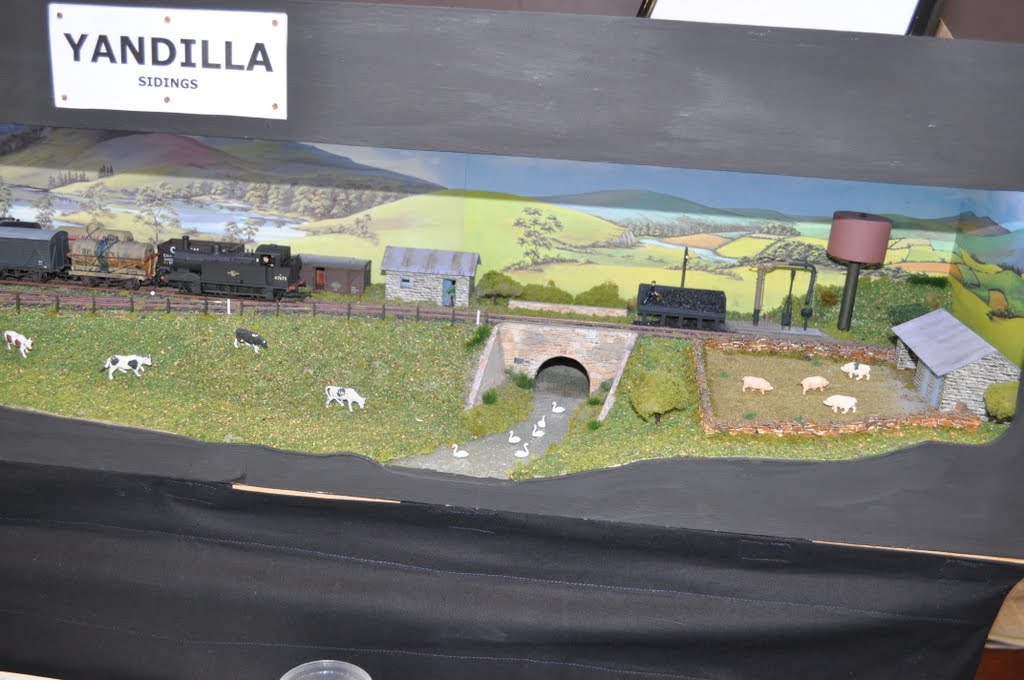
Image courtesy of David Bromage

Using the link in the heading above will take you David’s portfolio for the exhibition. I hope that you enjoy looking into this scene and learning as much as I have from it. I’d like to build an Inglenook in HO for exhibition use this southern spring and summer. I have several layout ideas for an inglenook and a Supernook – who knows what we’ll end up with!

Site seeing: August 31 – Winter is going (at least down here)

Winter is over, although where we live in Ballarat at 420m (1370 feet) above sea level, you’d be hard pressed to tell that change of season has arrived. Our mornings are still cold, the winds are still lazy (they go through and not around you), and the weather is not shiny or happy. However, my seasonal allergies have kicked in, and the Wattle has been in full bloom for about 3 weeks now. I’m sniffling, my eyes are streaming and I look like I’ve gone five rounds with the late, great Muhammad Ali. My allergies and the weather are not the reason for today’s end of Winter post…

Site 1: Croft on the ScaleFour society’s website

Built as a shunting puzzle (Inglenook) and based loosely upon the real Croft goods (Darlington, NER, not Leicestershire LNWR), Croft is a magnificent example of simple effective display and operation. The image below courtesy of RMWeb and Steve Taylor.

I could go on at length about this layout, or I can let you soak up the atmosphere of this image and then follow the ScaleFour link above.

Site 2: RMWeb’s Croft Gallery

Go, look, mind blown.

Hope that this gets your creative juices flowing. Looking forward to the Southern Spring.

Site seeing: August 29 – trouble reaching http://www.tichytraingroup.com

I’m putting out a call for help to all of you today.

I’m having the biggest issue when trying to get to the Tichy Trains website. I’m wondering if others may be having similar issues. I keep getting connection errors and I’m wondering whether others outside of the continental USA may be seeing the same errors?

Here are the errors (occurring across all browsers)

This site can’t be reached. The connection was reset.
Try: Checking the connection - Checking the proxy and the firewall
ERR_CONNECTION_RESET

Just so you know I am in Australia and am not blocking or otherwise filtering content out through my firewall. I used to be able to reach the site. It is only recently that I’ve had issues reaching the site.

I’m wondering if anyone else has found this issue and found a solution for it.

Site seeing – August 28 – 1980 Frisco S Scale layout “Cheltenham”

Tom and I have been out of contact for some time but recently reconnected on the Railway Modellers surprising best friend – “Facebook”. I’ve known Tom Potthast since my early days in Austin, Texas, since around late 1997 or early 1998, when I met him at King’s Hobby. Tom has been an S scale modeller since before I met him and pitched hard for me to choose that scale. Originally from St Louis he lives in Virginia. As I’ve noted in the title of the post he’s working on a 1980 era Frisco S scale layout. He’s not advised of a website or other online location so I’ll be posting and sharing photos of his layout here.

Site 1: Information on Tom’s layout “Cheltenham”
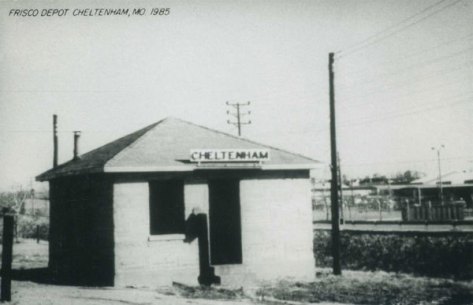
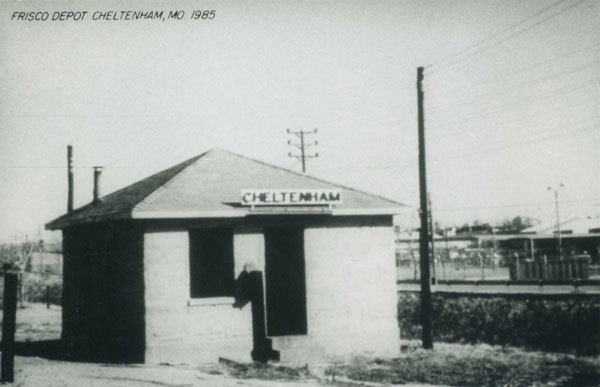
cheltenham_missouri

Tom told me that Cheltenham was a commuter stop, within the city limits of St Louis. The structure in the image above survived into the 1980s. The area Tom’s modeling is located between Hampton Ave. and Kingshighway. It is just a short piece of the railroad yet has plenty of switching potential.
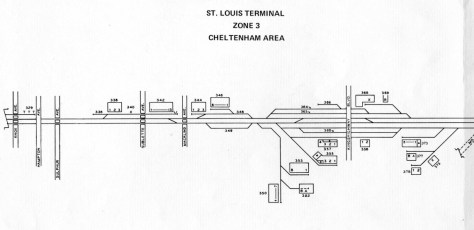
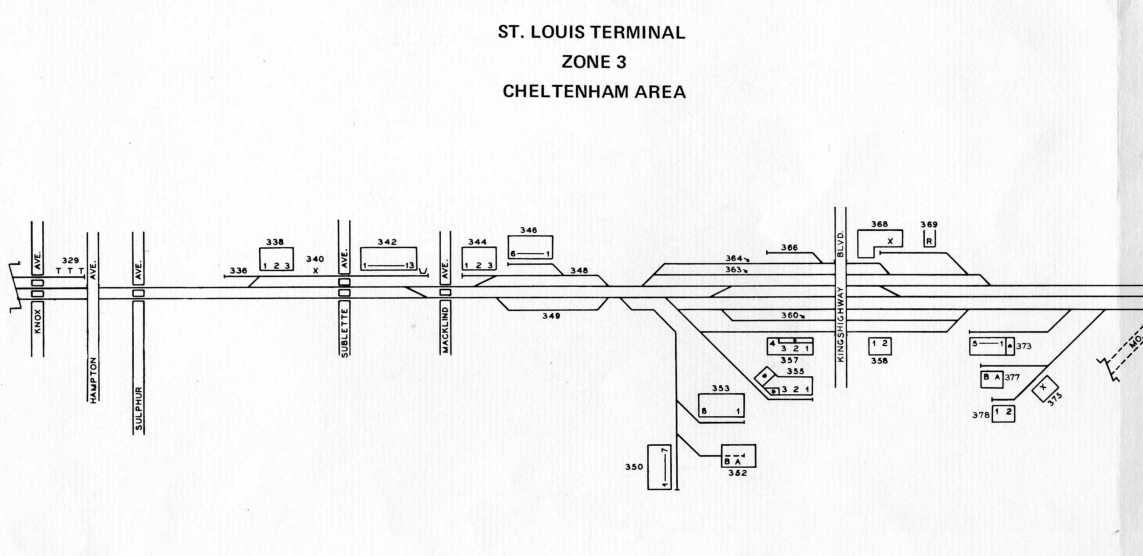
St Louis Terminal - Zone 3 - Cheltenham Area

There is no official track plan. It was planned out using a full size mock-up before final construction began using a PDF of the area as a guide. I’ve added a section of that track diagram to show the area he’s modelling above.

Tom says that “… one day when I get my two-car-garage-like space it will include Lindenwood yard and a great deal of interchange with other roads such as the N&W (Wabash) TRRA, Manufactures Railway (Anheuser Busch), BN and Mopac.”

Site 2: Some of Tom’s S scale weathered cars

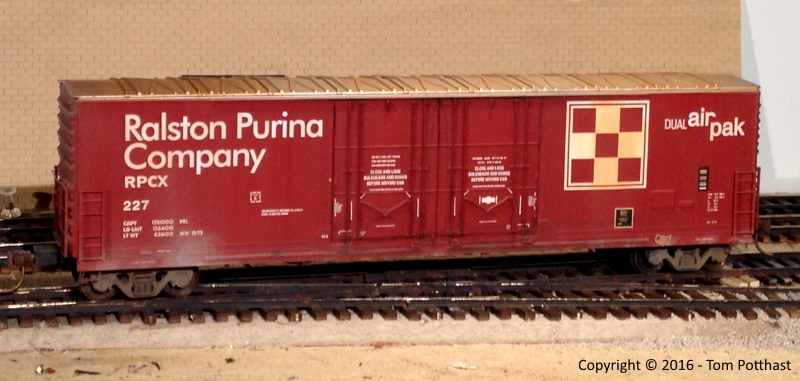
What inspired Tom to write me was the Martin Wellberg’s German Gmhs 53 weathered wagon. He supplied a few photos for me to share and promised more in the near future. RPCX 227 is the first photo showing a car that is lightly weathered.

RPCX-227_Weathered

Below is a car from the same series RPCX #101-#240. Built by Evans USRE (Blue Island, IL) in Lot 1169A of Nov 1973. Stenciled: Return to PC Sharonville, OH. These were eventually to become a part of the CNW fleet (series 540300-540436 cars) after Purina gave up the RPCX reporting mark in 1989. Image below courtesy of Steve Vincent and Railcar Photos.

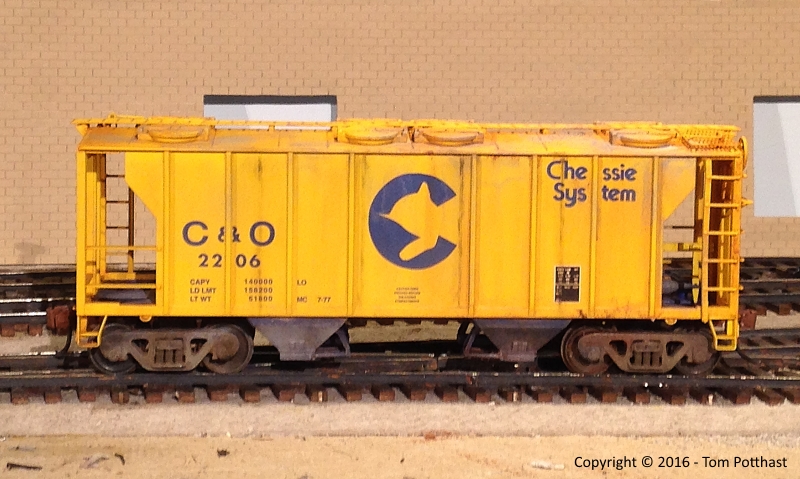
The second photo shows Tom’s CO 2206. A covered hopper in CO series 2300-2374 built by General American Transportation Co. during Aug-63. I could not find a prototype photo of this car.
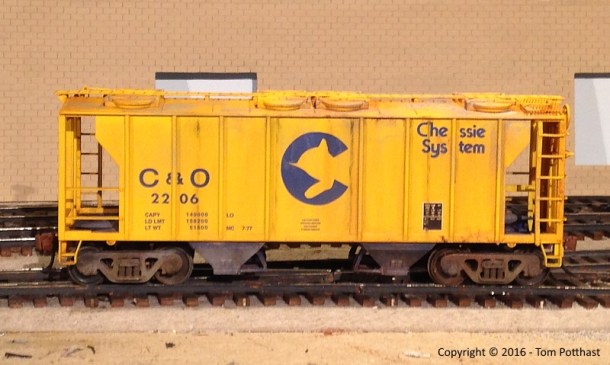
CO-2206_Weathered

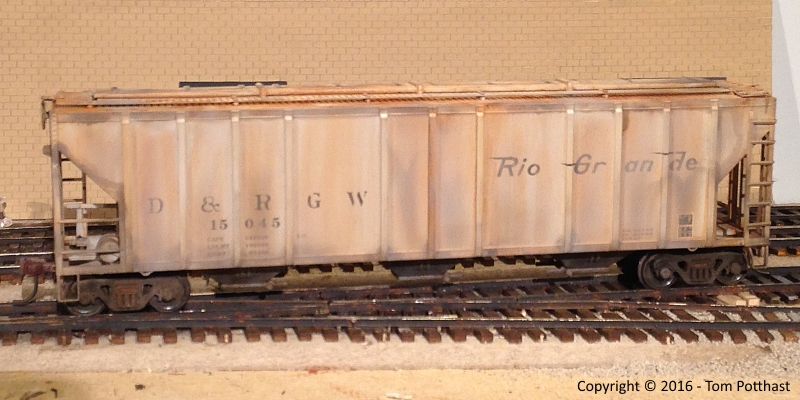
The next photo shows DRGW 15045 a 3-bay rib-sided covered hopper in the DRGW series 15000-15149 built by Pullman-Standard, Lot 8923, in 64.

DRGW-15045_Weathered

I found a close match in DRGW 15006 in the same series on the Railcar Photos website. This photo is by Kent Charles.

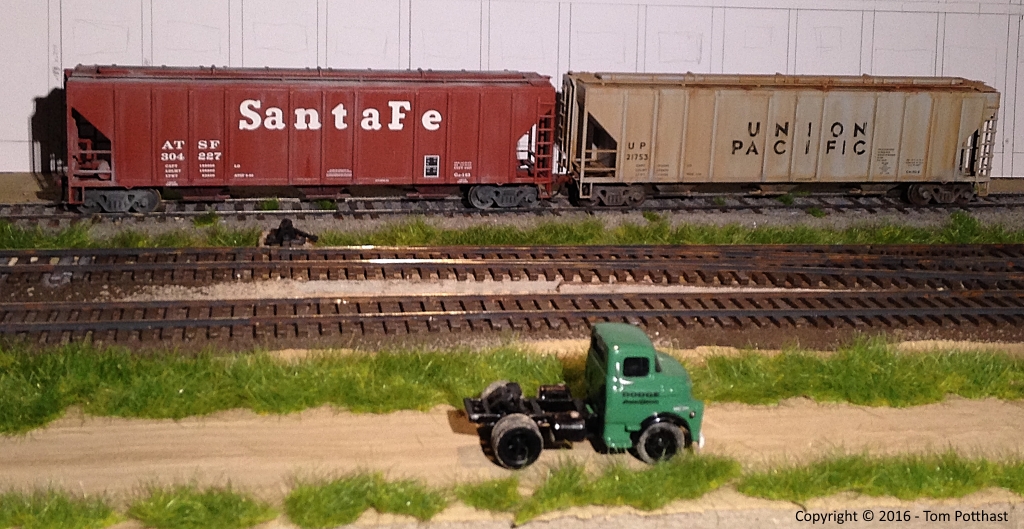
Finally I’ve got a slightly wider shot showing two more covered hoppers and some of the layout and scenery.
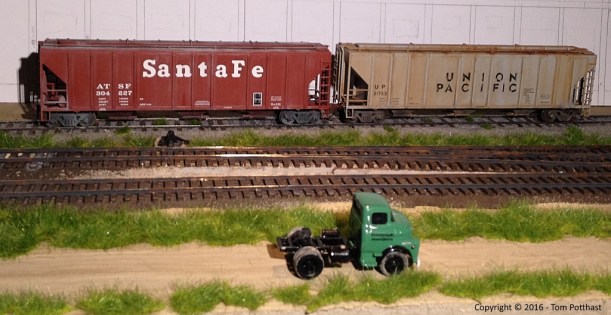
ATSF-304227_UP-21753_Weathered

Thanks to Tom for allowing me to post his photos. Looking forward to seeing more of the layout and rolling stock and locomotives Tom. Thanks for sharing.

Site seeing – August 26 – Weathered and downright dirty

If you’ve followed the blog for any length of time, or know me personally, you’ll know that I don’t like clean things (my personal hygiene excepted). Every model I touch ends up weathered to one degree or another. And so onto todays sites of interest.

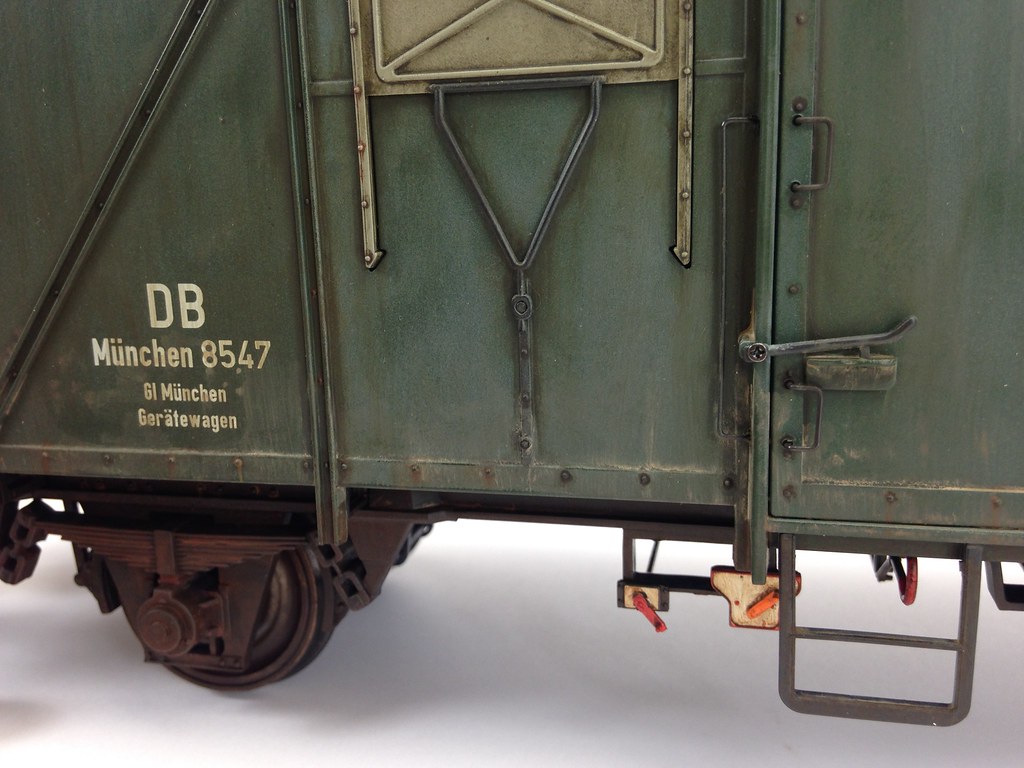
Site 1: Dirty stuff by Martin Wellberg – A German Gmhs 53 Boxcar in scale 1 (1:32nd scale)

This is part 1 of Martin’s so far 3 part treatise on weathering this large railcar. Wait till you see the photos. That’s all I’m saying on the matter.

Site 2: This is part 2 of the weathering of said German boxcar

In part 2 there is a little more of what Martin has been up to. Drool people, just drool.

Site 3: Part 3 from above

More train eye candy as Martin gets on with the weathering on the Gmhs 53 boxcar.

Site 4: Freerails Forum posts by Martin on other large-scale rail subjects

You should not need to be a member to view the posts. Definitely to post or reply though. Lots more pictures in what is now a 6 page post by Martin and those of us following him. Not to be missed.

Here’s a taste of the work Martin is creating:

I hope you enjoy Martin’s work.

Site Seeing – August 23 – Wetterau Food Services

August is the month where year 12 high school focuses on getting elder children ready to complete their schooling and head off to life or to University. This month we’ve toured possible University campuses to see what is on offer and where she can look on planning to attend next year.

Last weekend was an out-of-town visit (120km away) next weekend there’s another University visit on (only 3km away this time). All too soon she’ll be moving out and living on Campus (but don’t tell her that). Finally I’ll get my half of the train room! Anyhow – on to today’s sites of interest.

Site 1:  Wetterau Food Services

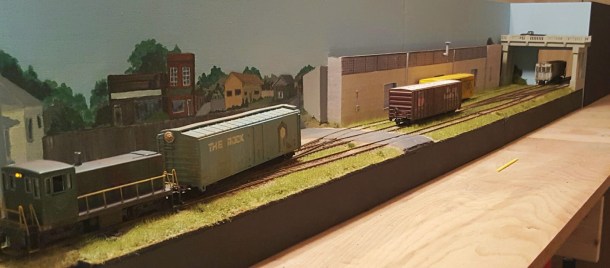
Tom Conboy’s layout’s shown in all it’s glory on the Model Railroad Hobbyist site. Tom writes on the first page: “The Wetterau Food Services Micro Layout was completed in February of 2016.  Layout planning and construction began in 2014.  I am enjoying operations on the layout, and wanted to share the steps I followed in building this micro layout here on MRH.   I  have learned quite a bit in building it, and hope you will find it informative.”

Head over and take a look through his shared build log. It is very interesting and a great looking layout. What’s not to like – a 70 tonner runs through it.

Site 2: Tom’s Model Railroad Scrapbook

This is the second of Tom’s sites where he’s shared the building of the layout.

Site 3: The Micro Model Railroad Cartel

The third site providing more information on the build of the layout in nine parts.

All great sites full of information for those interested in building a small layout and for those interested building a layout using Fome-Cor.