The reason the Inglenook is such a popular subject for small layouts is simple: it works on many levels to enable operations. Today let’s look at one recently found Australian design.
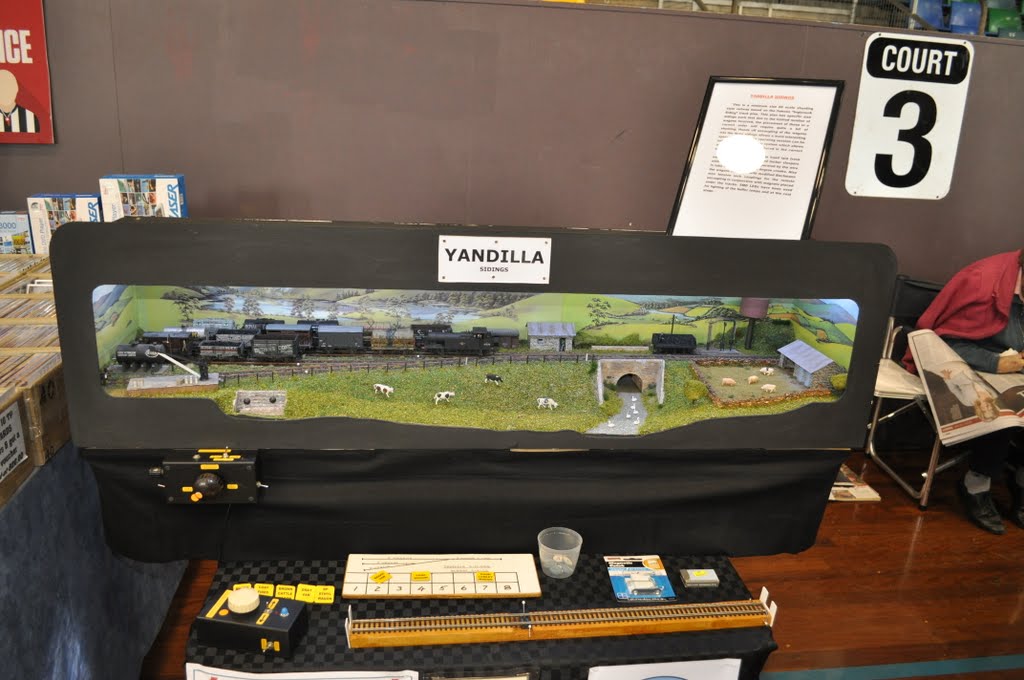
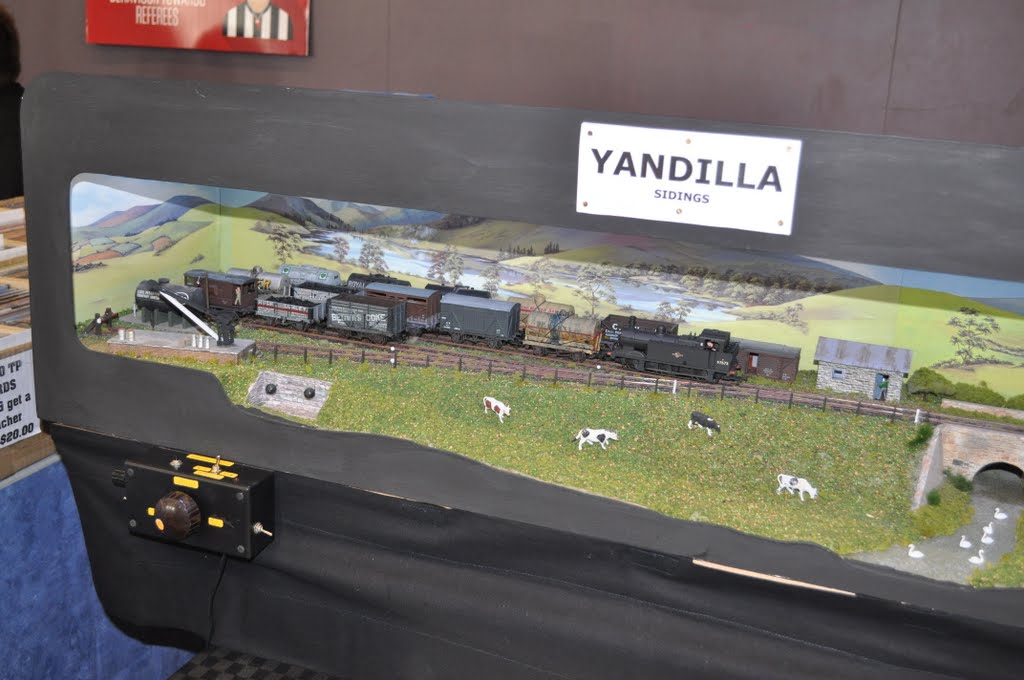
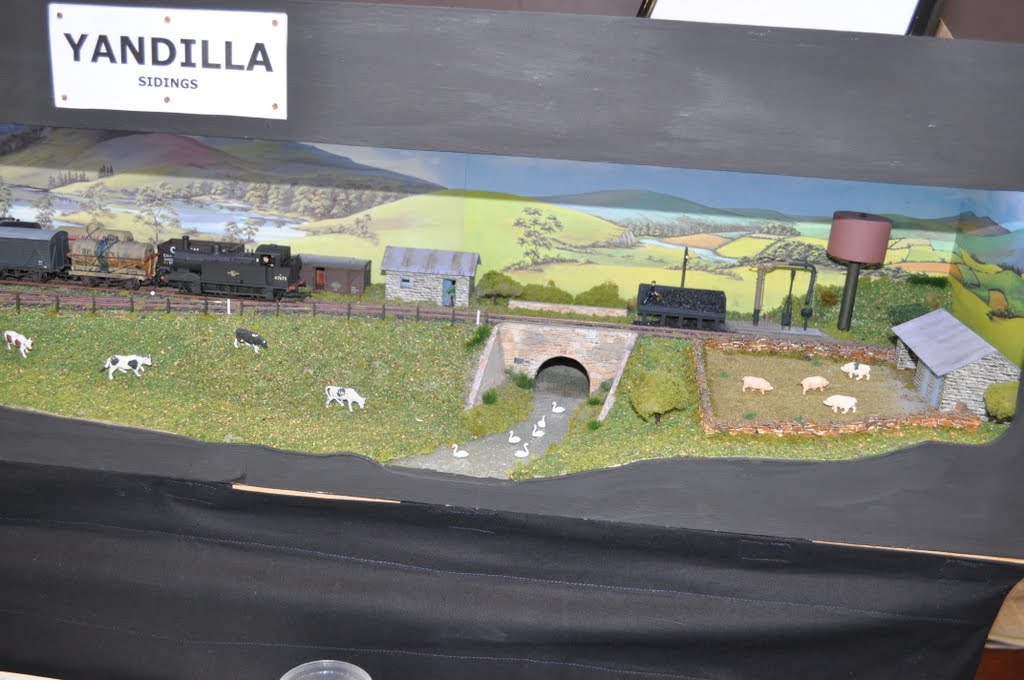
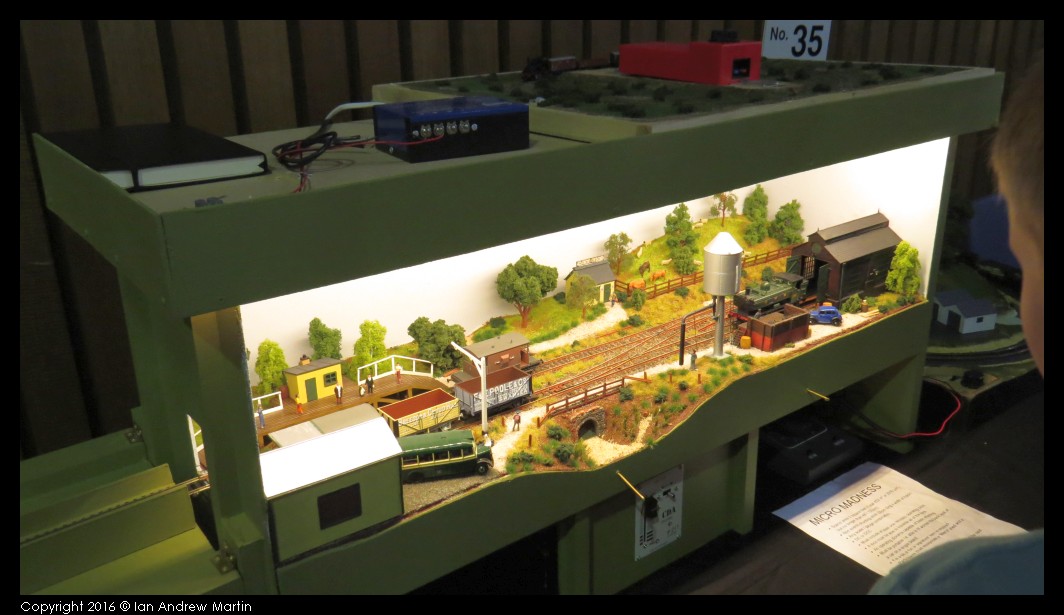
Captured and photographed by David Bromage at the Gold Coast Model Train Show in or around June 2016 at the Carrara Indoor Sports Stadium this layout shows what can be achieved in a small space with great presentation and attention to detail.
Image courtesy of David Bromage
In this overall image you see the entirety of the layout. What it shows to me is that you can have a small layout (in this case with UK prototype trains) that keeps the interest of the viewer and the operator, allows interactivity between the viewer and the operator (and should you choose to do so) allow the viewer to become the operator.
Image courtesy of David Bromage
In addition you can build the layout board and case quickly, with little effort if using pre-built (Ikea style) components. Then you can go to town on the detail in the viewable scene. If you want more than you can add more into the scene, or as the operator has, show the operating scheme to the public at large.
Image courtesy of David Bromage
Using the link in the heading above will take you David’s portfolio for the exhibition. I hope that you enjoy looking into this scene and learning as much as I have from it. I’d like to build an Inglenook in HO for exhibition use this southern spring and summer. I have several layout ideas for an inglenook and a Supernook – who knows what we’ll end up with!
Whether you model the US, UK, Australian, Canadian, South American or European scene one thing that O scale requires is imagination. As much as I would like to have a very large garden and shed layout, the reality is that is not going to happen due to constraints with money and time. I have not enough of either and so the scope of what I model has to be within my reach, simple to achieve and quick to build and ready to a credible level of detail and where possible use what I have to hand. On to today’s site of interest.
Site 1: Pick Purse Halt O scale in 9′ by 2′ by Richard and Sue Andrews
When space is tight using imagination allows you to find and define the layout’s place within the wider railway network; Pick Purse Halt does this admirably. Let’s take a look at the track plan first and see why.
Pick Purse Halt’s track plan
On first look, there’s not much to the track plan. One turnout and a couple of sidings. The layout portrays a small passenger halt along a GWR Country branch. So we’re set in time during the 1930s with steam railmotors and Auto Coaches on passenger work and pannier tanks working the freight trains. Let’s assume though that the line did not close during the 1960s and the Beeching cuts; where would that take us?
Single car DMUs such as RDCs, Gloucester RC&W Class 122 Bubble Cars, Tokyo abounds with types, as does Europe and I think you may now get the idea. All we’ve talked about though is the passenger service on the through line. There is also the short freight passing by and reversing into the sidings. Or coming in direct from stage left; this is where the operational potential of the layout really comes into its own.
The freight area can be worked differently in many ways both visually and conceptually:
As described in the plan for UK mid-1930s
As a factory dock during the 1950s through the 1970s and 1980s
As a simple team track arrangement for literally any time you like
As a small transload point with a Y and a platform for unloading two rail cars by pallet truck and forklift
As a small layout Pick Purse Halt punches way above its weight. So much to be done with the design and the scenic treatment depending on the era and location you model. Your choice could come down to using what you have on hand to set the location.
With controlled lines of sight, and the feeling of the rest of the railway just beyond the board, this could well prove to be the best idea of the month.
Like this post and comment if you find it useful or would like further information; if you’ve not already subscribed to keep up to date you can do so now using the link at the top of the post.
Ian Futers’ layouts seem to get around more than the builder himself. Probably because he manages to build great small layouts with plenty of operating potential that remain popular year after year.
Ian Atkinson and Chris Towers’ of Broadford Model Railway Club own the layout presently. The layout, built originally in basic form by Ian Futers, is in the process of being enhanced by the present owners. A Scottish 1950-1970s era layout with a station, goods facilities and just four turnouts comprises two 4′ 6″ scenic boards and a 4′ 6″ fiddle yard with a three road traverser board.
Operation of the line is in the late steam early diesel period. Coal, Timber and fish traffic somehow still survive along with a mediocre passenger service.
Like this post and comment if you find it useful or would like further information; if you’ve not already subscribed to keep up to date you can do so now using the link at the top of the post.
Paul Allen’s masterpiece Inglenook, built in OO scale, shows what can be scaled up very simply to British O scale (1:43) with the use of commercially available kits, RTR trucks and loco’s available now or in the very near future. The entire aim is to keep cars and loco’s short to keep the visible part of the layout within the 8′ (2400mm) maximum. Giving enough run and movement without taking up the entire house.
Ingleton Sidings, designed to sit on a standard home window sill or ironing board, illustrates what can be achieved in a minimum with RTR products and basic scratchbuilding techniques. The location as modelled is fictional and represents a small BR sorting siding during the late 1950s through to the early 1960s. The layout features point motors, 16v lighting, line side CCTV and Kadee automatic coupling. With the layout detailed and weathered to represent the last days of steam.
If you are thinking of going British O at minimum cost and personal commitment then Ingleton Sidings might be the place where you start.
Now see it in action:
First up an overview of the layout and features:
Next, from February 2014 – the initial running of DCC and Sound on the layout at the Milton Keynes model railway exhibition:
April is now and forever more deemed to be the ‘O scale’ small layout month.
Throughout April I’ll be posting layout plans, and information, on small and achievable layouts that have already been built in O scale, or that could be up-sized from the smaller scales to fit in a maximum visible space of 8 feet x 2 feet (2400 x 600 mm).
The only requirement is that it must be based on the recognised scales of:
1:43.5 (UK & Australian Standard gauge)
1:45 (European)
1:48 (US & Australian Broad gauge)
So this includes 0n30, Metre gauge, standard, broad, and anything else that you can imagine. Traction can be steam, diesel and, or electric. If you have an industrial track plan or layout that is small in nature I’d be really interested in seeing more information or links to your website especially.
I’ll still be posting the usual informative and layout focused information as normal, this is simply something special I’ve wanted to do for some time.
If you have any ideas or layouts that you’d like to share during April drop me a line through the comment field and I’ll work with you to get that information into a post!
Don’t forget to ‘Like‘ this post and ‘Comment‘ if you find it useful or would like to offer or need further information. If you’ve not already subscribed to keep up to date you can do so now using the link at the top of this or any post or page.
Glenn Sanders runs a very tight-knit and helpful group over on Facebook. I’m pretty sure that you need to be a member of Facebook to view the group, and you have to be added by Glenn, but since joining I have found some of the best modellers on there. Ray O’Neill of HELM and 59th and Rust fame is just one of the great modellers on the group. It is also a great place to share ideas and plans for your industrial switching layout (ISL) too. If you get a chance drop by and see what’s going on. Very layout focused.
For those of you who might know Ray O’Neill through his 59th and Rust layout, he has another underway at the moment that I wanted to share with you. End of the spur is an industrial switching layout (ISL) set in an inner city industrial area, using combined motive power moved because there is no run-around as in the image left, there is a lot of switching to do and surprisingly a lot of space to get it done in with 12′ (feet) of run and 14″ (inches) of depth. There are some great ideas that I’ve seen in this build that I’ll be using on my layout too. Among them the switch frog polarity controller – which is genius.
Is there no end to designing a layout? I sincerely hope not, I’m having too much fun!
I’ve added a page to the 12 foot layout modelling project for the design process. It’s been really good to check the images from a distance (and not standing at the layout board) and seeing where things could be improved. I’m going to make changes and get to the Mk III design later this week.
It’s nice to know that I’m getting closer to an ideal layout design that will keep me happy switching and let me enjoy the layout for the next few years.
Keep an eye out for updates to the page later in the week.
This will provide a Work-in-Progress report of what’s happening in the layout build process. For now there’s a front page. It provides my overall thoughts and a photo showing the proposed design (already laid out in track).
As I stated on the page there’ll be more coming in the future including:
Track laying,
Building construction,
Detailing,
Operations design, and
A session report or two
Looking forward to getting this underway this month.
After I reblogged Rails West’s San Fernando Valley Branch post on December 7th I took a look around the web to see if there were other sites that had information on this very interesting branch line. Luckily I found one. I could not find a SPINS book in my stash of SP paperwork to cover the area however you could certainly find this information from many of the online dealers (found at the last link) today.
There’s a week’s worth of information here and I hope you enjoy reading through it all.
Bruce Petty’s website has some really fine information (including lots of photos) of the branch in the early 1908s that would of interest should you decide to model the branch or one just like it. It includes the names of the industries served and the car lengths of the spurs.
Another of Bruce’s pages this time with photographs of the freight stations along sections of the line. Nice if you wanted to model any of these buildings specifically.
Bruce has a model railroad covering a portion of the branch that was featured in the 2007 Great Model Railways (Kalmbach Publications). Take a good look around and take a look at some of the links on the page for the modelling articles there. Really goo stuff.
A great site with a huge range of detail and links about the SPINS system and the TOPS system. And yes UK modellers that is the same system BR purchased from the SP in the 1960s.
On June 02, 2015 I made mention in a post of a grain silo operation close to the CBD in Melbourne, Victoria that allows for interesting operation, and would keep a model railroader busy and interested for the length of a short operating session (around a half an hour).
Image 1: G529 stabled in the dead-end siding at Kensington. The grain hoppers and the switch engine are down by the flour mill (courtesy of wongm’s rail gallery – LINK)
A little background
For those of you not in Australia let me give you a little background on the site from image 1 above. The photo above is from the grade (level) crossing at Kensington station. The station buildings are directly behind the photographer. G529 is sitting at the north end of the site on a dead-end siding used for second units or for red-carded (bad-ordered) cars.
The two lines under wire are the UP (left-hand line to Melbourne) and the DOWN (right-hand line from Melbourne) lines to the outer suburban terminus of Craigieburn, a fast growing suburb 26 Km to Melbourne’s north. Grain trains come north from Tottenham Yard and back into the sidings. When they leave they have to do a long looping route north, then west before returning to the yard once more. A fair bit of this is on the suburban Craigieburn passenger line. This situation occurred because of changes to rail lines for the Regional Rail Link that has taken freight lines out of service.
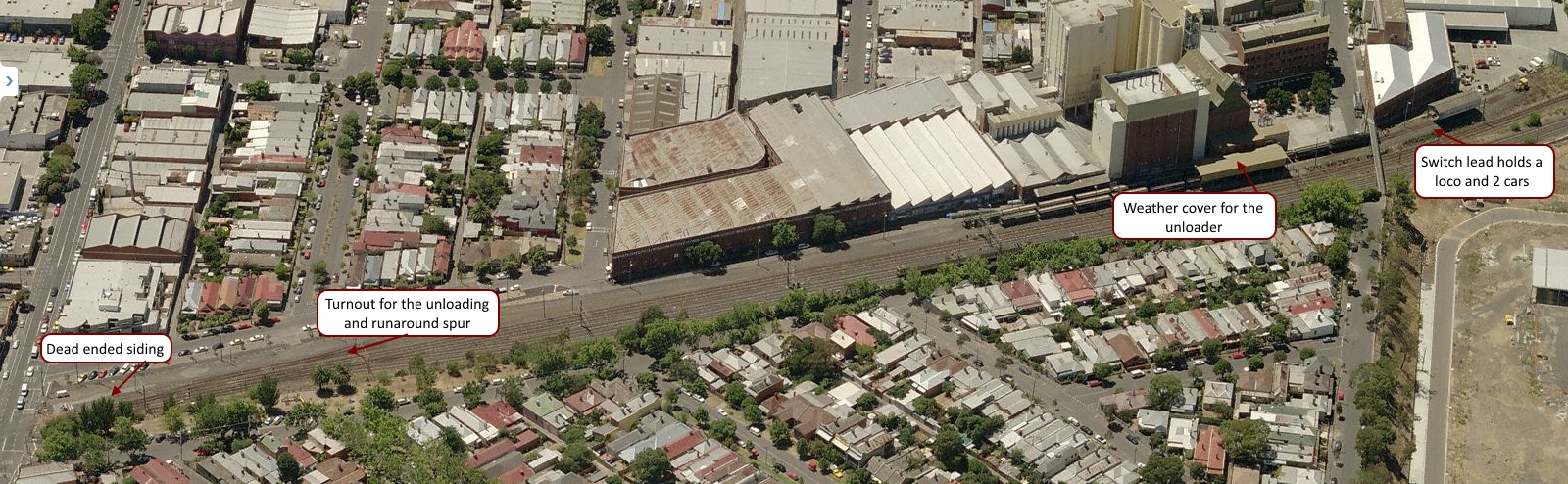
The single slip allows access into the site from the DOWN line. On the mill site there are two spurs with the left road running over the under track unloading auger; the right is a passing siding. The switching problem on this site is that the turnout at the end of the two roads only has enough room for two grain cars, and one locomotive at a time.
Image 2: An overview of the site (courtesy of Bing – LINK)
Operation
Generally the train has two locomotives. While a single locomotive can handle the work, and would be easier on the crews when switching, the extra power helps clear the path for the passenger services on the Craigieburn line. Melbourne’s rail network is greatly used by the it’s citizens and the infrastructure is congested requiring new signalling to allow greater train density. Anything that holds up one train has knock-on effects that can and do regularly impact on the rest of the network. So any freight movements using passenger routes tend to be over-powered.
Image 3: A track diagram showing the grain siding and signalling at Kensington (courtesy VicSIG)
1. Arrival
The shift begins with the loaded grain train arriving early on the north-bound suburban tracks. The train pulls into Kensington stations up platform road, before informing train control that they are ready to reverse into the facility. Train control (under CTC) unlocks the shunt signal 7, switch 8 and switch 9 to allow the movement and the train reverses into the site, putting the grain cars onto the ‘left-hand’ unloading road. On completion of the move the crew contacts train control once more and the switches and signals returned to normal.
2. Set up
The crew has to unload one of the locomotives. Without the room to run the power around at the switching end on the unloading road one loco is usually parked on the ‘B’ siding at the north end of the site. Image 2 below shows the problem on-site with the short headshunt (switching lead).
Image 4: The switching problem – the short headshunt (courtesy of wongm’s rail gallery – LINK)
3. Switching / Shunting
Prior to unloading beginning the mill staff remove the metal grate covers to allow grain to begin unloading into the under-track auger. With only one loco for shunting (switching) the operation is fairly straight-forward:
The first two cars unload at the under-track auger
When unloaded the train pulls forward to two car lengths to begin the unloading process again and handbrakes are applied
The loco cuts off the two empty cars, pulls them to the headshunt, before pushing back onto the passing siding
Handbrakes are applied on the two empty cars before the loco cuts off and moves back to the headshunt
The loco reverses onto the loaded cars, and the cycle repeats until all the cars are empty.
With all the cars emptied the mill workers cover the auger pit with the metal covers. The loco eases off the unloaded cars, runs into the headshunt, and backs through the unloading road back to siding B. Here it picks up the previously stabled locomotive and once MU’d they back onto the empty cars; with the air pumped and they wait for train control to authorise their return to the running lines.
Modelling
Operation of this layout design element offers a lot of opportunity. Whether a small train or a large one the work to be done, including air brake operations and taking time to switch back and forth would give a lot of interest for those so inclined. I can see this being a great industry especially for the modular railroader. Across two or more modules, you’d have the best of all worlds with action on the main, and then a lot of switching action on the modules.
Being self-contained the industry is a real winner and could be transplanted anywhere.
Resources
There are a couple of videos available below for you to get an idea of the action at Kensington.
In the second video you can see the operation under way with the switching in this case being handled by BL class # 32.
You can find out more about the locomotives using the resource links below:
If you have information that you can share about operations at the site, please let me know. I’ve found everything that I can about the site and its operation, but there is nothing like a driver or someone else knowledgeable of the site sharing what they know. Leave a comment, like and subscribe to the blog if that suits you.


 Ian Atkinson and Chris Towers’ of Broadford Model Railway Club own the layout presently. The layout, built originally in basic form by Ian Futers, is in the process of being enhanced by the present owners. A Scottish 1950-1970s era layout with a station, goods facilities and just four turnouts comprises two 4′ 6″ scenic boards and a 4′ 6″ fiddle yard with a three road traverser board.

![nevard_110330_ingleton-sdgs_DSC_1821_02_web1-400x267[1]](https://andrews-trains.com/wp-content/uploads/2016/03/nevard_110330_ingleton-sdgs_dsc_1821_02_web1-400x2671.jpg?w=300&h=200)
 For those of you who might know Ray O’Neill through his 59th and Rust layout, he has another underway at the moment that I wanted to share with you. End of the spur is an industrial switching layout (ISL) set in an inner city industrial area, using combined motive power moved because there is no run-around as in the image left, there is a lot of switching to do and surprisingly a lot of space to get it done in with 12′ (feet) of run and 14″ (inches) of depth. There are some great ideas that I’ve seen in this build that I’ll be using on my layout too. Among them the switch frog polarity controller – which is genius.


 Andrew's Trains