Category Archives: Operations

Focused on operational aspects of layouts

Site Seeing – March 18 – The ‘other’ Glendale freight layout edition

It’s been a while since my last post and that is thankfully due to being fully employed for the first time in two and a half years. A full-time job is a very satisfying thing. But I digress.

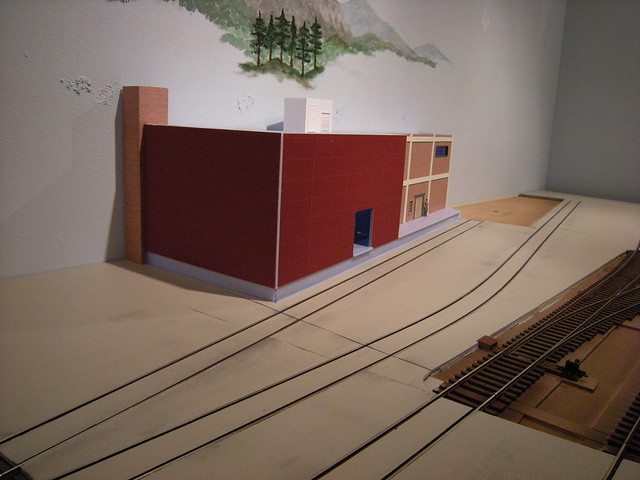
As I wrote in my March 6th post I’ve worked up another idea for the Glendale Freight layout. Let me say from the outset, that this is not one of my better ideas; especially after seeing Bruce Petty’s original layout. There’s merit in the ideas expressed in the design certainly – it just doesn’t have that vibe going on as Bruce’s layout does in spades. Before I go on to tear my work apart let’s take a look at a 1/12th scale model and why I find them so useful for designing a layout.

So what’s wrong with this layout idea?

  • Firstly the central theme of the design is not the freight station, it is the entrance from staging onto the layout.
  • I wanted to have the train enter through a portal of buildings, cross the street and then go about its business. It’s a pretty skimpy idea right? There’s no meat on the bones though.
  • Why this means to enter onto the layout instead of some other way? Is there some missing story about this means of entrance; did the city grow up around the freight station for example? But isn’t this supposed to be Glendale CA, right? Well, is it?

The layout is overall 8 feet long (2400mm) and each square is 12 x 12 inches (300 x 300 mm). It is 2 feet (600mm) wide. And it’s very linear.

So what would I do different now that I’ve built this mini layout?

  1. Angle the entrance onto the layout,
  2. Angle the buildings and the street to the long axis of the layout,
  3. Cluster the switches near the end of the run around, and finally
  4. I’d make a transition between the industrial area on ‘main street’ at the entrance end and the other end of the layout – making it more suburban

And having had a while to think on how I’d make those changes here’s a rough drawing of the layout that ‘could’ spring from this thought experiment.
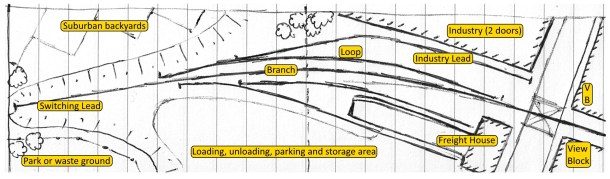
This design has gravitas. It is the last bastion of railroading in the inner city, and the edge of the suburbs. Sure there are some strange curves, and I’d rework the industry lead and the industry back wall too. But it is much more interesting and tells much more of a story than the first layout.

This layout could be setup as is with the industries, it could be modified for a single industry layout (say an industrial workplace such as a foundry), or it could be something that I’ve not considered and that you already have swimming around in that pool of ideas in your head. As an aside, I videoed the first layout build process. If interested in seeing that video let me know in the comments and I’ll post it here over the next week or so.

Site seeing – March 06 – Bruce Petty’s Glendale Freight house Module Redux edition

In a post on January 18, 2017 I made mention of Bruce Petty’s excellent module of the end of the Union Pacific’s Glendale Branch and the freight station located there. Bruce’s Module is 5 feet (1500mm) x 18 inches (450mm) but to my eye looks much bigger because of the great use of the space he has made. There is no crowding, no feeling of busyness, only the feeling of a warm summers afternoon in Los Angeles sometime during the 1960s or 1970s. This small scene is evocative and places you immediately in the place and time, even if that is coloured by your chosen time period.

The majority of my layout designs fit into an 8 foot space Bruce’s layout module with the addition of a 3 foot fiddle yard fits right in the space available and would make an excellent display or exhibition layout. More importantly it would fit with any time period from the late 1940s – early 1950s (when I believe that the freight house was built) through to the mid to late 1980s when I believe the freight house fell out of use.

As I said in the previous post I’ve pondered over how to use Bruce’s track plan in other ways. I’ve even worked the design up into a 1/12th scale model to see how it might work. I’ll come back to the alternative in my next post; for now let’s revisit Bruce’s excellent module.

A closer look at Bruce’s module

While this module is a part of Bruce’s larger railroad forming the end of the UP’s Glendale branch it can also stand alone as a layout in its own right. At its heart it is an Inglenook layout. Each of the freight house roads can take two 40 foot boxcars against the dock. For those of you interested in modelling this layout at a later stage it is highly likely that the Freight station never hosted more than 2 x 50 foot boxcars at any one time. If it did so then they would be placed on the right most track with the second car either unloaded directly into trucks as shown in Photo 1 above or set off spot on the left most track and switched out once a suitable space was available at the dock. Lots of switching possibilities here.

Of particular note in the photo above is the connecting piece to the rest of the layout. I like this little yet important touch. The wooden insert which allows the module to join the layout has been disguised as a typical UP/SP bridge. Very smart and ensures that the layout and the module appear to be a single whole and not something that Bruce built later on.

Operation

Operations on this layout would be pretty good too. As we’ve discussed before on the blog Inglenooks are completely prototypical and often used by railroads in tight places. Operating with a locomotive pushing in – pulling out switching focuses on the industry or industries served. The longest track on Bruce’s layout I would use as my switching storage and sorting track. The incoming train pulling outbound cars before spotting them on the long track. Cars would then be switched according to requirement on the remaining two car tracks at the docks. Any cars from those pulled needing to be spotted back at the dock could then be spotted before the locomotive crew pick up the remaining outbound cars and head back across the bridge and back to the yard. And here endeth the session.

Short, clear, easy to achieve, enjoyable and within the 30 minutes to 1 hour per day play time that a small layout should give you. Whether you use a single person (driver/engineer only) or two person (driver/engineer and conductor) crew to do the work the time taken will remain roughly the same. I prefer a two person crew simply because it makes the play time more fun when family or friends get involved.

Hope that this revisit has been of some use. If you like the blog don’t forget to Like and Subscribe. PLease comment if you are looking for more information on layout designs or on the designs I’ve previously posted. And of course take the time to visit the “further reading and resources” links below.

Further Reading and Resources

Site seeing – February 19 – The small passenger layout edition

While searching for ideas recently I came across a now very old set of posts from 2001 onwards about the building of a narrow yet long passenger station layout. Onto today’s site of interest.

Site 1: Simon Martin’s Shelf Layout project

This appears to be an orphaned site, and I cannot find any information or updates beyond the 2005 update on the page. Which is a real shame as this layout is a simple, well designed and yet highly operational layout for the single operator at home or at an exhibition.

The track plan is clean and has no major needs apart from two switches and some flextrack. You could even use this to get into building your own track work. Operationally there is much to work with. Trains may arrive and depart from either platform. Heading to the fueling depot means that you need to either shunt back onto the main, then into the second platform road prior to running back into the fueling/storage road. Planning your moves here would be very worthwhile in the smooth operation of the layout.

The fueling/storage point on the bottom left of the plan gives options for storing stock on the layout without over crowding the scene. Scenically the station building hides the end of the platform roads and gives the layout a greater depth than would otherwise be the case.

I think this would be a great design to work with not only in the short-term, but for the longer term by adding all the bells and whistles (such as automated announcements, details, more scenery and upgraded ready to run models.

I’ve tried finding anything else by the blogger but have been unsuccessful. I’d love to see more of this layout and what it became. No luck however. So we’ll just have to enjoy the layout as it would have been. If you know anything about the layout, the author or have contact details for Simon, let me know in the comments.

Site seeing – February 17 – Alain Kap’s excellent exhibition layout blog

I’ve not met or talked with Alain before. But his small layout popped up on one of my regular reads, Carl Arendt’s Micro/Small layouts site, when notification went out about a page update this week. But we’ll get to all of this shortly. For now on with the site seeing.

Site 1: Alain Kap’s Exhibition Layout

The link above takes you to the Alain’s blog with a search set for his Show Layout posts. There are five articles included so far, each of which shows something new and to me interesting. The board design and build are my favourite so far. As this gives me something to think about for diorama style layouts in the future.

The layout, based on Shortliner Jack’s Box Street layout, is well worth the look as Alain takes you through the baseboard build and then through track laying and building creation. Looking forward to more of this coming in the near future. There is way more great modelling there too, and not just railways.

Site 2: Carendt.com – February update

There are four layouts featured in this update:

  1. R.I.P. Car Shop – by Alain KAP in HO standard gauge
  2. Ingly Nook – by Scott Pollard in 009 narrow gauge
  3. Piper’s Yard – by Andrew Cockburn in OO standard gauge, and
  4. Bridge Street – by David Collett also in OO standard gauge

All of which meet the criteria for small and friendly little layouts, they also are well done visually and technically. Very well worth looking at all the pictures provided in the post.

I do hope you enjoy this post. If you do, or don’t, let me know in the comments.

Site seeing – February 11 – The load of scrap edition

Update and explanation

There has been  a shortage of posts on Andrew’s Trains during February, due to a couple of factors. First and most importantly my eldest is moving to another city and beginning at University. Mum and I have put in a lot of work to get her ready for the transition during January and so far in February. This has included multiple trips back and forth looking for accommodation, signing of leases, paying rent, bond and the government related tasks that need to be done to get your adult life underway. The second reason in my output has been extreme heat events we’ve suffered in regional Victoria over the last couple of weeks. Most homes in town don’t have air conditioning. Ballarat’s climate (being nearly 1500 feet above sea level with usually low humidity) means that apart from a few days each year we don’t need it. However, when the air temperature gets over 35 degrees Celsius (this week over the 40 degree Celsius mark) there is simply nowhere to hide from the heat. February is Victoria’s hottest month and the most dangerous. Enough of all of that for now – on to the modelling.

Site 1: The Design Build Op Blog – Scrap Steel Loads

Image courtesy of designbuildop.hansmanns.org

Mike Weiss, one of the Wheeling Freight Terminal crew members has a very clever method of creating scrap steel loads for gondolas. His approach takes on industry standards, rather than the usual articles in model railroad magazines about making scrap steel loads. Often these articles don’t provide an easy way to remove the loads without a wire loop or hidden magnet. In this article Mike addresses both issues. There is a lot of great information on the blog beyond this post. Take the time to look around. Very well worth the effort.

Site seeing – January 18 – the ‘Perfect Storm’ but in a good way edition

I’ve had an idea for a small layout, running around the mouse wheel that I use for a brain, for a while now. What kicked the idea off was a 2013 plan published in the Model Railroader for the Glendale Freight House that Union Pacific built there during what I ‘believe’ was the early 1950s. Bruce Petty has already built a layout based on the real location and using the UP freight house in Glendale. Let’s take a look at that first to see where we start from.

Site 1: The Union Pacific freight station drawings

Step one of this plan is to get a copy of the plans. They are available for logged in users on the MR site by clicking the link above.

Modellers in HO scale will need to enlarge the drawing substantially (which is doable at a local copy store)to be able to build directly off the drawing.

Big thanks to my next site owner for the idea about doing that. He uses the protective sleeves (clear plastic ones) to build on.

The model once completed using liquid polystyrene cement does not stick to these plastic sleeves and Bruce simply lifts the completed side of the model off the sleeve. Plan protected, model free, what’s not to like about that? I just wish I’d thought of that all these many years later. I did mention that I have a mouse driving the wheel that powers the mental machinery, right?

Site 2: Bruce Petty’s LA River Railroads site

Bruce’s website is a trove of information on the railroads of LA. His layout looks fantastic too. Of most interest to me was his article on the Glendale freight house build which you access from the link above. Well worth reading the entire page and taking in the method of building it. Clever, clever man!

This building rests on his Glendale module. When speaking to him via email earlier this week he told me: “… the modules for my layout are 18 inches wide and 5 feet long. If I ever move the layout goes with me easily taken down. All structures
and small detail parts come off the layout. On the Glendale module only the loading dock stays as it is concrete. No big deal to take this module down off the shelf brackets, it’s the end of the UP Glendale Branch.

Essentially the layout is an Inglenook (and exactly as the original). Bruce says that just like the original “… it gets switching crews from Southern Pacific and Union pacific. It’s a fun module to switch on and I can take it to shows.” What more do you need?

In the next post I’ll be taking a look at how I’d like to model this location as a stand alone layout. I’ll be taking a slightly different tack to Bruce’s excellent representation. I’ve been thinking about using an interesting technique to cover off the gaping hole in the wall exit to the fiddle yard that ought to work perfectly for this design; and all in 8 feet.

Additional resources:

Bruce has kindly provided me with images of the layout module. My thanks to Bruce for his kindness in being so willing in talking to a stranger and being willing to take photos of his layout especially for me to share with you.

All included images above are copyright of the creator and author: Bruce Petty. Used with permission on Andrew’s Trains.

Site seeing January 16 – The Bart Van Doorn edition

Back in very late December 2015 I showcased Bart’s then pretty new O (1/48th) scale layout – 33rd Street. It’s been just over 12 months and he’s been making improvements the entire time. And they’re very, very good improvements.

That was then:

DSCN4104

This is now:

33 Street yard at night fall

Image 1: Bart’s eye candy

See what I mean?

Site 1: Bart’s flickr stream

Click over to Bart’s flickr site and get acquainted with his work. Some really good stuff here for the model builder, especially those of us bitten by the O scale bug to see what can be achieved in a relatively small space.

In addition since I last visited his site he’s extended the track plan somewhat giving himself more room to play in. Enjoy and keep a watch on his stream. He updates his images fairly regularly.

Site 2: Bart’s YouTube page has updates too

This is just one of his posted videos. There are more available after the jump -just click the YouTube logo to go to Bart’s YT page.

Take a look around and enjoy. It’s a great idea for a layout in any scale. Looking forward to giving his street light a go.

Site seeing – November 4 – The ‘I got track plans coming out my ears’ edition

Small layouts are my thing. Like most modellers in Australia space here is at a premium. So a small space layout, offering lots of operating potential, is the way to go.

Recently a long time model railroad friend Shortliner Jack shot me several links over to look at. We’ll be coming back to look closely at those this month. For right now though let’s take a look at a downloadable and one of Shortliner’s links.

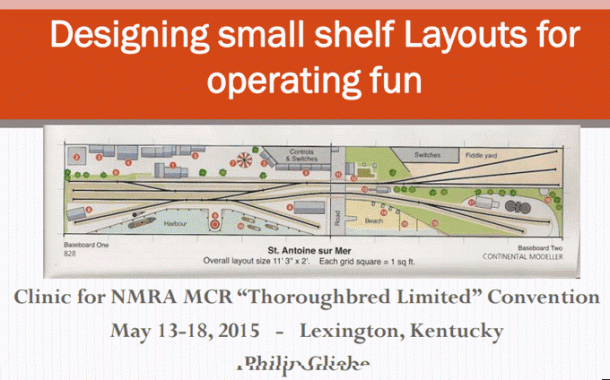
Site 1: Designing small shelf Layouts for operating fun

Presented back in 2015 at the NMRA’s Thoroughbred Limited 2015 MCR Convention in Kentucky I felt that this download (in PDF format) provides a great overview of small layouts and a bit of learning about the why and how along the way.

small-layout-handout

The details shown on the Inglenook drawing on page 4 are wrong (you can find out more about Inglenooks in this post); besides that however there are some exceptional small layout designs that should inspire the modeller in you to get out there and make something.

Site 2: Railroad Line Forum – Layout Design Ideas

This is the site that Shortliner Jack pointed me to as a source for his next layout inspiration. Being in the far north of Scotland, buried in snow for 9/10ths of the year, and surrounded by only boxes of Whisky for company he has a lot of time to work on layouts. One layout in Proto48 caught his eye specifically:

There are so many more designs in this thread large and small that you’ll spend several hours looking through and pondering them all. Great ideas and thanks to Robert Chant for sharing his design on the forum.


Site seeing – 10 September – All you ever wanted (or needed) to know about Inglenooks

Since we’re on somewhat of a roll with the Inglenook this week and it’s uses in small layout design let’s go to the source of all things Inglenook.

Site 1: Adrian Wymann’s “The Model Railways Shunting Puzzles website”

If you’ve not heard of Adrian’s site before then you are in a for a treat. This site has everything that you ever wanted to know about shunting puzzles, including the Timesaver and the Inglenook.

Image courtesy of Adrian Wymann

Of interest for those of us thinking of building a layout using the Inglenook design is the discussion on the design of operation and movement for the layout. Additionally there is the mechanics of designing and building the layout also. Very well worth the look.

Site 2: Adrian Wymann’s layout “Little Bazeley-By-The-Sea

Putting the Inglenook to work Adrian’s great little layout deserves a look. Well designed, well executed and well presented Adrian walks you through the design and build process and provides a lot of insight into the process.

Image courtesy of Adrian Wymann

Head on over to the websites and do a bit of reading – you’ll not be disappointed.

Site seeing – September 09 (the follow-on Inglenook folio edition)

Yesterday we looked at Yandilla Sidings, an excellently presented Australian Inglenook exhibition layout (read more about that post here). Today we have another Inglenook that jumped out at me on the Micro/Small Model RR Layouts group on Facebook.

Site 1: Ben Gray’s “Rozelle Street” layout

First we need a little context before we get to the layout’s brilliance. As a Western Sydney boy, I regularly saw long and short freights during the 1970s come through Blacktown in Sydney’s west before and after school. Living in Marayong on the Richmond branchline we had regular freights to and from the Riverstone Meatworks, and further up the line to Richmond itself.

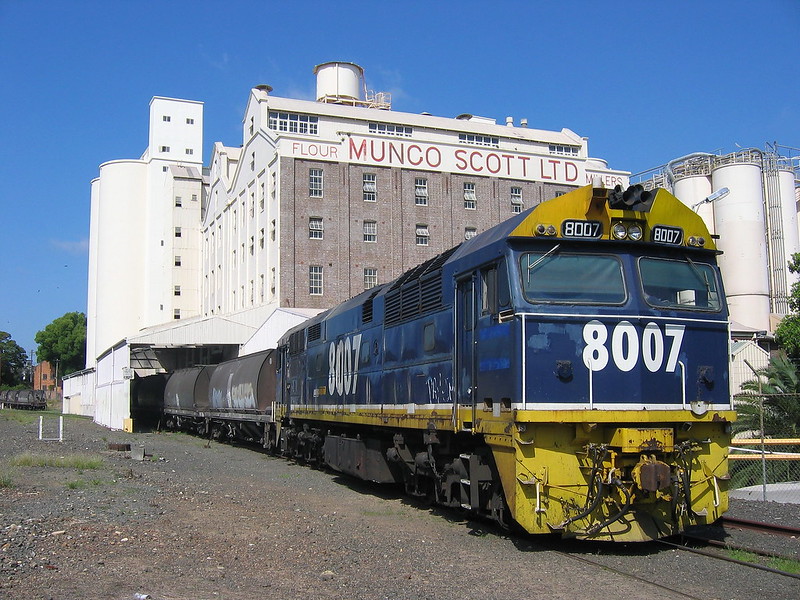
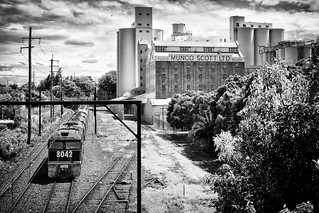
In the inner west (when I could wrangle a train trip into the city) I saw several locations that I always thought I’d like to model. The Mungo Scott flour mill siding for one as shown below seemed ideal. It was inner-city, working class, railway grit that has had me fascinated all my life. Here’s two examples from that location.

Image courtesy of Rob Cook

8042 at Mungo Scott

Image courtesy of Trent Nicholson

So now that you have a visual context of the type of layout that I’d always wanted to build let’s take a look at Ben Gray’s vision of inner city railway industry in a small space (not that you’d notice).

Image courtesy of Ben Gray

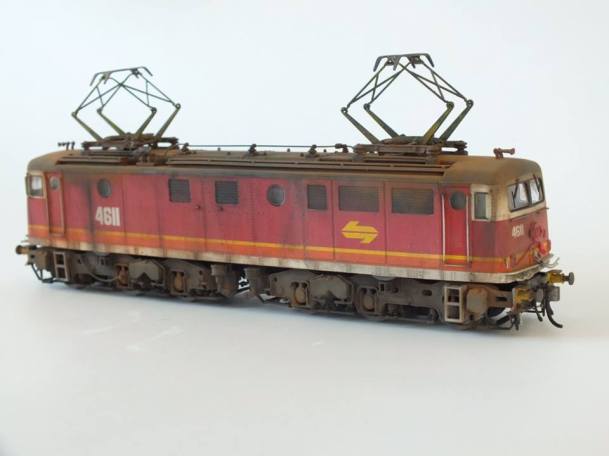
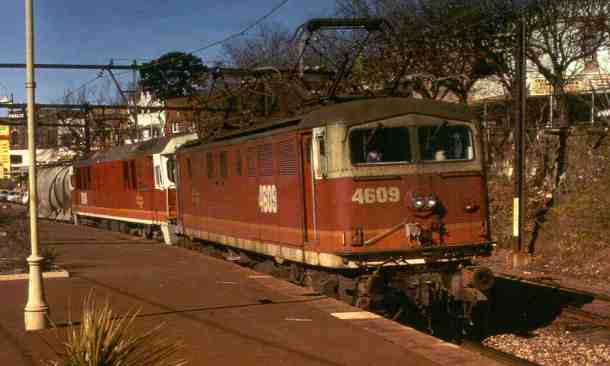
The image above caught my eye immediately. First, I loved seeing these 46 class electric locos working freight and passenger traffic around the Sydney network. Designed for heavy freight drag work out of the Sydney basin and over the ranges to our west, these locomotives were built by Metropolitan-Vickers and its partner Beyer, Peacock and Company in England for the New South Wales Government Railways. For many years these were the most powerful locomotives in Australia with a one-hour rating of 3,780 horsepower (2,820 kW) and the ability to deliver more over short periods. They are to me the most beautiful locomotives (electric or diesel) built and look fantastic on this Inglenook (if only there were overhead wire – sigh).

There are some very clever uses of visual trickery here. The layout is just an Inglenook but it is so much more because the focus is not on the Inglenook; rather the focus is on the concept of the viewer’s experience of the layout. You have to be an inner city kid, who saw locomotives similar in appearance, doing what locomotives do with freight cars. And how it worked on me. Good one Ben and well done on taking me back 30 years with one photo.

Enjoy another view of the layout. Follow the links above and if you’re a Facebook user head on over to the group and join in the small layout love. Finally see if you can work out some of the clever tricks used in the design of the layout.

Now for a little more 46 class locomotive weathering porn (model first, prototype last):

Image courtesy of Dean Bradley

And

Image courtesy of http://nswrailrambler.blogspot.com.au/

The lovely old 46’s were notorious for getting and staying grubby, but really what’s not to like eh? All the best see you over the weekend.