Category Archives: Operations

Focused on operational aspects of layouts

Site Seeing – The Little Critter that could edition

It’s not often that you get to see internal (in-plant) company railway operations today. Thankfully “Saginaw Terminal Docks” (Facebook and YouTube) posted a video from Reid Machinery in Lansing, Mi showing how they use old freight cars to store valuable machinery on their site prior to sale.


Reid Machinery’s internal railroad

Reid Machinery Inc of Lansing Michigan have specialised in moving machinery, primarily in the forging industry, throughout North America since 1992. And while that may not seem like the most worthy thing to write about on the third Tuesday in July – I urge you to hang around a moment longer. You see they also hold their large (as in big – not lots of) inventory on and in their own railroad assets.

Yes – they have their own switching layout.

Thanks to Saginaw Terminal Docks we have a front row seat, and a cab ride on one of these switching moves. I asked him about connections to the rest of the world. He tells me that the in-plant line connects to the JAIL/Adrian & Blissfield on over a mile of old track through Lansing’s south side.

And this is so modellable…


YouTube video

Some of the things to watch out for in the video are:

  • The three person crew (Engineer, conductor, and digger – and yes it’s a guy with  a shovel)
  • Slow switching speeds
  • At around the 18 minute mark – opening the boxcar door with the forklift forks (we often model the result but the actual operation is rarely filmed)

So sit back, turn up the volume and enjoy the show.


Resources

Site seeing – the Second Hand Inglenook edition – September 20, 2018

I admire modellers who can get to the meat of a project, quickly and with vigour. Gazmanjack (Gary) on RMWeb used second-hand track, wood and other parts from his modelling left-overs to create a stunningly good small layout for operations. Read on for more.


Linden Ford – the second-hand layout

Gazmanjack (his handle on RMWeb) back in 2014 built an outstanding layout from left over bits and pieces, as an adjunct to his current layout, to give himself something to operate on during the other layout’s longer build. I’ve only just found it and wanted to share the forum post with you.

And what a cracker this layout is. I won’t go into too much detail here, as I think the adage of a picture telling a thousand words is true on this occasion. There is plenty of information in the post too on the build including scenery, tree armatures, and so on.

Image 1: Linden Ford – an outstanding small Inglenook layout

I hope that you find inspiration in the post. So much with so little that turned out so well. Well done Gary!


Resources

Site seeing – Op till you drop – Blue flag “Video” edition – August 26, 2018

In my August 18 post we looked at modelling and using Blue Flags for your operating sessions. Thanks to Charles Malinowski’s timely reminder, there’s an additional video for context.


MRR Video Series – Taking Care of Business

Model Railroader magazine has a series of videos (most are pay to play). However some of the best of them are free for you to watch. One of these focuses on the SMS Rail Lines industrial park in New Jersey.

I did try to embed their video (as they offer this as an option – like YouTube) however, it didn’t work. Instead you’ll find below the link for the video. THis will take you straight to the page and then play away.

The video is narrated and professionally shot and edited. It is really well done and shows the operations in the Industrial Park and the blue flag in action. Thanks to Charles for reminding me of the video. I hope that you all enjoy watching and learning.

Don’t forget to comment on and share this post with your friends.


Resources

Taking Care of Business: SMS Rail Lines

Site seeing – Loco dead line edition – August 20

Locomotive dead lines make fascinating modelling subjects. One layout idea that has percolated along for the last couple of years relates to a locomotive rebuilder. A recent post by one of my favourite modellers, Mike Confalone, over on the Model Railroad Hobbyist forums, provides a great starting point.


Modelling a deadline

One layout idea that’s been percolating along for the last couple of years relates to a locomotive rebuilder. One aspect of that design is the deadline, that is, the line of locomotives waiting for work to begin on their rebirth, parts removal for donation to other units, and for some the final indignity – the cutters torch and a change of state to scrap metal. Fortuitously, a small project by Mike Confalone over on the Model Railroad Hobbyist forums has been focused on a deadline too.  Mike writes in the post that:

On the proto-freelanced Allagash, we have a caboose track at Madrid. With the move to 1984 a few years back, the caboose track is used less and less as cabooses begin to become less common. We still run them on most of the road jobs, but most of the locals go without, per the prototype in that era. So, I’ve converted the caboose track to a diesel deadline. Its a bit tight but it’s the only available real estate in the yard and I didn’t want to put them on a remote siding. I wanted the deadline near the engine house. Seemed to make sense.

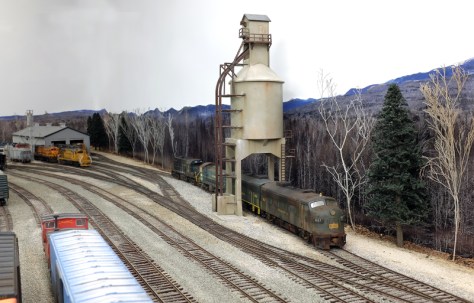
Click the photo above to go straight to the MRH forum post

There’s five pages of comments and information there as of my writing this post. Being a fan of Mike’s work I may be biased. However, I find his work to be of the highest quality and well worth the time to review. I hope that you feel the same way after you’ve read through the thread.


Resources

  • There is a Megastructures documentary (Mega Breakdown – train overhaul) that is worth watching for an overview if you haven’t seen this type of operation before:


Site seeing – Saturday morning video watching edition

It’s been a while since I’ve had the time to post. A range of reasons you’re all familiar with – work, tiredness, time pressure and the needs for others among them. And then that this is at the moment a hobby and not my primary income source (sigh).

While taking a little time out for myself in the early morning (before the sun came up on a very chilly day in Ballarat) I rediscovered the video produced by the folks over at Model Railroader on model railroad operations. Hosted by the late (and greatly lamented Andy Sperandeo) this video is a great introduction to operations, without all the paperwork, and other stuff that can hamper your entry into the realm.

I hope you enjoy, and it is great to share with you Andy’s wit and personality. I miss being able to chat with him as I did every now and then online about operations and the finer points he knew from a lifetime of modelling. Have a great weekend.

Site update – Operations pages updated

I’ve completed a complete rewrite of the introduction page to the operations section. In addition I’ve added another page to the ops section to improve the information flow. I wrote the original in September 2014 stating that it would be a living document, and so it has proved.

You can read the updated intro page here. That page then refers you to the new 101 – Ops Intro page which has more information on the subject moved on from the first page. I’ve updated several of the other pages also. There is still more work to do to make a better complete article. I’ll continue working on this section during January and February 2018. More information once I complete the new sections.

I don’t expect that you will agree with me on every point in this article series on Operations. For me it is about creating the conversation, and getting people to talk and think about the subject. I hope that you will use it as a jumping off point from which to refine your own vision of what model railroad operations means for you.

Make sure to comment and share your ideas with me. I love hearing what you have to say.

Site Seeing – August 7 – Master class: Operating Session

A recent post on the Model Railroad Hobbyist site by Tim Garland and the associated video (see below) shows the realism and enjoyment that can be achieved by operators with little cost beyond the time to set up and the time to operate.

What I enjoyed most out of this operating session video was the way that both Tim (who works as an Engineer for NS) and Tom Klimoski (the layout owner) work together as a team to get the ‘work’ done in a professional way, without hassle, in a small layout space, all the time working the layout to get the switching work done. Better was the way that you cannot see the engineer (Tom in this case) only the conductor on the ground working the cars into place.

Watch the video below and share your thoughts here or on Facebook.

At the Recent Ballarat Model Railway show (June 2017) I managed to catch up with a long time railway mate and his layout. When I saw this video I forwarded it onto Neil as a teaching tool to help him get operations going on his own layout. I think that what Tom Klimoski has recorded is the gold standard for small layout operations. It shows how (and I’m guessing on time) over a shorter operating session two people can work and have a lot of fun switching. Maximising the usefulness of a small layout by following the rules as set out, and by opening and closing gates, calling out the moves, and so on makes such a difference. I hope that you enjoy the video as much as I did.

Additionally there is a great post by Tim going on over at the MRH site about this video. Click the link at the top of the post for more. Lots of really good stuff in that post for the operator as well.

Ops, TT&TO, invective, and blah-blah-blah

It’s been a while since my last post. Life has become hectic with lots of work (as the opposite to none at all for quite some time) so to keep the blog moving I thought I’d cross post my response to Joe Fugate’s recent editorial: Secret to needing less layout on page 11 of the June 2017 edition of the e-zine ‘Model Railroad Hobbyist’. I found that as I read through the responses there was a lot of heat being generated by those for and against the smaller layout ethos. A recent kind email from a new model railroading friend Charles Malinowski got me to thinking about the original post on Joe’s editorial and the thought that perhaps it might be time to draw that line in the sand on this blog too.

If you can, take a moment, to read of some of the initial responses to Joe’s posting. Then either read my post on the MRH  site or as reproduced below. Don’t be shy. Got something to say, then comment and start the conversation here. It’s the only way we all learn.

Am I missing something? Did the hobby just become a pain in the butt during this discussion (and I’m not through reading all the responses yet)? Timetable and train orders, and… all to much work for me. While I understand that model railroading is all things to all people I don’t need all of that other stuff to make a me a happy modeller or operator.

I like small layouts. I live in rented accommodation, and will likely for the remainder of my life due to circumstances beyond my control. My wife loves the idea of me ‘not’ cluttering the place up with ugly wooden stuff that takes over the space, so I have to consider the aesthetic of any layout design as well as the piece of furniture it must also purport to be.

I’m limited in space, money and the time I have available to actually build the thing. So a long time ago I took the first mile, last mile approach to railway modelling. I model industries and locations where there is a lot of work to go on (switching) at an industry or location (such as a team track facility) getting the loads in and out in an efficient and useful way.

Do I care about Timetable and Train Order operation? Nope. Does it affect me as either the modelled customer or as an operator? Nope. And lastly, does it affect my enjoyment of the hobby? Nope. Would I love to model TT&TO operations? I’d love to but I cannot afford it.

I use paperwork, operations plans and rule books to model, and there’s a reason for this. I like my crew (usually my son and I) to feel the need to get the work done efficiently and with haste. There’s a train to catch out there somewhere and our cars need to be on it. I love operating by real railroad rules and with prototypical operations paperwork.

I focus on the things that matter to me, and that is the first mile and the last mile. What happens in between where the rail line curves away from my business – is none of my business. I put a lot of thought into what makes operations work for me. And I’ve shared that online as well. And it is not all that hard to achieve, especially in a small space. You can read more about that on my blog.

Joe’s TOMA approach I like. It means that it is achievable, in space, time and money. It gets you working quickly and allows for interests to develop as your skills and knowledge develop. Big TOMA, small TOMA, even in between TOMA… who cares? The idea is to get something going that allows you to play, find out what you enjoy the most and do that with the effort you have available.

Thanks Joe for sharing that article. I’ve been following along with the TOMA approach because it mirrors what I’m already doing and because it makes sense from my son’s perspective (Dad can we get something running now, I want to play with the trains again).

I appreciate that others do things differently. It’s a good thing. Let’s not get so focused on the forest that we forget about the trees. Happy modelling from Ballarat in Victoria.

Site update – May 23 – TSE Boxcars – additional lading and operation information added

Who says that asking for help doesn’t work?

When I wrote the TSE Boxcars page, about images I took back in 2005 in Austin Texas, I had no idea about the operational nature of the cars. Thanks to Paul, who is familiar with the cars, their loads, and operations I now can share a little more information with you.

This morning (AEST) Paul wrote the following: “Those cars came in empty. We would spot six at a time Balcones Recycling and they would be loaded with waste paper. There was about 30 of these cars that were in captured service. We would send the loaded cars out on the UP. They did not come in loaded with lumber. East end lumber is now long gone, and it has been at least 40 years since they received rail service.

My thanks go out to Paul for sharing his time and knowledge with me. One of the reasons I love the Model Railway community is their willingness to share. Greatest hobby in the world? I’d like to think so.

I’ve updated the page with the information Paul has provided. Good to know finally what they were there for, and the operation cycle they used.

Site update – 20 March – Updated 12 foot home layout design page

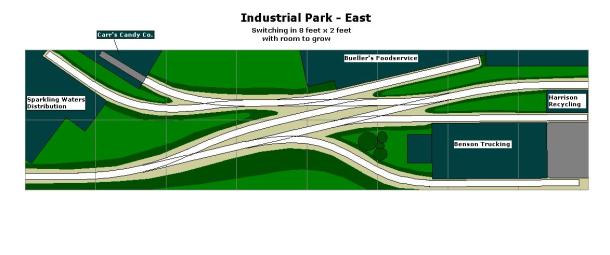
There has been a lot of thoughtful experimentation going on at Andrew’s Trains of late. While I was ‘reasonably happy’ with my Mk 72 layout design I wasn’t joyous about it. Recently while rediscovering some of my older layout designs I came across the design for ‘Industrial Park East’, as shown below, from somewhere about 2006-7.‘. Something in this design called out to me and so I set off on a slight redesign from the Mk 72 to Mk73 version. The changes I made have allowed me to get the ‘flow’, and the look that I wanted. I know this all sounds like something ‘the Dude’ would say from the Big Lebowski at this point but if it doesn’t work for you while you’re designing it, then it sure won’t work for you once you’ve committed track to plywood.

There’s a lot more information on the what, the why and the wherefore on the additional layout design page (yes I added another one to keep it all straight in my head). If your interest is peaked and you’d like to see more click the link in the line above and head on over to read on.

Thanks for reading – now it’s back to your regularly scheduled programming.