Category Archives: Liked off site

Other builders layouts that I admire

Site Seeing – The Super Duper Switch Stand Edition – 9 September 2018


Using Sunset Valley Railroad switch stands on the layout

Operating realism is very important to me. It ensures that those working my layouts move at a realistic pace and in a realistic way. Switch operation is a big part of that goal for me.


The source of inspiration – Port Rowan in 1:64

Originally inspired by a post on Trevor Marshall’s Port Rowan blog, I want to include these switch stands as a part of my operating realism approach.

I particularly like the fact that Trevor uses a single style of padlock to lock the switches along with a length of chain. This ensures that all switches must be unlocked before use, and relocked after use as happens on the 1:1 railroad.

As Trevor says in the blog post, they are more expensive than other simpler options. However, I think that if you have a small layout, and realistic operation is your thing, then the cost is worth it. And they’ll last forever.

I’ve wanted to share this post for a long time, but only recently found all the links again after long searching. I hope you enjoy reading about this and get inspired.


Resources

Site seeing – Op till you drop – Blue flag “Video” edition – August 26, 2018

In my August 18 post we looked at modelling and using Blue Flags for your operating sessions. Thanks to Charles Malinowski’s timely reminder, there’s an additional video for context.


MRR Video Series – Taking Care of Business

Model Railroader magazine has a series of videos (most are pay to play). However some of the best of them are free for you to watch. One of these focuses on the SMS Rail Lines industrial park in New Jersey.

I did try to embed their video (as they offer this as an option – like YouTube) however, it didn’t work. Instead you’ll find below the link for the video. THis will take you straight to the page and then play away.

The video is narrated and professionally shot and edited. It is really well done and shows the operations in the Industrial Park and the blue flag in action. Thanks to Charles for reminding me of the video. I hope that you all enjoy watching and learning.

Don’t forget to comment on and share this post with your friends.


Resources

Taking Care of Business: SMS Rail Lines

Site seeing – Saturday morning video watching edition

It’s been a while since I’ve had the time to post. A range of reasons you’re all familiar with – work, tiredness, time pressure and the needs for others among them. And then that this is at the moment a hobby and not my primary income source (sigh).

While taking a little time out for myself in the early morning (before the sun came up on a very chilly day in Ballarat) I rediscovered the video produced by the folks over at Model Railroader on model railroad operations. Hosted by the late (and greatly lamented Andy Sperandeo) this video is a great introduction to operations, without all the paperwork, and other stuff that can hamper your entry into the realm.

I hope you enjoy, and it is great to share with you Andy’s wit and personality. I miss being able to chat with him as I did every now and then online about operations and the finer points he knew from a lifetime of modelling. Have a great weekend.

Ops, TT&TO, invective, and blah-blah-blah

It’s been a while since my last post. Life has become hectic with lots of work (as the opposite to none at all for quite some time) so to keep the blog moving I thought I’d cross post my response to Joe Fugate’s recent editorial: Secret to needing less layout on page 11 of the June 2017 edition of the e-zine ‘Model Railroad Hobbyist’. I found that as I read through the responses there was a lot of heat being generated by those for and against the smaller layout ethos. A recent kind email from a new model railroading friend Charles Malinowski got me to thinking about the original post on Joe’s editorial and the thought that perhaps it might be time to draw that line in the sand on this blog too.

If you can, take a moment, to read of some of the initial responses to Joe’s posting. Then either read my post on the MRH  site or as reproduced below. Don’t be shy. Got something to say, then comment and start the conversation here. It’s the only way we all learn.

Am I missing something? Did the hobby just become a pain in the butt during this discussion (and I’m not through reading all the responses yet)? Timetable and train orders, and… all to much work for me. While I understand that model railroading is all things to all people I don’t need all of that other stuff to make a me a happy modeller or operator.

I like small layouts. I live in rented accommodation, and will likely for the remainder of my life due to circumstances beyond my control. My wife loves the idea of me ‘not’ cluttering the place up with ugly wooden stuff that takes over the space, so I have to consider the aesthetic of any layout design as well as the piece of furniture it must also purport to be.

I’m limited in space, money and the time I have available to actually build the thing. So a long time ago I took the first mile, last mile approach to railway modelling. I model industries and locations where there is a lot of work to go on (switching) at an industry or location (such as a team track facility) getting the loads in and out in an efficient and useful way.

Do I care about Timetable and Train Order operation? Nope. Does it affect me as either the modelled customer or as an operator? Nope. And lastly, does it affect my enjoyment of the hobby? Nope. Would I love to model TT&TO operations? I’d love to but I cannot afford it.

I use paperwork, operations plans and rule books to model, and there’s a reason for this. I like my crew (usually my son and I) to feel the need to get the work done efficiently and with haste. There’s a train to catch out there somewhere and our cars need to be on it. I love operating by real railroad rules and with prototypical operations paperwork.

I focus on the things that matter to me, and that is the first mile and the last mile. What happens in between where the rail line curves away from my business – is none of my business. I put a lot of thought into what makes operations work for me. And I’ve shared that online as well. And it is not all that hard to achieve, especially in a small space. You can read more about that on my blog.

Joe’s TOMA approach I like. It means that it is achievable, in space, time and money. It gets you working quickly and allows for interests to develop as your skills and knowledge develop. Big TOMA, small TOMA, even in between TOMA… who cares? The idea is to get something going that allows you to play, find out what you enjoy the most and do that with the effort you have available.

Thanks Joe for sharing that article. I’ve been following along with the TOMA approach because it mirrors what I’m already doing and because it makes sense from my son’s perspective (Dad can we get something running now, I want to play with the trains again).

I appreciate that others do things differently. It’s a good thing. Let’s not get so focused on the forest that we forget about the trees. Happy modelling from Ballarat in Victoria.

Site seeing – February 19 – The small passenger layout edition

While searching for ideas recently I came across a now very old set of posts from 2001 onwards about the building of a narrow yet long passenger station layout. Onto today’s site of interest.

Site 1: Simon Martin’s Shelf Layout project

This appears to be an orphaned site, and I cannot find any information or updates beyond the 2005 update on the page. Which is a real shame as this layout is a simple, well designed and yet highly operational layout for the single operator at home or at an exhibition.

The track plan is clean and has no major needs apart from two switches and some flextrack. You could even use this to get into building your own track work. Operationally there is much to work with. Trains may arrive and depart from either platform. Heading to the fueling depot means that you need to either shunt back onto the main, then into the second platform road prior to running back into the fueling/storage road. Planning your moves here would be very worthwhile in the smooth operation of the layout.

The fueling/storage point on the bottom left of the plan gives options for storing stock on the layout without over crowding the scene. Scenically the station building hides the end of the platform roads and gives the layout a greater depth than would otherwise be the case.

I think this would be a great design to work with not only in the short-term, but for the longer term by adding all the bells and whistles (such as automated announcements, details, more scenery and upgraded ready to run models.

I’ve tried finding anything else by the blogger but have been unsuccessful. I’d love to see more of this layout and what it became. No luck however. So we’ll just have to enjoy the layout as it would have been. If you know anything about the layout, the author or have contact details for Simon, let me know in the comments.

Site seeing: August 31 – Winter is going (at least down here)

Winter is over, although where we live in Ballarat at 420m (1370 feet) above sea level, you’d be hard pressed to tell that change of season has arrived. Our mornings are still cold, the winds are still lazy (they go through and not around you), and the weather is not shiny or happy. However, my seasonal allergies have kicked in, and the Wattle has been in full bloom for about 3 weeks now. I’m sniffling, my eyes are streaming and I look like I’ve gone five rounds with the late, great Muhammad Ali. My allergies and the weather are not the reason for today’s end of Winter post…

Site 1: Croft on the ScaleFour society’s website

Built as a shunting puzzle (Inglenook) and based loosely upon the real Croft goods (Darlington, NER, not Leicestershire LNWR), Croft is a magnificent example of simple effective display and operation. The image below courtesy of RMWeb and Steve Taylor.

I could go on at length about this layout, or I can let you soak up the atmosphere of this image and then follow the ScaleFour link above.

Site 2: RMWeb’s Croft Gallery

Go, look, mind blown.

Hope that this gets your creative juices flowing. Looking forward to the Southern Spring.

Site seeing – August 28 – 1980 Frisco S Scale layout “Cheltenham”

Tom and I have been out of contact for some time but recently reconnected on the Railway Modellers surprising best friend – “Facebook”. I’ve known Tom Potthast since my early days in Austin, Texas, since around late 1997 or early 1998, when I met him at King’s Hobby. Tom has been an S scale modeller since before I met him and pitched hard for me to choose that scale. Originally from St Louis he lives in Virginia. As I’ve noted in the title of the post he’s working on a 1980 era Frisco S scale layout. He’s not advised of a website or other online location so I’ll be posting and sharing photos of his layout here.

Site 1: Information on Tom’s layout “Cheltenham”

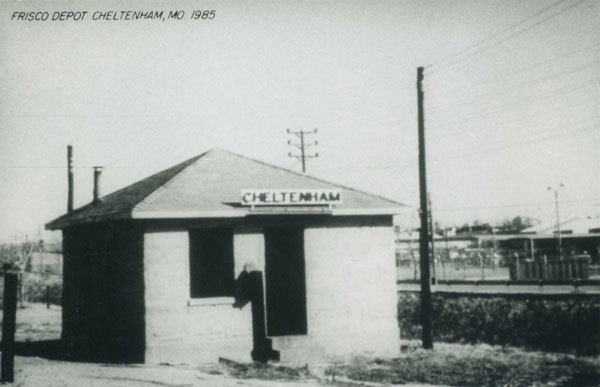
cheltenham_missouri

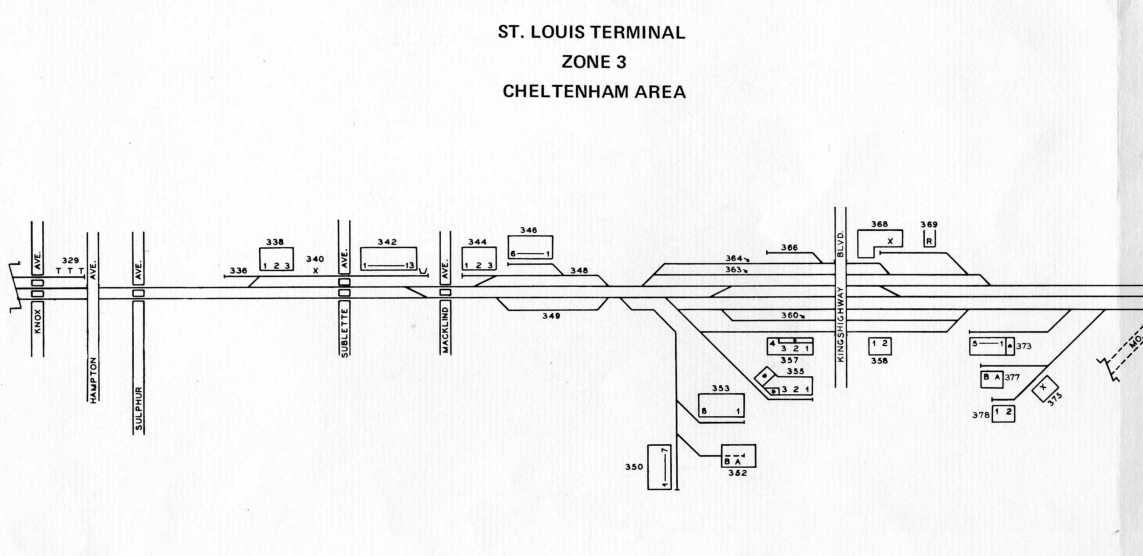
Tom told me that Cheltenham was a commuter stop, within the city limits of St Louis. The structure in the image above survived into the 1980s. The area Tom’s modeling is located between Hampton Ave. and Kingshighway. It is just a short piece of the railroad yet has plenty of switching potential.

St Louis Terminal - Zone 3 - Cheltenham Area

There is no official track plan. It was planned out using a full size mock-up before final construction began using a PDF of the area as a guide. I’ve added a section of that track diagram to show the area he’s modelling above.

Tom says that “… one day when I get my two-car-garage-like space it will include Lindenwood yard and a great deal of interchange with other roads such as the N&W (Wabash) TRRA, Manufactures Railway (Anheuser Busch), BN and Mopac.”

Site 2: Some of Tom’s S scale weathered cars

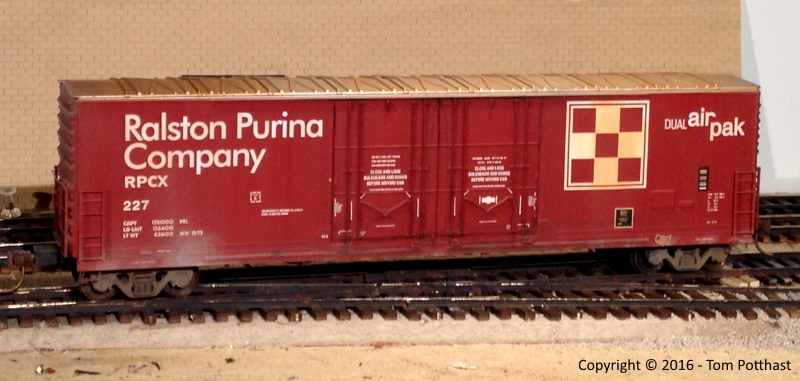
What inspired Tom to write me was the Martin Wellberg’s German Gmhs 53 weathered wagon. He supplied a few photos for me to share and promised more in the near future. RPCX 227 is the first photo showing a car that is lightly weathered.

RPCX-227_Weathered

Below is a car from the same series RPCX #101-#240. Built by Evans USRE (Blue Island, IL) in Lot 1169A of Nov 1973. Stenciled: Return to PC Sharonville, OH. These were eventually to become a part of the CNW fleet (series 540300-540436 cars) after Purina gave up the RPCX reporting mark in 1989. Image below courtesy of Steve Vincent and Railcar Photos.

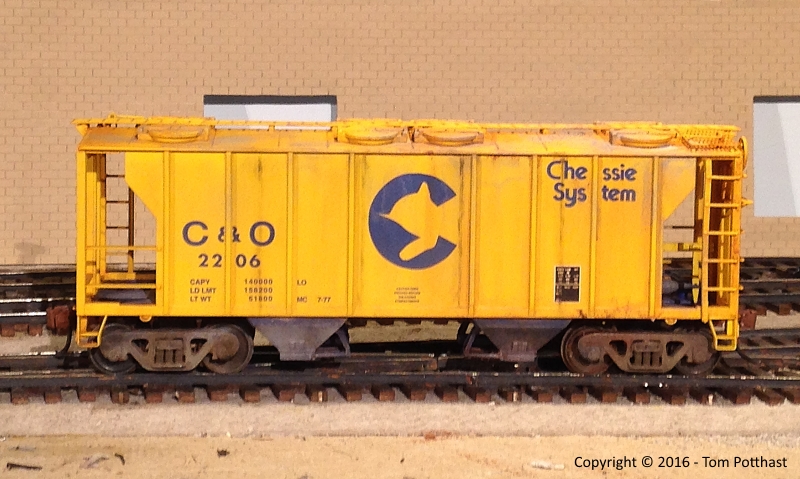
The second photo shows Tom’s CO 2206. A covered hopper in CO series 2300-2374 built by General American Transportation Co. during Aug-63. I could not find a prototype photo of this car.

CO-2206_Weathered

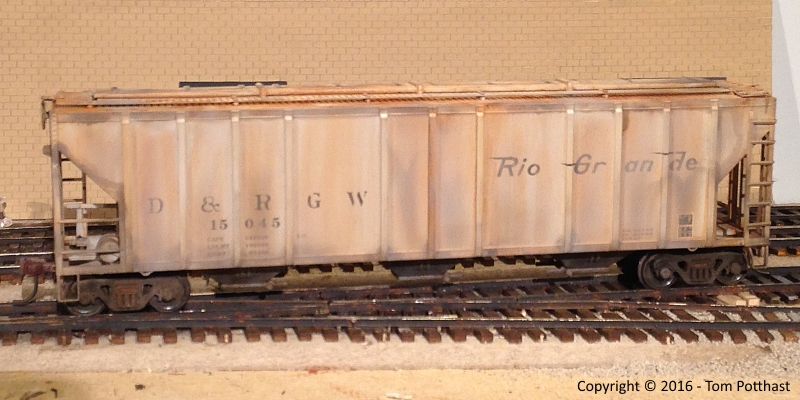
The next photo shows DRGW 15045 a 3-bay rib-sided covered hopper in the DRGW series 15000-15149 built by Pullman-Standard, Lot 8923, in 64.

DRGW-15045_Weathered

I found a close match in DRGW 15006 in the same series on the Railcar Photos website. This photo is by Kent Charles.

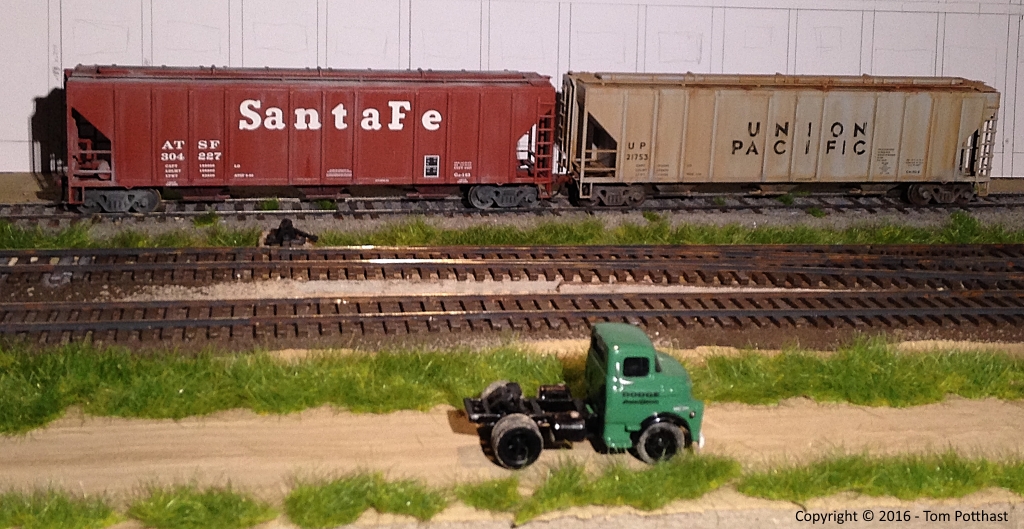
Finally I’ve got a slightly wider shot showing two more covered hoppers and some of the layout and scenery.

ATSF-304227_UP-21753_Weathered

Thanks to Tom for allowing me to post his photos. Looking forward to seeing more of the layout and rolling stock and locomotives Tom. Thanks for sharing.

Site seeing – Tueday 14 June 2016

As you tool around the web you come across some interesting and useful sites. I’ve found it hard to have a simple to find and use repository since the end of basic HTML coding. I’ve bookmarked and so on but I wanted to have a better place to go.

So today I’ve added a new section for these resources.  I’ll add site links when I find them; adding information about the sites so that you decide their value before you visit them.

Visit the following two pages:

Enjoy

Site seeing – May 11 (the Shelf layout Inglenook post)

It’s been some time since my last post, due mainly to work and other real world commitments. Recently while enjoying a little downtime, I cam across a great set of posts and the layout blog. I wanted to share that with you.

Site 1: Burbank Branch Layout

A simple Inglenook track plan, this layout has some outstanding features that make it worth looking into. Not least is the modelling skill shown going into the layout by the builder – survivaljoe over on the MRH website..

Burbank Branch Layout plan

As a renter he needed to build a layout that could move when he moved and not mount to or damage any of the walls in the dwelling. The control is DC for the moment while he waits for new technology in the market to mature. That does not appear to change the slow running qualities of locomotives.

Designed for operating sessions of roughly 30 minutes at a time (which I’ve talked about several times before as the perfect amount of time to operate on a small layout) this layout really shines up well, even without all the scenery in place.

The video above shows a basic operating session and the modelling quality involved.

While the video above shows images taken during the build process. I hope that you enjoy look at the layout as much as I have. Look into the resources below for the build and blog over the MRH site also.

Resources:

Site seeing – February 13 (the behind the scenes edition)


Site 1: Switching/Shunting/Shelf “Small Model Train Layouts” (Facebook group)

Glenn Sanders runs a very tight-knit and helpful group over on Facebook. I’m pretty sure that you need to be a member of Facebook to view the group, and you have to be added by Glenn, but since joining I have found some of the best modellers on there. Ray O’Neill of HELM and 59th and Rust fame is just one of the great modellers on the group. It is also a great place to share ideas and plans for your industrial switching layout (ISL) too. If you get a chance drop by and see what’s going on. Very layout focused.

Site 2: End of the spur!

For those of you who might know Ray O’Neill through his 59th and Rust layout, he has another underway at the moment that I wanted to share with you. End of the spur is an industrial switching layout (ISL) set in an inner city industrial area, using combined motive power moved because there is no run-around as in the image left, there is a lot of switching to do and surprisingly a lot of space to get it done in with 12′ (feet) of run and 14″ (inches) of depth. There are some great ideas that I’ve seen in this build that I’ll be using on my layout too. Among them the switch frog polarity controller – which is genius.

Have a great Saturday.