Category Archives: 1. Small

Small layout designs

Site Seeing: December 14

After I reblogged Rails West’s San Fernando Valley Branch post on December 7th I took a look around the web to see if there were other sites that had information on this very interesting branch line. Luckily I found one. I could not find a SPINS book in my stash of SP paperwork to cover the area however you could certainly find this information from many of the online dealers (found at the last link) today.

There’s a week’s worth of information here and I hope you enjoy reading through it all.

Site 1: Burbank Branch Industries, 1981

Bruce Petty’s website has some really fine information (including lots of photos) of the branch in the early 1908s that would of interest should you decide to model the branch or one just like it. It includes the names of the industries served and the car lengths of the spurs.

Site 2: San Fernando Valley Freight Station Photos

Another of Bruce’s pages this time with photographs of the freight stations along sections of the line. Nice if you wanted to model any of these buildings specifically.

Site 3: Bruce’s layout page

Bruce has a model railroad covering a portion of the branch that was featured in the 2007 Great Model Railways (Kalmbach Publications). Take a good look around and take a look at some of the links on the page for the modelling articles there. Really goo stuff.

Site 4: CLIC, SPINS, ZTS: Zones, tracks, spots Identification

Some solid information on the different forms of track and spot identification. Main site is in German but the page is written in English.

Site 5: An overview of SPINS and the TOPS system that underpinned it

A great site with a huge range of detail and links about the SPINS system and the TOPS system. And yes UK modellers that is the same system BR purchased from the SP in the 1960s.

Site seeing 28 September – the Sprung has springed edition!

It is spring in the southern half of the world, and as a result everyone is coming down with seasonal allergies after a very long (well it seemed that way), cold (no it really was as cold as charity according to the weather bureau) and miserable winter.

Today is also marks my brother’s birthday – so Happy Birthday Scott. Hope that you get the message. More importantly I hope that you are reading the blog! But enough of me and onto the site seeing!

Site 1: One turnout layout variation

I’ve mentioned Chris Mears’ site in the past. His current post provides some interesting thoughts on variations among other thoughts on the “One turnout layout” posited by Lance Mindheim in the May 2013 edition of the Model Railroad Hobbyist Magazine.

Read the article, and then read, and take part if you’re willing, in the discussion at the end of the post. It’s been thoughtful reading. Not saying that I agree with it all, but it has been thought provoking.

Site seeing – August 10th

Yesterday was all about passenger service; today is all about freight. Chris Gilbert pointed this video out, on his YouTube page. However the producer is ChicagoJoe28. But enough words let’s get to the video.

Site 1: Mike switches Batory Foods Chicago Terminal railroad

Video 1: Batory Food Switching on the Chicago Terminal

A little history

Located at 2234 W 43rd St, Chicago, IL 60609, Batory Foods began trading in 1979 when Abel Friedman opened Chicago Sweeteners. As a single source supplier of basic food ingredients such as sugar, flour, salt, starch, milk, oats, honey and corn syrup. Chicago Sweeteners expanded its product offering over time, as food manufacturers sought to develop healthier products.

With success in the greater Chicago market, the Company brought its broad line model to food manufacturing centres around the country. Some of the growth came with the original business; some by way of acquisition with:

  • Sugar Incentives bought in 1995,
  • Ingredients International in 2006,
  • Quality Ingredients in 2008,
  • LSI in 2009,
  • Industrial Ingredients in 2009,
  • Massey Fair in 2011, and
  • Mac Source in 2011.

Recently, the various names were consolidates into the single name: Batory Foods.

The layout idea

The site’s switched as an Inglenook. The two on-site spurs lead to undercover augers (I’m assuming here of course) for unloading powdered or granulated product.

Batory Foods Chicago - An Inglenook you can model

Image 1: The unloading spots (courtesy of Bing)

The storage track goes to other industries further down the track, but does not show recent use from my quick look. The loco has to push the cars into the site so you have a simple, prototypical Inglenook that won’t take up too much space. It is small enough that you could model any date from 1979 on in HO, S or O scale.

SCORE! What are your thoughts?

Thanks to Chris Gilbert for the vision, and to ChicagoJoe28 for filming it.

Why I chose not to design my layout – Part 5

Somewhere back in a previous post I am certain that I published a basic op session. Today I wanted to update that in light of the new layout design, as there is a pretty big change to both the ops plan and the layout since I first set track on plywood.

A Modified Op Session

An op session will start where ever the previous session stopped. You should keep in mind that I am aiming to have roughly one 30 minute operating session per night, at least 3 nights per week. I’d like more but the realities of work and family mean that aiming for 3 nights is achievable.

Assuming that a full day’s work (around 90 minutes odd) is planned for say a Saturday op session here’s how the work would be done.

The yardmaster will go through the electronic system (more about that later on) and determine what cars are due to be picked up and what inbound cars are due to be setout for the day. The YM then hands the paperwork off to the switch crew and goes about his business.

We pick up with the switch crew after they’ve already travelled out to the interchange, connected on, pumped up the air and begun their return back to the Industrial park.

  1. Train arrives from interchange
  2. Loco runs around the train on the arrival track and moves the train over to the classification 1 track
  3. Cars are classified according to the switch list using the main, loop and the Class 2 track
  4. The crew checks the pickups and setouts for industries and then sets about doing the individual jobs for each customer. In cases where there are multiple customers on a spur, the job is handled as a single job
  5. Industries are pulled and setout as required by the switching documentation
  6. The crew then returns outbound cars to the yard, for storage while other switching goes on for other customers (if any that day)
  7. Once all of the industries for that day are switched all outbound cars are made up into a train (blocking is not required)
  8. The final work for the day is to pull the outbounds to the interchange
  9. The cars are set out, handbrakes applied as needed and the air bled off
  10. The loco crew return empty handed to the yard, carry out any further trimming of the class tracks as needed, and
  11. Run the loco back into the maintenance facility.

Here endeth the operating session.

As I said above this full operating session ought to take up about 90 minutes. Allowing the session to be broken down into shorter, easier to achieve 30 minute mini-sessions means I’ll be more likelt to play with my layout, and get more enjoyment from it.

Between sessions the paper work will be hung on clip boards off the front of the layout ready for me the next night.

Should I want to run a longer session I can do that and simply complete the previous sessions work as a part of that.

Why I chose not to design my layout – Part 4

I did some measuring on the new track plan (version 3) today and the result is pleasing (at least to me). On the HVRR we use a XAF10 Railbox car as our standard measure for cars; These car’s measure 190 mm over coupler faces – that’s right on the 54′ and some change that a real car has for door spacing if it is recorded as a 50′ car. With the numbers in hand I tried a few calculations to see how everything fit.

Yard Tracks

With measurements now completed on all of the storage and “yard” tracks our holding ability on all tracks suggests that the:

  • Main (at 1400 mm) can clear 7 standard cars,
  • Loop (at 1500 mm) can clear 8 standard cars.
  • Classification track 1(at 1800 mm) can clear 9 cars ,
  • Classification track 2 (at 1300 mm) can clear 6 cars, and
  • The total on-track yard capacity is 30 cars (not including the interchange as I consider the interchange loadings to be a part of this number).

Yard Occupancy

I don’t want to flood the yard on any one day so I expect that the total yard occupancy at maximum will be 50% of the total – leaving me with 15 cars maximum. So that even with a full train of 9 cars coming in from the interchange I can use Class 1 & 2 to store all of the cars and leave the main and the loop free to work. More on this though below.

Industry tracks

On the main board there are two industries:

  • Industry 1 is 800 mm long and can manage 4 cars
  • Industry 2 is 1600 mm long and can manage 8 cars
  • Interchange track (at 2400 mm) can clear 9 cars plus the loco. The interchange track is considered an industry also.

The trackage on the base of the L are to be built based on an article in Model Trains International #58, page 106 by Bruce Petty. While this was essentially an article on scratchbuilding the Strongheart Packing Co. there was also a track diagram included. While I cannot post the magazine article here for you, I can point you to Bruce’s website which has the same information and track diagram (link here)

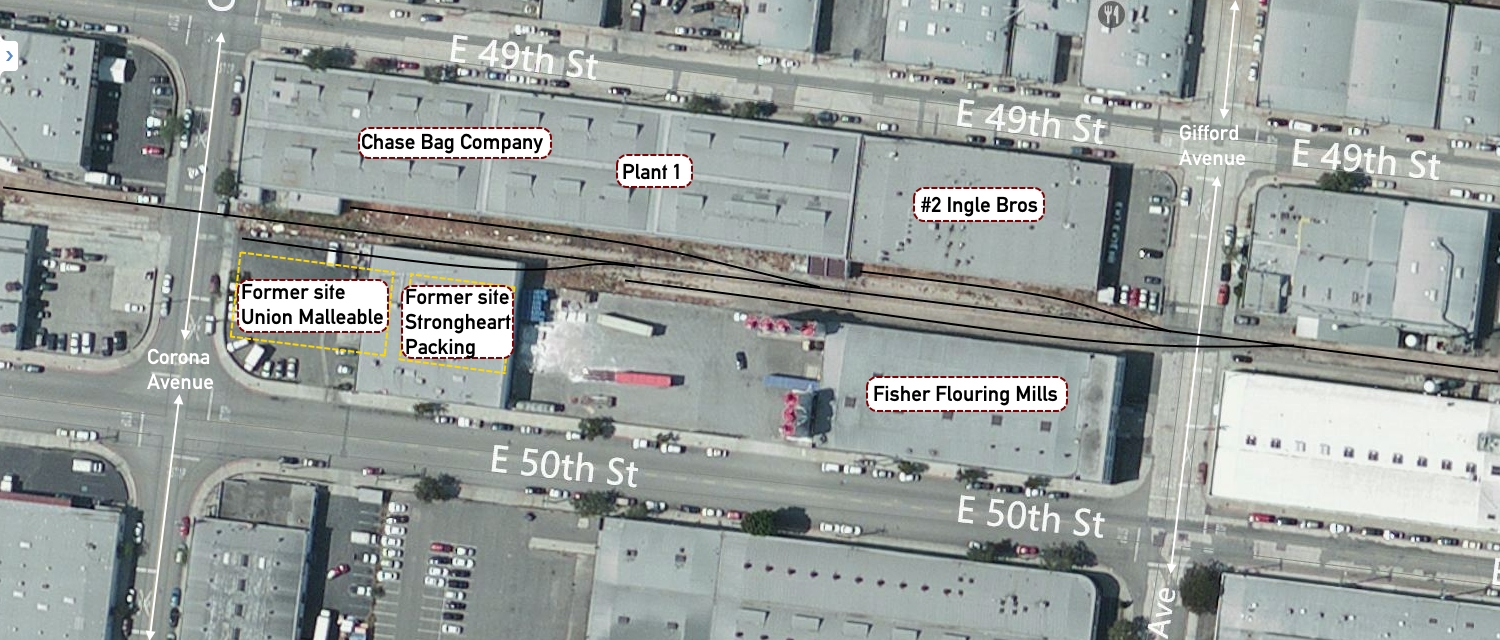
The current track layout in this area bounded by East 49th and E 50th Street is somewhat different from that of 25 – 35 years ago, this is reflected in the two images here:
Strongheart Packing Co - Vernon CA

Image 1: Block bounded by 49th & 50th Street, and Gifford To Corona Ave

This is an overhead view of the same block as in the article, but several of the buildings have been removed; specifically Union Malleable and Strongheart Packing. Otherwise the track for the most psrt seems to be intact.

Vernon CA - 49-50th Street - Gifford to Corona Ave - Track Layout

Another overhead view showing a slightly different angle that puts the article map in perspective.

I’ll be leaving building’s in place at Ingle Bros. It is a nice, generic building, plain brick that will be easy to model. It will have the two car spots as on the plan. The Chase Bag Co will go. In it’s place I’m going to put a team track. This will ensure that I can have a range of cars in that spot, and in addition give a great view of the remainder of this section of the layout.

The other buildings will be changed slightly to give that 1970’s renewal look of tilt-up concrete construction so prevalent in Texas.

Industry occupancy

Just as for the yard, I do not want to flood the industry tracks with cars. There are two reasons for this:

  1. I like that industries are not always blocked with cars – this is also very prototypical, and
  2. I am aiming at maximum to have industries be 50-60 percent occupied

Thus the total car numbers of the main board will be:

  • Industry 1 holds on average 2 cars with a maximum of 3 cars
  • Industry 2 holds on average 4 cars with a maximum of 5 cars
  • Interchange holds on average 5 cars (rounded up from 4.5) to 7 cars.

As noted earlier it can clear up to 9 cars at any one time if needed; this ensures that the interchange and the yard tracks should never be flooded with cars to stop the operations of the railroad.

The industrial park (bottom of the L) boards will hold on average 7 cars using the same occupancy rate. In total then the maximum cars in and out of the layout (should all of the occupied spots be switched on one day) would be 17 cars. Luckily that is not going to happen because these car movements would be spread over 6 days.

I am hoping the average will be in the range of 4-5 cars per session. This meets my goal of a short switching session, but with plenty of interest for me as the crew. More on this later.

Site Seeing February 21

It’s all operations Saturday, thanks to Martin Hogg, the owner and operator of Brett.

Site 1: Brett – a full operating session video

Martin Hogg’s released a new video (Brett’s been featured recently on the blog).

This time you get to see a full operating session from start to finish.

This video shows just how much enjoyment you can derive from switching on a relatively small layout with a reasonably simple track plan.

I’m guessing the operating session lasted around 25 – 30 minutes from start to finish. As soon as I get some feedback from Martin I’ll update this post and let you know for sure.

Good work that man! On you Martin.

Update 1:
I talked with Martin Hogg today and he confirmed that the operating session takes about 25 minutes (although he says its heard to be sure as he was busy phaffing around with the camera to be sure). He’ll be running another session to confirm that but I’m pretty sure that it’ll be right around the 25 minute mark, depending on the work to be done.

Layout Builders of Note – Chris Gilbert

Introduction

I’ve known Chris Gilbert for many years thanks to the Internet, specifically RMWeb. Chris has always managed to be a great mentor on things model railroad, even if he was not aware of his mentorship. He’s been successful in building, exhibiting and publishing a range of model small exhibition layouts over the last several years. What gets me is how quickly he puts these model marvels together.

Florida Springs (V 2.0) – An HO Scale exhibition layout

Chris in his own style said that he started the layout on Tuesday the 10th of February with a trip to his local hardware store.

Within five days he was at this stage:

As if that was not enough to make me feel like I need to pick up my game, his detailing is exquisite. If you take a link at post number 5 (link here) you’ll see what I mean.

Every time I see what Chris can do in so short a time, I am simply bowled over. He thinks about something and then he gets it done. It’s something that I am going to aim for in my modelling this year.

Before I can get there though I have to complete some other modelling projects to finish for my local model club show in April (you can read more about that on the Modellers of Ballarat blog (link here).

I’ve listed other sites in the resources section below. Enjoy having a look at Chris’ layouts. They really are magnificent works of art.

Resources

· You can find out more about the O scale Fort Smith Railroad layout (External Link) here.

· You can visit Chris’ YouTube channel (link here) – and watch his videos of Haston and North Haston – great stuff.

Site seeing – February07

There are some sites that I find myself returning to time after time. Vibrant sites with lots of new ideas and a great wealth of modellers, who love to share.  My favourite message board is to be on and partake in is RMWeb.

There is always a project or layout build under way that has something to give you. Today I’d like to point out two projects on RMWeb that I find really interesting for a number of reasons.

Site 1 – Down Ampney

Built in 7mm scale as a basic garage-garden-garage line; the garden section is in effect just a single track with a couple of sidings and scenery provided by mother nature. Control is planned to be a mixture of DCC and RC.

The Scenic modelled section is to be situated within the garage with a cassette fiddle yard on the other side. The garden will include a viaduct but be fairly basic for the sake of ease of building and getting something up and running quickly and to reduce maintenance.

Site 2 – Draycott (Camp) Halt Sidings

The model depicts a small corrugated Goods Shed and two sidings, with the tail-end of the Head-Shunt also represented, the Loop being ‘off stage’ so to speak. This is a classic Inglenook type ‘shunting plank’ and will give somewhere to have some fun with ‘shunting puzzles’ and to test new stock whilst Down Ampney is being built.

Conclusion

While both are 7mm O scale layouts, the standard of modelling is very high, while the area and layout being modelled is small and simple. Lots of working potential too.

Well its a very warm day in Ballarat, and my son and I are off to the local pool. Hope you’re having a great day where you are too.

A tuning fork just begging to be modelled

Introduction

If you have not seen a tuning fork layout, it is a very simple 1 turnout operation. If you are still not seeing it in your mind, think of the letter ‘Y’. Most of the layouts I’ve seen assume either a mainline and a siding, or two sidings. However, that does not mean little operational potential. I found a video by Thornapple River Rail Series on YouTube [Link is below] this week and it got the creative juices flowing.

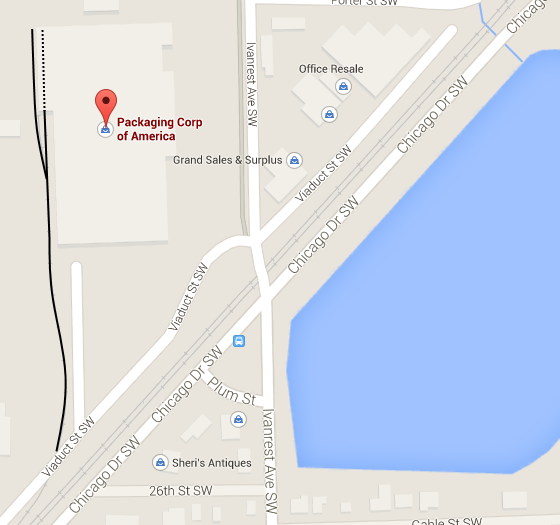
Packaging Corp of America - Grandville MI

Image 1: The location of the facility from Google Maps

The kicker is that the second of the spurs is used to allow switching to take place on the spur itself. Before you do any more reading watch the video (It is 18 odd minutes long but if you start at about the 4:36 minute mark you’ll get the gist pretty quickly).

Video 1: thanks to Thornapple River Rail Series

Operations

If you start at about the 4:40 mark into the video you’ll see the following occur:

  • Loco and first three cars cut off from the train
  • Same pulls forward of the spur switch, and reverses across Viaduct St SW toward the plant
  • You’ll notice the second spur on the outside of the plant as the train pushes back toward the plant
  • Once the roller door comes up, the train pushes back into the dock area, picks up the outbound cars, and pulls forward again to clear the switch for the spur
  • Next, the outbound cars get pushed onto the exterior spur
  • Inbound cars get pulled forward onto the spur again, the switch is reset, and the inbound cars are pushed back into the dock
  • Loco cuts off, pulls forward to clear the switch, and once changed over, pushes back to hook on and pump up the air on the 3 outbound cars
  • Pulling forward the loco and three outbound cars cross over the road and re-join the train
  • Just to add the cherry on top, the train then reverses back to the yard with the engineer riding the caboose

Now all of this takes between 10 – 14 minutes of video time. But what a fantastic way to spend your 5-20-5 minutes of daily modelling / operating time (read a post on that concept here).

If you want to make it last a little longer, first re-arrange the incoming cars into the order as required by the plant. Additionally some cars may not be unloaded yet, and they need to be moved off-spot, and then back on again with new inbound cars. Some cars may need to be left off-spot on the exterior spur for the next switching session.

Layout idea

While I mainly model in HO my true passion is 0 scale (and bigger when I can manage it). Alas I have not the room for a big layout to run those sized trains – yet.

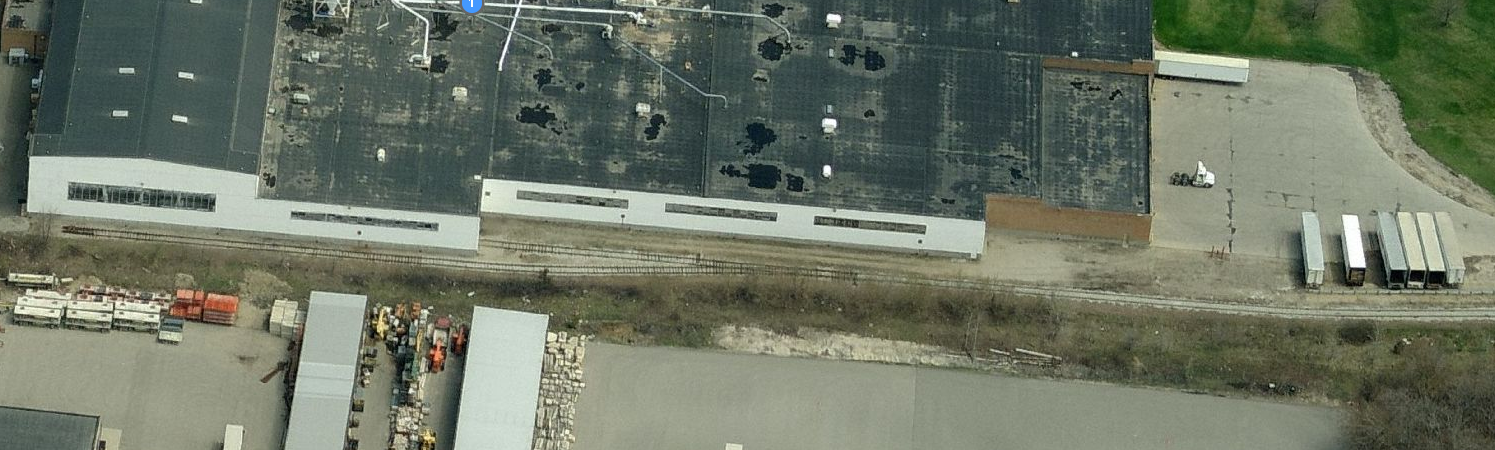
The layout - via BING Maps

Image 2: The complete layout (click for a larger version of the file)

For an 0 scale layout I cannot think of a better idea. You could easily do that in 12 feet and no more than 12 inches wide. If you really had the room you could do it in 18 inches wide and go nuts with weathering, winter trees as in the video, and the knocked over Armco barriers. Glorious! The big gotcha here is that the switching lead ahead of the switch has to be longer than 2x the maximum number of cars you switch into the dock. Don’t forget to add a loco length on top of that too.

So if you switch in 3 cars and out 3 cars you’ll need to have six spots plus a loco length to allow the switching to take place.

Hope that this gets your creative juices flowing. And thanks to Thornapple River Rail Series for posting the video. I am going to be looking through a bunch of his videos now for other similar ideas for my layouts in the future.

It’s a sunny and pleasant Saturday afternoon in Ballarat, hope you’re enjoying your day where you are.

Resources:

Google Maps: Location

Bing Maps:     Location

Brett – a great small layout you can model

Introduction

When you travel for business, you can spend a lot of time staring at the walls of your hotel room. While travelling in June of 2014 I came across Martin Hogg’s YouTube channel and his switching layout – Brett. Martin has built one of the best operating layouts for a small space. 8 feet long and 1 foot wide it packs in plenty of switching while allowing short, focused operating sessions that you can set up and run any evening without a lot of effort.

Martin’s Videos

Here’s Martin’s first Video:

In November 2014 Martin posted another video:

In November I was lucky enough to catch up with Martin; I wanted to find out what had been his inspiration and focus for designing Brett.

Designing Brett

Previously known as Dreary, Martin’s layout has been renamed to Brett after a recent revamp. Still set in Idaho in the early 80s the layout is at the end of a branch line, now under the ownership the Yellow Pine Railroad (YPRR). Essentially a run-around loop, with industries off each end of the loop and an interchange track, trains enter from front right and loads are spotted at industries according to the crew’s switch list for that day.

Martin says that his attention has wandered recently and that the railway had taken a backseat to other modelling interests. “I decided to re-vamp the shelf layout. I have various plans brewing for another American one, but I decided to try to get some more out of this and I have to say, so far it is working.” The layout is essentially a loop with sidings.

Martin says that “there was no room to have a traditional staging or fiddle yard”.

“The track at the front right acts as the ‘interchange’ or in/out track.”

Operating Brett

Early on in the design Martin decided that “there was little point in creating an illusion of ‘somewhere else’ as this layout wasn’t going to be leaving my spare room. So the front track acts as the on-scene staging and provides the start and end point for the game play.”

The loop in front of Smith & Hogg’s track can contain a maximum of three 50 foot cars, Northwest Lumber can  handle 2 cars, and Farmers Co-Op can handle up to three 50 foot cars, while the team track and Smith and Hogg can manage a single car each.

The aim of the game Martin says is not to overload the layout with too many cars. Martin prefers to switch a couple of cars for 30 minutes at day’s end, rather than spend a couple of hours once every now and then. Additionally only having to setup a couple of cars means it is faster to set up and tear down an operating session at the end of the working day.

“I planned to allow 1 loco+2 cars (or 3 cars) as an ideal length for each spur to allow switching moves. The ‘interchange’ or fiddle track at front is the same.”

Industries

There are four industry spots on the layout. From Left to right they are:

  1. Team track
  2. Northwest Lumber
  3. Smith & Hogg Hardware, and
  4. Brett Elevator (Farmer’s Co-Op)

More information

Would you like to learn more about Brett and Martin Hogg? You can download a full article by clicking here: Small Layouts: Brett – A switching layout design