Category Archives: 1. Small

Small layout designs

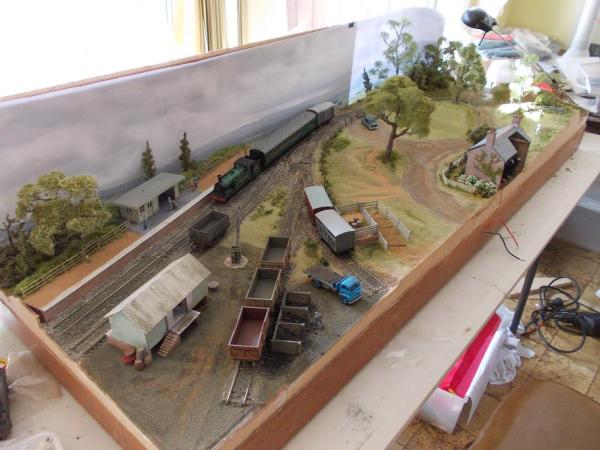
Evans Hollow Industrial: Build Update (A name finally)

It’s nice to have the time to allow ideas to form in their own way, and in their own time. Deciding on a name with the new layout has been one of those journeys…


Finding a name

Tonight after dinner the family and I caught the end of my favourite movie ‘Field of Dreams’. I believe this movie is the ultimate Dad and son movie. The constant refrain in the movie is: ‘If you build it, he will come’. I’m under no illusion that my Dad will walk out of the corn field any time soon to spend time to operate with me. (I don’t have a cornfield, and I’m avert to cornfield meets in any case.) On the odd chance that he does walk out of the corn he’ll have a great time working the layout. So you know – there’ll be a complete post covering everything you’ll want to know about operating the layout in a future post – never fear.

I doubt that I would have my love of trains and transportation if it were not for my Dad. We were not a well to do family but my father made sure that I had a train set or two, including a Triang 00 scale Dock shunter set. We had our issues he and I, but then which father and son do not? Without his early influence I doubt I’d have had my life long passion of railway modelling and transportation.

My Dad (Evan Louis Martin) was a World War 2 veteran, suffering silently all of his life after service with PTSD. Passing through the veil in 1993 I will be celebrating him in October 2021 on his 100th birthday.

It’s fitting then that the man who started it all for me should have this layout named after him. After my ‘Field of Dreams’ moment last night I’ve decided instead on celebrating the man who bought me to my passion. So I’d like to welcome you to the Evans Hollow Industrial.

There’ll be another post on the layout soon, Part 3 covering the building of the trestles. All the best until then.

Site Seeing – The Little Critter that could edition

It’s not often that you get to see internal (in-plant) company railway operations today. Thankfully “Saginaw Terminal Docks” (Facebook and YouTube) posted a video from Reid Machinery in Lansing, Mi showing how they use old freight cars to store valuable machinery on their site prior to sale.


Reid Machinery’s internal railroad

Reid Machinery Inc of Lansing Michigan have specialised in moving machinery, primarily in the forging industry, throughout North America since 1992. And while that may not seem like the most worthy thing to write about on the third Tuesday in July – I urge you to hang around a moment longer. You see they also hold their large (as in big – not lots of) inventory on and in their own railroad assets.

Yes – they have their own switching layout.

Thanks to Saginaw Terminal Docks we have a front row seat, and a cab ride on one of these switching moves. I asked him about connections to the rest of the world. He tells me that the in-plant line connects to the JAIL/Adrian & Blissfield on over a mile of old track through Lansing’s south side.

And this is so modellable…


YouTube video

Some of the things to watch out for in the video are:

  • The three person crew (Engineer, conductor, and digger – and yes it’s a guy with  a shovel)
  • Slow switching speeds
  • At around the 18 minute mark – opening the boxcar door with the forklift forks (we often model the result but the actual operation is rarely filmed)

So sit back, turn up the volume and enjoy the show.


Resources

Jack ‘Shortliner’ Trollope – RIP – April 27, 2019

For those of you reading, who did not know Jack “Shortliner” Trollope, AKA Shortliner Jack, you really missed out on an experience. Jack was a courteous and caring man, modeller and mentor. Always giving of his ideas, and time, with many across the world of model railways.

His passion for small space railroad modelling ignited my passion. It wasn’t until today that I realised I have been in touch with him regularly for most of the last 20 years online, in forums and through the Model Trains International magazine and website. He was the person who first took an interest in my designs and got me to write several articles for MTI over the years.

His most enduring design (I think) was Box Street yard. A timeless design along the lines of Cyril Freezer’s ‘Minories’, Alan Wright’s ‘Inglenook’ and John Allen’s ‘Timesaver’. To have a layout design spoken about in that august company should by anyone’s model railroading standard be considered an honour. I’ve included an image of Box Street below (image courtesy of Carendt.com) . Click on the image to get taken to the site for a full review of Jack’s layout design. A fitting tribute to the man and the modeller.

To his wife and family you have my deepest sympathies. I’ve shed a tear, and to his memory I’ll raise a beer shortly. RIP Jack. You’ll be greatly missed. You’ll not be forgotten.

Andrew

Insight – Why am I modelling the way I do?

A recent conversation with a fellow modeller has bought me back to thinking about why I’m modelling, and what my modelling should represent. Let me explain.


I have a lot less modelling time now than I ever did before, due to my work commitment, which is driving the nature of my modelling in different (if interesting new) directions.

Among the changes I’ve had to make is in the scope of the work. Because it takes longer to complete larger and more complex projects I’m focusing on smaller easier to complete in a day projects as my primary goal. I have some large projects that remain on the table. These will be for items I cannot buy, kitbash or otherwise make out of something else.

Will this change the nature of posts that appear here on the Andrew’s Trains blog? No, I don’t believe so. This blog has always been about small layouts with lots of operational potential, and that is in line with what I am moving to in my modelling.

Weathering will continue to play a large part in my modelling, upgrading blue-box style kits to better reflect the prototype is where I found real joy in modelling as a young man. And I’m going back to that in a big way this year. There’ll be more posts along these lines to come over the next few months as I get my modelling life back in order.

With a demanding and hectic work life simplicity is my goal. Modelling simplicity likewise has to be the case. Simple projects that can be done with:

  1. tools I already have,
  2. resources I already have, and
  3. that can be completed in the time I have to give them.

This is the focus of my modelling going forward. Likewise to layout building. I have a couple of projects that I want to complete, one of which is a Supernook, a new design I’m working on now that will begin with the baseboards build before we left the USA 13 years ago. I’ll be continuing on with the US-based shunting layouts, but I’m interested in building a Australian/UK-based Minories layout soon as well.


Takeaway

I’ve made modelling a complex and often difficult endeavour. I’ve lost my love of producing models that I enjoyed building and that I am proud of. Life is short, and more so as I near my mid 50s. Time with my family and enjoying what I do is not limitless. So the time is now to make the changes that keep me happy, healed and enjoying what I do. I hope that you will stay along for the ride. With almost 100,000 unique views over the last 3 years I’m hopeful that you will stick around and see what is coming.

Site Seeing – the “I love the Yard” edition

Imagine an industrial 7mm narrow and standard gauge model railway with radio controlled crane and lorries. Then look at a great video and see it in action.


The Yard

Built by a group of four during a three-month period for a club exhibition. This layout is in 7mm scale and uses both 16.5mm (3.5mm HO standard gauge) and 32mm (7mm O scale gauge) track. Scenic area is only 2’2” x 6’, with an overall size of 2’2” x 9’ including fiddle yard.

Of particular note are the working features of the layout including:

  • standard and narrow gauge trains
  • working gantry crane, and
  • radio controlled lorries

The gantry crane had apparently been on another layout and manually controlled. When moved to the yard it was converted to radio control. The lorries, which I believe are the work of Mr Giles Favell, (see the resources section below for more) were in use on other layouts. The rolling stock came from other layouts also.

Control of trains is by DCC, while point control uses MERG canbus.


Resources

See more about the wonders of Giles Favell’s radio control 7mm scale lorries and his layouts at:

Site Seeing – The David Barrow fan boy edition – September 24, 2018

We moved back to Australia in 2006. So, I have to live through others when they visit David Barrow in Austin Texas, my wife’s hometown, and where we spent 10 years from 1997. Trevor Marshall visited recently and came away with a great post on the man and his layouts – including his new small (comparatively speaking) O scale layout which really piqued my interest.


David Barrow’s layouts

Hi – my name is Andrew – and I’m a David Barrow fan boy tragic…

I first remember reading about David Barrow’s Cat Mountain and Santa Fé layout in the 1980s in Model Railroader magazine. As a young man, dreaming about my large future model railway plans, David’s layouts (there were at my last count about 17 versions of the Cat Mountain) were my ideal. While I dream of those massive layouts still I took another path to small layout designs.

Recently David Barrow has followed down that rabbit hole, this time in O scale, with a new layout. You can read more about that in the second link below by Trevor Marshall.

David’s layout design and presentation skills are unique in the hobby. Not to everyone’s taste I’ll grant, yet having seen and operated on the layout once in 2005, I did not notice its minimal scenic treatment. I was too interested in the operational side of things.

Image 1: Davids Barrow’s entire O Scale layout – battery-powered and operated by radio

Once again the layout design is the centre of attention and the scenic treatment is classic David Barrow – minimalist. However, you can use the design and then scenic it to your heart’s content. Hmmm – now let me see – I have 3 boards in the garage on which that layout design would fit perfectly…

You can out more on this layout in the Model Railroad Planning 2018 publication from Kalmbach.


Resources

Site seeing – the Second Hand Inglenook edition – September 20, 2018

I admire modellers who can get to the meat of a project, quickly and with vigour. Gazmanjack (Gary) on RMWeb used second-hand track, wood and other parts from his modelling left-overs to create a stunningly good small layout for operations. Read on for more.


Linden Ford – the second-hand layout

Gazmanjack (his handle on RMWeb) back in 2014 built an outstanding layout from left over bits and pieces, as an adjunct to his current layout, to give himself something to operate on during the other layout’s longer build. I’ve only just found it and wanted to share the forum post with you.

And what a cracker this layout is. I won’t go into too much detail here, as I think the adage of a picture telling a thousand words is true on this occasion. There is plenty of information in the post too on the build including scenery, tree armatures, and so on.

Image 1: Linden Ford – an outstanding small Inglenook layout

I hope that you find inspiration in the post. So much with so little that turned out so well. Well done Gary!


Resources

Site Seeing – The Super Duper Switch Stand Edition – 9 September 2018


Using Sunset Valley Railroad switch stands on the layout

Operating realism is very important to me. It ensures that those working my layouts move at a realistic pace and in a realistic way. Switch operation is a big part of that goal for me.


The source of inspiration – Port Rowan in 1:64

Originally inspired by a post on Trevor Marshall’s Port Rowan blog, I want to include these switch stands as a part of my operating realism approach.

I particularly like the fact that Trevor uses a single style of padlock to lock the switches along with a length of chain. This ensures that all switches must be unlocked before use, and relocked after use as happens on the 1:1 railroad.

As Trevor says in the blog post, they are more expensive than other simpler options. However, I think that if you have a small layout, and realistic operation is your thing, then the cost is worth it. And they’ll last forever.

I’ve wanted to share this post for a long time, but only recently found all the links again after long searching. I hope you enjoy reading about this and get inspired.


Resources

Site Seeing – the Model RR to Go edition

Good day readers wherever you may be, and whatever you may be doing. It has been a while since my last post. That’s mainly down to my work schedule being all-consuming, and the days being long and the start times being all over the clock face. Nine months into my new role as a tram driver I’ve just managed a couple of weeks off and needed every moment to recover.

While recovering and looking around for some layout baseboard design ideas today I stumbled across Rick De Candido’s Fillmore Avenue Roundhouse blog.

His section of layout concepts (click this link to open a new window) has several great ideas. He really thinks outside the box on many of his designs. There is such creativity from this space starved modeller.


POST UPDATE – August 8, 2019
It appears that Rick’s WP site has been removed. I’m trying to contact him through multiple sites to see if there is a new site for this layout. I’ll do my best to keep this post updated.

His terminal layout is something to see too, and can utilise up to 6 operators on the layout during each 2.5 hour operating session. Well worth the time to visit the site and take a long read through the many useful posts there. Thanks to Rick for sharing his passion.

Rick’s Fillmore Avenue Roundhouse layout

Unfortunately I have no contact details for Rick, and there is nothing on the site where I can post a comment to let him know that I’ve profiled his site. If any of you can help with getting me in touch with Rick would you please reply to this post?

Site Seeing – August 7 – Master class: Operating Session

A recent post on the Model Railroad Hobbyist site by Tim Garland and the associated video (see below) shows the realism and enjoyment that can be achieved by operators with little cost beyond the time to set up and the time to operate.

What I enjoyed most out of this operating session video was the way that both Tim (who works as an Engineer for NS) and Tom Klimoski (the layout owner) work together as a team to get the ‘work’ done in a professional way, without hassle, in a small layout space, all the time working the layout to get the switching work done. Better was the way that you cannot see the engineer (Tom in this case) only the conductor on the ground working the cars into place.

Watch the video below and share your thoughts here or on Facebook.

At the Recent Ballarat Model Railway show (June 2017) I managed to catch up with a long time railway mate and his layout. When I saw this video I forwarded it onto Neil as a teaching tool to help him get operations going on his own layout. I think that what Tom Klimoski has recorded is the gold standard for small layout operations. It shows how (and I’m guessing on time) over a shorter operating session two people can work and have a lot of fun switching. Maximising the usefulness of a small layout by following the rules as set out, and by opening and closing gates, calling out the moves, and so on makes such a difference. I hope that you enjoy the video as much as I did.

Additionally there is a great post by Tim going on over at the MRH site about this video. Click the link at the top of the post for more. Lots of really good stuff in that post for the operator as well.