Category Archives: Layout Design

Site seeing – March 9

Introduction

All of last week I was sicker than could be with the current Ballarat flu bug. I am almost over it just in time to see the cooler Autumn weather really kick in. As a result of the dreaded lurgy I did not feel in the mood to model or post or do anything beyond making a buck. The next few posts are a catch up from the last week and should bring me back up to speed.

Site 1: Trevor Marshall’s ‘The Peterboro Project

With the current layout build under way, I’ve looked about for inspiration for the scenic treatment. In both the model and the prototypical sense I’ve found inspiration for the look as well as the overall design. Today’s site is a source of my inspiration. I hope that you enjoy looking it over as much as I have.

Trevor’s S Scale Port Rowan layout has been featured here before. Before this S Scale masterpiece there was an HO Scale masterpiece – The Peterboro Project. In 2006 he and a friend, intrigued by the Free-mo modular standard, decided to build a module.

Not just any module though, this was a complete layout module set, that could then be joined to other modules with like-minded Freemo modellers. While the layout itself is fantastic, the experiment did not work out for Trevor and his friend. The layout .

However, the pictures of the layout still exist, and are very worthwhile to review.

Enjoy

Site seeing – March 7

Introduction

Lance Mindheim is a force in the design of operational layouts. Today’s site seeing tour takes us to an article on his views and to his new website (built on WordPress no less).

Site 1: Railroad Model Craftsmen

In this article (offsite link) Lance talks about the play value in our layouts, and how without the play value, the layout will in the long run fail to please.

Site 2: Lance Mindheim’s new site

Lance has moved his site (offsite link) across to a new platform that finally allows searching. He’ll be updating and moving older content across to the new site over time. But for the moment the link I’ve provided takes you straight to the blog. This is where most of the content is right now.

This is inspiration

One image, can have vast and lasting influence on the viewer. For modellers, as Chris Mears points out in this post, one single image can make the difference between a model that works for you or one that falls short of your expectation. And none of us want something not quite right.
For Chris this image is iconic and is what he wants out of his model railroad experience. Enjoy reading along.

Chris Mears's avatarPrince Street

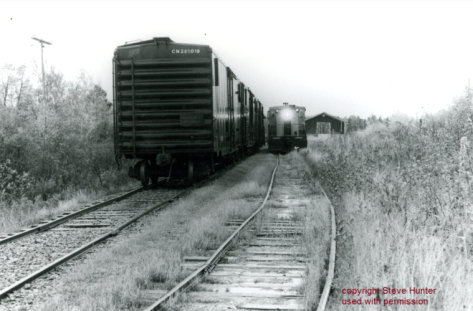
Steve Hunter kindly shared this photo he took it in 1981 at Mount Albion, Prince Edward Island. The subject is my favourite railroad operation and in the frame he found a way to capture why. This scene is central to my own layout’s inspiration. I’ll never have the words to properly thank Steve for sharing his passion for the railroad with me or inviting me into his archive.

mountalbion1981blog1
There’s just so much to drink in from this photograph and it tells so many stories it’s hard to know where to concentrate one’s attention.

The train is sitting on the main line. We’re facing Hazelbrook and ultimately Charlottetown. When the Murray Harbour sub was first built this line actually continued straight into Charlottetown on a bridge across the Hillsborough River. The bridge ultimately proved too light and by the 1950’s was closed. The subdivision was trimmed back, station by station, to…

View original post 287 more words

Why I chose not to design my layout – part 2

Introduction

In my last post (Why I chose not to design my layout – part 1) I discussed some of the reasons for ‘eyeballing’ my new layout and not ‘designing’ my new layout. This time around I wanted to clarify any uncertainties around the design process, and continue on with some meta-data about the design to help me clear my vision of the layout and the eventual role I’d like it to take in the future.

The Mod. 1, Mark 1 Eyeball

There is nothing better than eyeballing a space, and understanding how all the elements fit together. Obviously it makes the process easier if you understand what you aim to make, and have a sense of perspective on the amount of track you can reasonably have within the bounds of the layout space.

The layout’s story

My layout’s story revolves around switching within an industrial park. Service delivery is the primary focus of the layout and thus switching is the primary activity of the layout. With the design I wanted to be able to have a train:

  • arrive from the class 1 partner (interchange track),
  • be brought into the industrial park (switching yard),
  • switched into job lots for delivery within the park (customers), or to off-spot storage (storage yard),
  • run out to the customers needing switching that day, switch the site and then return to the yard,
  • have outbound cars switched and readied for delivery to the class 1 partner, and finally
  • have the outbound cars switched to the interchange track

Because I expect to have multiple small operating sessions each week, independent jobs that allow me to complete a little part of the operating session (between 30 – 50 minutes) each day I need a layout that supports that kind of operation.  Should I manage to get a couple of people over who want to operate a full session, we can simply pick up the next job sheet and continue on from where we started.

Why the design I’ve come up with?

A multiple industry layout was always my goal since I decided to build another layout in 2003. You can see some of these layouts in the Layout Design Gallery (Offsite Link), or directly from the ‘Resources’ section below.

I read about the Modesto & Empire Traction in Model Railroader many years ago, and have a lot of research on them. But as we don’t own our own home I am loath to build something bigger than my current proposed layout even semi-permanently at the moment. So I’ve gone down the path with my own module design, that can be added to over time. Another influence was the Progressive Rail layout that MR did several years ago. Again too big for me, but there is a core of the operation that I can mimic in the space I have.

In the next post ‘Why I chose not to “design” my new layout – part 3’ I’ll review my ideas on the operational aspect of the layout; the proposed paperwork that I want to use. It’s getting late and Sons of Liberty is on the Tele tonight. From Ballarat, on a cool and clear evening – good night.

Resources:

Multi Industry Switching Layouts


Why I chose not to design my layout – part 1

Introduction

I’ve designed a lot of layouts over the years, because I wanted to and because I got paid to. With my new layout though I wanted to take a more organic approach, one that relied less on the ruler and more on the eye.

Apparently I’m not the only one following this process. Over on Lance Mindheim’s blog, he recently wrote in a post  that (offsite Link Here) – “… with a smaller project a lot can be accomplished in 1:1 scale simply by mocking things up full-scale with boxes and loose pieces of track.  The elements can be re-sized and moved around until you get the look that you want…

I know exactly what I want this new layout to look like. I know the signature scenes I want to include, and I have my set of wants that have to be included to make this enjoyable for me. Sometimes you simply cannot beat the mod 1, mark 1 eyeball to tell you when you’ve hit the mark.

It’s all about the operations

Over the last couple of months I’ve played around with the physics on my DCC & Sound equipped engines. When I’ve times the sessions using an old Tablet computer set aside specifically for that task, what I’ve noticed is that when running prototypically, that is with slow switching speeds, easy moves, and time between moves to allow the offsider (a conductor, or second person) to do their work, eating up 20 minutes is very easy.

To enjoy an operating session I have to be actively involved in the doing of the work. To do this I have made changes to freight cars that I’ve found have a profound effect on how I work. For example; I’ve brought average car weight up, close to the Cubed-Root (CR) of the real car. You might not want to do this if you are running plastic trucks and wheel-sets or have cars traversing long distances as wear and tear will show.

Coupler Bounce what the … ?

With Kadee equalised metal trucks and metal wheel sets I’ve noticed a complete change in the physics involved, and that is what I had hoped for. So when I couple up to a single freight car with a CR close to the real weight you do not get what I call coupler bounce.

Coupler bounce is where the car takes off in the opposite direction (thanks Sir Isaac) when a locomotive pushes up against the car’s coupler face. My lighter freight cars continued to do this no matter how lightly I pushed up to couple on. The added weight causes friction in the Kadee truck journals, and physics come into play such that the extra CR weight requires more energy to get moving.

As I convert cars over to Kadee trucks I’m making sure that I CR the weight to make sure I get better handling characteristics. I know that this flies in the face of the accepted practice, but once you see this in action, especially in a longer string of cars when the slack runs out, you can never go back.

It’s all in the switch action

I love working yards, and switching industries. I was born to play at doing this. It keeps me happy, and engaged, and with many locations to switch, that are independent of each other I will never get bored with the challenge of switching a layout with multiple customer spurs and car spots.

I love the down and dirty, first mile, last mile railroad action that you find in customer switching. With a marshalling area that allows me to make up trains for delivery to interchange, and break down trains for delivery to customers and I’m about as happy as anyone can be.

In part two of this particular rant, I’ll talk more about the operations and paperwork that I’m going to use on the layout. For now, the sun is out, the wind is very cool and all is well in Ballarat. So I’ll leave you to it…

Site Seeing February 21

It’s all operations Saturday, thanks to Martin Hogg, the owner and operator of Brett.

Site 1: Brett – a full operating session video

Martin Hogg’s released a new video (Brett’s been featured recently on the blog).

This time you get to see a full operating session from start to finish.

This video shows just how much enjoyment you can derive from switching on a relatively small layout with a reasonably simple track plan.

I’m guessing the operating session lasted around 25 – 30 minutes from start to finish. As soon as I get some feedback from Martin I’ll update this post and let you know for sure.

Good work that man! On you Martin.

Update 1:
I talked with Martin Hogg today and he confirmed that the operating session takes about 25 minutes (although he says its heard to be sure as he was busy phaffing around with the camera to be sure). He’ll be running another session to confirm that but I’m pretty sure that it’ll be right around the 25 minute mark, depending on the work to be done.

Site Seeing 18 February

Introduction

The IAIS Grimes Industrial Line

1 – The IAIS Grimes Industrial Line

In my site seeing post yesterday I mentioned the publishing bonanza we’ve inherited thanks to the internet. One of these great sites is the free (as in Beer) internet Model Railroading Magazine – the Model Railroad Hobbyist (Link Here).

Apart from a great magazine that I’ve read since issue number one, there are the modellers blogs that are associated on the site. Among the best of the blogs is the Grimes Industrial layout blog of JFMcNab (Link Here).

You can also see a range of photos from his layout on the Unofficial IAIS Railfans website (Link Here).

Take some time and take a look around and discover the Grimes Industrial Line. I think you’ll enjoy the Grimes Line sites.

Resources:

Watch one of James’ videos from his YouTube channel:

Moving cars …(without a locomotive) — Part III

Over on Chris Gilbert’s new layout thread I’ve posted a suggestion for a car  puller. Using nothing more than a map pin. You can view my response here: Offsite Link

As always happens you post one thing and then find another site with an even better idea. Rails West has already done all of the hard work and provided not one but three posts all about car pullers.

Moving cars …(without a locomotive) — Part III.

via Moving cars …(without a locomotive) — Part III.

Enjoy your reading on car pullers.

Layout Builders of Note – Chris Gilbert

Introduction

I’ve known Chris Gilbert for many years thanks to the Internet, specifically RMWeb. Chris has always managed to be a great mentor on things model railroad, even if he was not aware of his mentorship. He’s been successful in building, exhibiting and publishing a range of model small exhibition layouts over the last several years. What gets me is how quickly he puts these model marvels together.

Florida Springs (V 2.0) – An HO Scale exhibition layout

Chris in his own style said that he started the layout on Tuesday the 10th of February with a trip to his local hardware store.

Within five days he was at this stage:

As if that was not enough to make me feel like I need to pick up my game, his detailing is exquisite. If you take a link at post number 5 (link here) you’ll see what I mean.

Every time I see what Chris can do in so short a time, I am simply bowled over. He thinks about something and then he gets it done. It’s something that I am going to aim for in my modelling this year.

Before I can get there though I have to complete some other modelling projects to finish for my local model club show in April (you can read more about that on the Modellers of Ballarat blog (link here).

I’ve listed other sites in the resources section below. Enjoy having a look at Chris’ layouts. They really are magnificent works of art.

Resources

· You can find out more about the O scale Fort Smith Railroad layout (External Link) here.

· You can visit Chris’ YouTube channel (link here) – and watch his videos of Haston and North Haston – great stuff.

Site seeing – February07

There are some sites that I find myself returning to time after time. Vibrant sites with lots of new ideas and a great wealth of modellers, who love to share.  My favourite message board is to be on and partake in is RMWeb.

There is always a project or layout build under way that has something to give you. Today I’d like to point out two projects on RMWeb that I find really interesting for a number of reasons.

Site 1 – Down Ampney

Built in 7mm scale as a basic garage-garden-garage line; the garden section is in effect just a single track with a couple of sidings and scenery provided by mother nature. Control is planned to be a mixture of DCC and RC.

The Scenic modelled section is to be situated within the garage with a cassette fiddle yard on the other side. The garden will include a viaduct but be fairly basic for the sake of ease of building and getting something up and running quickly and to reduce maintenance.

Site 2 – Draycott (Camp) Halt Sidings

The model depicts a small corrugated Goods Shed and two sidings, with the tail-end of the Head-Shunt also represented, the Loop being ‘off stage’ so to speak. This is a classic Inglenook type ‘shunting plank’ and will give somewhere to have some fun with ‘shunting puzzles’ and to test new stock whilst Down Ampney is being built.

Conclusion

While both are 7mm O scale layouts, the standard of modelling is very high, while the area and layout being modelled is small and simple. Lots of working potential too.

Well its a very warm day in Ballarat, and my son and I are off to the local pool. Hope you’re having a great day where you are too.