
NOTE!
This is a quick and dirty overview of the Inglenook design and how I apply it to operational layout designs.
For a complete, unadulterated, in-depth, and mind-blowingly deep dive into all aspects of switching puzzles, small layout design and the use of various tricks to enhance the look and realism I urge you to visit www.wymann.info/shuntingpuzzles.
Table of Contents
The Switching Puzzle
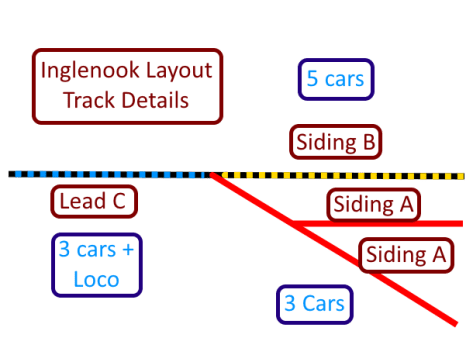
Shown in image 1 below is the design for the Inglenook shunting (switching) puzzle. Many railroad locations use this design in one form or another to serve passenger and freight facilities large and small. So, not just a game then it seems.
Inglenook Basics
From the plan above, you’ll note that there are:
- two short sidings the same length which I’ve called Siding A,
- one long siding which I’ve called Siding B, and
- the switching lead which I’ve called Lead C.
Keep in mind that the Inglenook was designed as a puzzle game.
As such there are constraints as in all games should you wish to use it as such. However, you can use the track layout as you see fit during your regular operating sessions while being able to switch to game mode changing nothing but the number of cars on the layout. Nice, eh? Here is one of my designs based on the Inglenook concept: Supernook III
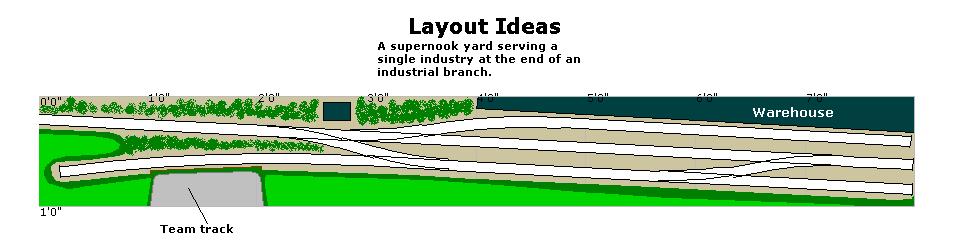
Despite the left-hand curved spur for the team track and the switching between the middle and lower track, the design is still a 5-3-3 inglenook at heart and can be used as such should you wish to play the game instead of operating a normal session.
Designing your Inglenook
You’ll see Inglenooks referred to as 3-2-2, 5-3-3 and 7-4-4 Inglenooks. The numbers refer to the car lengths that can fit on sidings B-A-A. The classic Inglenook uses a 5-3-3 pattern. You’ll note that for each number of cars sitting on Sidings A, Siding B is simply double the number of cars on Siding A, minus 1.
So for a classic 5-3-3 inglenook where siding A = 3 cars, siding ‘B’ becomes 2 times 3, minus 1, which equals 5. In formula terms:
Siding B = 2(Siding A)-1
Car and layout lengths
Determining how much physical space you need to build an Inglenook is easy. You’ll need to know the length of the:
- longest freight or passenger car you’ll be using
- longest locomotive, and
- switch or turnout in between the Lead (C) and Siding (B) from image 1 above. (Use the whole length of the switch to make it easier on yourself.)
The length of your longest car and locomotive should be measured over:
- coupler faces if you are using Kadee or other knuckle couplers (the face is the inside face of the coupler, not the outside of the coupler), and
- Buffer faces if you use Screw Link Couplings (EU or UK rolling stock) or the outside edge of Hornby/Bachmann/Etc. style couplings. Whichever is the longest measurement is what you should go with. It is always better to have a little wiggle room than not enough.
Now it is time for a little mathematics. To determine the length of the layout we have to solve the equation below, by measuring three items you’ll be using on your Inglenook,
First, here is the equation:
Lead (C) + Switch (S) + Siding B = minimum baseboard length
To break this down a little more and to make it easier to understand and compute let’s break down each of the three parts above as follows:
-
-
- Lead Length (C) = 3.5(X) + (Loco)
- Switch Length = S
- Siding B length = 5.5(X)
-
Where:
- (X) is equal to the longest freight car you’ll use, measured over the coupling face (for Kadee couplers that is the inside face of the knuckle, for EU and UK models it may be the UK tension lock coupler, or buffers if you use screw link style couplings.
- (Loco) is equal to the length (over coupler faces) of your longest locomotive.
- (S) is equal to the overall length of your switch, measured on the straight path, not the diverging path.
You need to allow an amount of clearance at each diverging route to the turnout to make sure that locomotives and cars do not hit. I prefer to allow 1/2 of the length of my car (X) for this.
Taking all of this into account, and having measured everything required above our equation now looks like this:
3.5(X) + (Loco) + S + 5.5(X) = minimum baseboard length
Doing the math is easy if you use a calculator or your mobile phone’s calculator to assist.
The Inglenook Puzzle
The operational rules of the Inglenook Sidings require that a departing train consist of a locomotive and 5 out of the 8 wagons sitting on the layout.
The 5 wagons are selected at random, whether by casting dice, cards pulled from a stack with images or descriptions of the cars they represent, or some other randomising method. Further, the train must be made up of the 5 wagons in the order in which they are selected.
The challenge of arranging the cars in order is driven by the lack of available space in the individual sidings and the headshunt for moving cars about the layout. Thus some advanced thinking is required. What initially appears to be a simple task can require quite a bit of thought and planning to arrive at a solution.
The Takeaway
The Inglenook is as simple as it gets for a small layout. In addition, it meets my 4 criteria for small operational layouts:
- It is affordable with only 2 switches (the most expensive components, next to a locomotive) and a couple of lengths of flex track.
- It’s quick to build (since you don’t require scenery, a backdrop or anything else.
- You don’t need a lot of skills or tools to build it (you can get your big box store to do most of the cutting for you).
- The return on your investment of time and cash is quick and long-lasting. And as a starter layout, there are tons of resources out there for how to build and use it. Most importantly, it will give you as many hours of enjoyment as you choose to have.
With the high number of possible solutions (40,320) you should be some while before you find the puzzle too easy to solve.
Resources
To discover everything you ever needed to know about the Inglenook, or other shunting/switching puzzles head over to the www.Wymann.info website mentioned above at the start of the article.
 Andrew's Trains