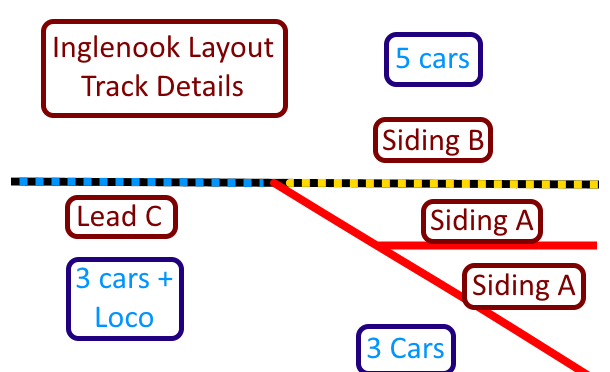
There’s a new section (Layout Design Basics) under the Articles menu. The first article there focuses on Inglenooks.
Layout design basics
I’ve added a new section on layout design basics under the ‘Articles’ menu. In the first page I’ve looked at the Inglenook. Bought about by the recent posts on the Montpelier, OH grain facility. Which is a double-ended Inglenook.
Inglenooks are a fascinating subject of study on there own, and really handy to come to terms with as a small layout designer since they can be used as a game, or in normal operating usage when switching your layout. All with the change of the number of cars on the layout.
There’s a lot of information on the page, and I’ve added links to the ultimate source of Inglenook knowledge too. Head on over to the page and check it out when you get a moment.
I posted a while ago about a flour mill, here in Melbourne, that showcases a loads-in, empties out flour milling operation. Today we’ll look at another operation, this time in Montpelier Ohio which is an empties-in/loads-out facility for grain. This is truly first/last-mile railroading at its best.
Switching the Montpelier Ohio Elevator
We’ll talk about modelling a facility using the track layout and operations featured in this post next time. For now, I’d suggest that you watch this outstanding video from YouTuber Scott Taipale. With WAER 223 an SW 1200 switcher (ex IHRC 223, ex TRRA 1223) working a unit grain train at the elevator in Montpelier Ohio.
This SW 1200 switcher was built for the Terminal RR of St Louis in 1955. Later owned by the Indiana Hi-Rail and successor Wabash Erie, it is now used exclusively by the Edon Farmers Co-Op to handle the bulk car movements you’ll note in the video.
A couple of notes on the video from Scott:
The line furthest right (North) used to be Wabash’s 1st district which ran from Toledo to Montpelier (now truncated, it ends 4800 feet behind/east of the camera)
The branch line connects to the former Wabash yard in Montpelier (now Norfolk Southern)
In my next post, we’ll look at how you can model a layout based on the track diagram and how you can fit this facility into your space and time limitations. Thanks for reading along. and if you get the chance please like and subscribe to this blog, and to the Facebook page. Your support is greatly appreciated.
First-mile/last-mile railroading, what modellers refer to as customer switching, is the customer end of railroading. That is the setting out and picking up cars from a customer’s premises on the railroad. This can be directly from a customer’s spur, a ramp at the local yard or a team track, off the local mainline.
It is the point at which the customer and the railroad meet. All railroad economics relies on it and always has. While in the modern era the customer has gotten bigger to take advantage of intermodel and block trains, the underlying forces remain the same. Customer shipping goods. Railroads picking up goods and moving them to their destination. Destination (consignee) receiving and accepting goods.
So why is this important to me?
For you, the small layout builder/operator, the first-mile/last-mile end of the operation is the:
simplest to model,
easiest to operate, and
most interesting to work with for the longer term
Whether you use a ‘tuning fork’, inglenook, supernook, or another layout design element you enjoy, by focusing on the customer end of the operation you make the layout simpler to build, which means getting going faster. You can operate for 10 minutes, 30 minutes or for as long or short as you have the time for. And over the life of the layout (whether that is a few months, or a decade or more), operation varies day to day, session by session, from a well-designed customer operation so that no two sessions are ever the same.
If you’ve been following the blog for a while you’ll know that I enjoy watching Railfan Danny on Youtube. Danny has just released another video, this time a Q&A session. One of those questions was about first-mile/last-mile railroading. I hope you’ll watch the entire video, for those without the time, I’ve linked to the 7:11 mark to watch the section specific to today’s post.
Resources
Railfan Danny’s “Railroad Questions Winter 2021”
There are more switching videos over at Danny’s YouTube channel, just follow the link below to go to all the videos with ‘switching’ in the description:

 Andrew's Trains