At the recent Caulfield model railway exhibition I managed to find three Athearn 50′ Gondolas (undecorated) for $10.00 each. They came from Casula Hobbies‘ back room clear out pile. These kits may have sat there for a week or ten years; apart from the covered tops being missing they were complete.
My understanding is that these kits are completely freelance, designed by Irv Athearn to fit in the same box as the 40′ box car and use the frame from the 50’ flat car. This frame also causes a problem in the side of the Gondola should be straight if you use the drop frame.
For my purposes – I really don’t care. They were 10 bucks each, look interesting and will fit in nicely on the layout as end of life cars, specifically in use for scrap loading. Besides which as a mid to late 1970s layout, a riveted car with a worn wooden floor, full of rusty scrap will look really nice.
The interior of the car at the moment is the standard riveted plastic with horrible ejector pin marks (photos will be forthcoming). I do have some wood siding that I’ll use to replace it though.
For this model I’ll make the following changes:
Kadee 70-ton Friction bearing trucks with 33″ wheels
Metal grabs, stirrups, coupler release lever
Extra weight
Kadee #58 couplers
The paint scheme: boxcar red with HVL markings. These cars are considered to at the end of their usable life, and as home road cars.
I travelled to Caulfield (some 130 Km) from home on Saturday the 22nd of August. I’m not complaining about the train ride, I never do, but I have to say that I expected better than I got at the exhibition.
The venue is large, well-lit, and well laid out. There is great vendor support, and there were some nice layouts on site. But – and I hesitate because I know that there’ll be some wailing and moaning when I say this – I did not enjoy my time at the show today and I did not enjoy seeing and photographing the layouts on offer; here’s why.
Issue number one: The vendors got all the light
If you’ve ever been to a race track (as in where horses race) you’ll know that the windows facing the track let in a lot of light. Why then do you put all the vendors there, who usually, but not always I agree, have their own lights. The layouts were by and large tucked away in dark holes in the venue, and the lighting on these layouts generally was not up to the task given the darkness that came about from the large walls and escalator spaces in which they found themselves.
I’ve got an idea. How about you give me the light I need to take my photographs (without a flash and without the need to run my digital camera at ISO 800 ) so that I can capture the model railway layouts in a reasonable amount of light. I understand that the vendors need light too. But since most of them had access to their own sources in any case, I wonder why they needed to be put at the windows. I guess what I’m wondering is: Was it a model railway exhibition, or a model railway manufacturer trade show, with a couple of layouts thrown in to keep the punters happy?
Issue number two: Layouts spread all over the place
I felt like I had to walk a mile to see the layouts. There was no logical layout to the layouts, tucked as they were about the space. Is there any reason the organisers could not cluster the layouts (with some natural light) and cluster the vendors in a vendor area? Don’t get me wrong, I bought three Athearn Blue box 50 foot gondolas (at $10.00 AU a pop – may I add my thanks to Casula Hobbies) so I spent some money beyond the $10.00 entry fees.
Some of the layouts were so well hidden that it was only on my second time walking around that I noticed them.
So what am I asking for?
Stawell Victoria’s Grampian Model Railroader (GMR) exhibition site at the SES Hall in Stawell showing what I mean about having lots of light for the viewing of the layouts (Courtesy of the GMR Website)
I’m interested in the modelling aspect of the hobby. I want to watch well modelled trains run through well modelled scenery. I want to see what other layout designers have come up with to dazzle me. I want to also see what the manufacturers have come out with. But mainly I’m interested in seeing layouts. 2015 will be the last time I’ll be visiting Caulfield. You may not agree, and I’m OK with that. I lived in the US for 10 years and the trend of having the manufacturers overwhelm exhibitions is long entrenched in the Texas modelling scene. It’s not something that I want to see happen here. Vendor support is critical for the success of model railway shows; they help offset the costs of hiring the space. However, it’s a model railway show. Let’s all think on that for a moment before we begin to pander too much to the vendors at the expense of the modellers and the layout exhibitors.
Your thoughts are always welcome, whether they’re bouquets for brick-bats. Have a great day.
Over on Gene’s P48 blog I’ve made mention of the build he’s had going on for some time. In fact the list of articles for the Wilson Reefer build is can be found by following this link to Gene’s website. You can skip to the last part and see the painting directly using the link below.
Yesterday was all about passenger service; today is all about freight. Chris Gilbert pointed this video out, on his YouTube page. However the producer is ChicagoJoe28. But enough words let’s get to the video.
Site 1: Mike switches Batory Foods Chicago Terminal railroad
Video 1: Batory Food Switching on the Chicago Terminal
A little history
Located at 2234 W 43rd St, Chicago, IL 60609, Batory Foods began trading in 1979 when Abel Friedman opened Chicago Sweeteners. As a single source supplier of basic food ingredients such as sugar, flour, salt, starch, milk, oats, honey and corn syrup. Chicago Sweeteners expanded its product offering over time, as food manufacturers sought to develop healthier products.
With success in the greater Chicago market, the Company brought its broad line model to food manufacturing centres around the country. Some of the growth came with the original business; some by way of acquisition with:
Sugar Incentives bought in 1995,
Ingredients International in 2006,
Quality Ingredients in 2008,
LSI in 2009,
Industrial Ingredients in 2009,
Massey Fair in 2011, and
Mac Source in 2011.
Recently, the various names were consolidates into the single name: Batory Foods.
The layout idea
The site’s switched as an Inglenook. The two on-site spurs lead to undercover augers (I’m assuming here of course) for unloading powdered or granulated product.
The storage track goes to other industries further down the track, but does not show recent use from my quick look. The loco has to push the cars into the site so you have a simple, prototypical Inglenook that won’t take up too much space. It is small enough that you could model any date from 1979 on in HO, S or O scale.
SCORE! What are your thoughts?
Thanks to Chris Gilbert for the vision, and to ChicagoJoe28 for filming it.
Just the one site to see today, on YouTube, and the background idea for a future layout design. Let’s away!
Site 1: Bacchus Marsh, Victoria
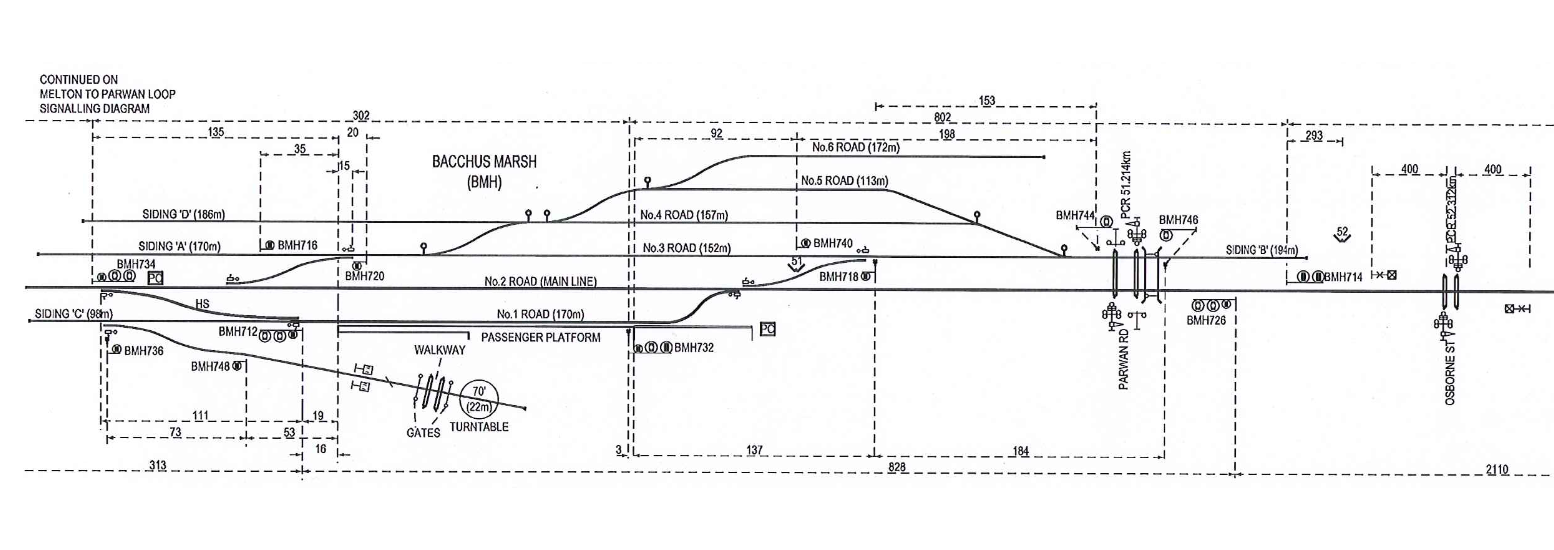
Whenever I travel to Melbourne on the train I pass through Bacchus Marsh (it’s around the halfway point between Ballarat and Melbourne). I recently found a new channel on YouTube featuring Trams and Trains from around Melbourne. Watching the operations in the video below at Bacchus Marsh led me to thinking about an exhibition layout. With the wealth of Ready to run (RTR) rolling stock available and the intensive working of the passenger service (especially the storage of train sets) this could have the makings of a great medium-sized exhibition layout.
First watch the video and then take a look at the signalling diagram below.
Video 1: V/Line Variety at Bacchus Marsh Railway Station in 2012
Image 1: The Bacchus Marsh signalling diagram & Tram layout
I think that there is plenty enough in the track layout to keep an exhibition crew going all weekend. With the station being both a single platform terminus and through platform (with the right hand side going through to Ballarat and beyond) this could be nirvana for DMU & Loco hauled railway modellers. Your thoughts?
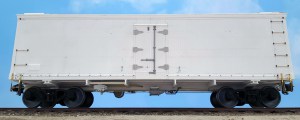
I’ve highlighted this build before, but wanted to share Gene’s final before paint images of his Wilson reefer. You’ve really got to take a close up look at the details he’s added during the build.
I had a few hours this week and was able to push to the completion on the Wilson meat reefer. Primer application is the next step in the process and finally the color. There are a few steps that I will go though showing details that were fabricated for the model.
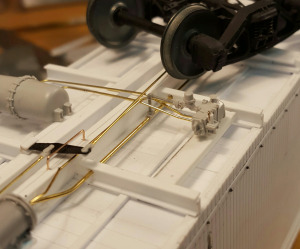
I added the control valve connection to the train line. The gray plastic parts were taken from a Grandt Line brake set. I sliced the bottom off the tee and mounted it to the train line with CA. The connection to the control valve with a cast elbow and pipe from the same Grandt sprue.
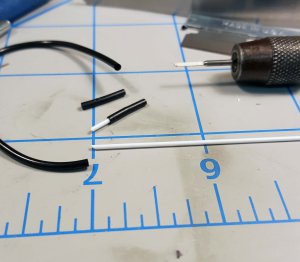
Ice was the cooling medium in these reefers. The water runoff from melting ice was drained via pipes or hoses on the underframe. I used some .060″ plastic hose inserted on a .040″ styrene rod. I made the hose about 18″ long. The drain is installed on the underside of the…
Work has kept me busy the last few weeks, and I’ve only posted a few times over the last couple of weeks due to that busyness. However, today I took the time and modelled some long overdue projects (I’m hoping to get them completed for the April 2016 MoB show – I was aiming to get them ready for April 2015 but there you go) .
On the table today was:
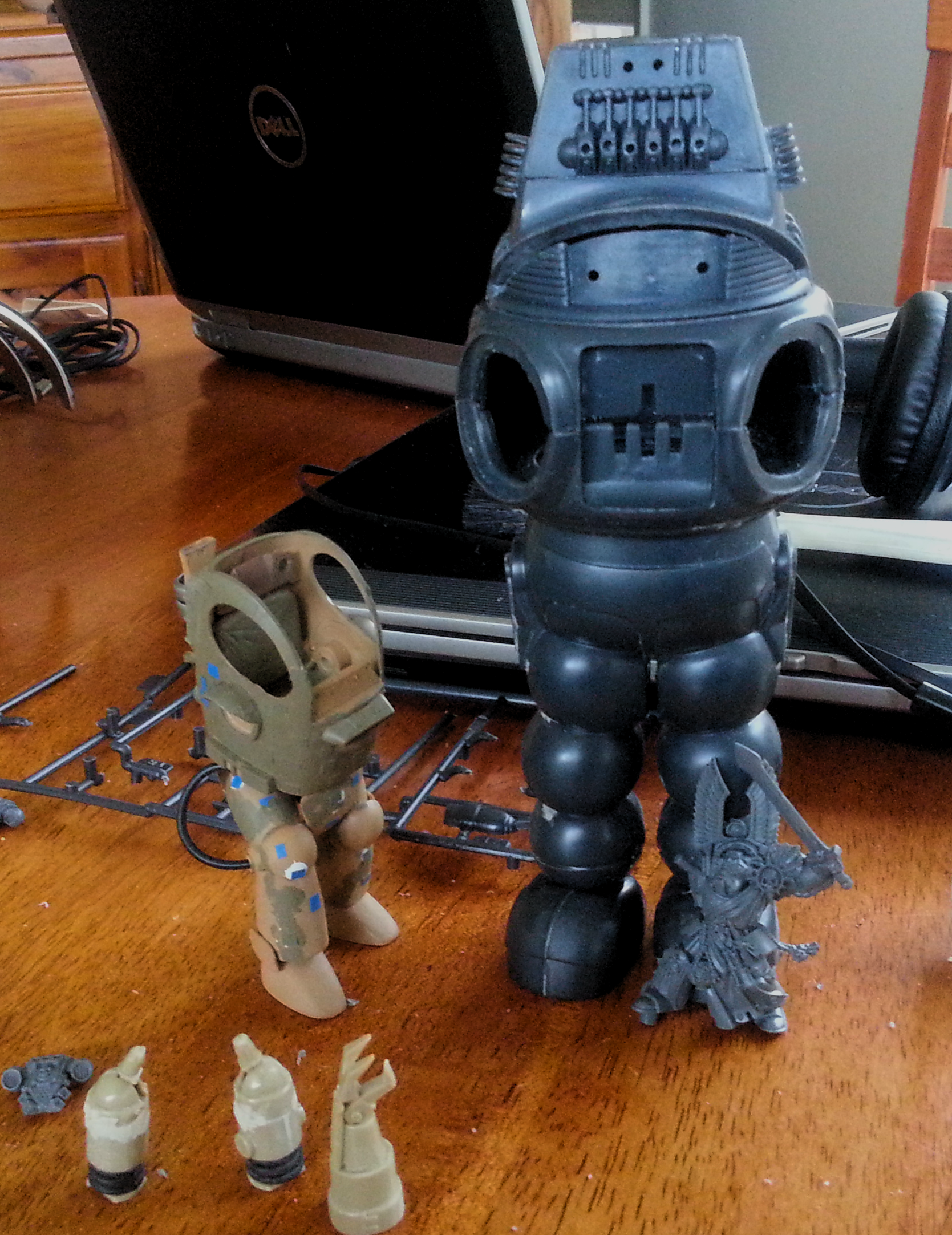
The Warhammer 40K Dark Vengeance starter set (My son got into Warhammer a couple of years ago and so for his 9th birthday I got him the starter set. Building stalled due to the complexity in the set models and issues with Games Workshop’s glue. So I’ve begun to help out by building the rest of the set up for him and fixing the build issues with some of the larger items in the set.
Robby the Robot (from the movie Forbidden Planet) which is a reissue of the old Polar Lights kit. It certainly shows its age, but I have always wanted a model of this iconic robot and so I now do, and finally
A very old Nitto kit of a powered suit PKA SF3D original. I’ve been working on this kit the longest and somewhere along the line lost the instructions (if there ever where any). So I got the building bug and figured the kit out. There are lots of moving parts and the kit is position-able. I wish I’d bought more of these kits when the chance was there.
Image 1: Robby, one of the Warhammer 40K pieces by Robby’s leg, and the Nitto kit left
The Warhammer stuff seems to scale out around 1/64th scale; The Nitto kit is 1/20th and Robby is 1/6th scale. The Nitto kit is getting a complex and time expensive camo paint job.
Well the sun was out, the skies clear, and temperatures actually got into double digits for the first time this month. All up a good and productive (if not a railway) modelling day. All the best.



 Andrew's Trains